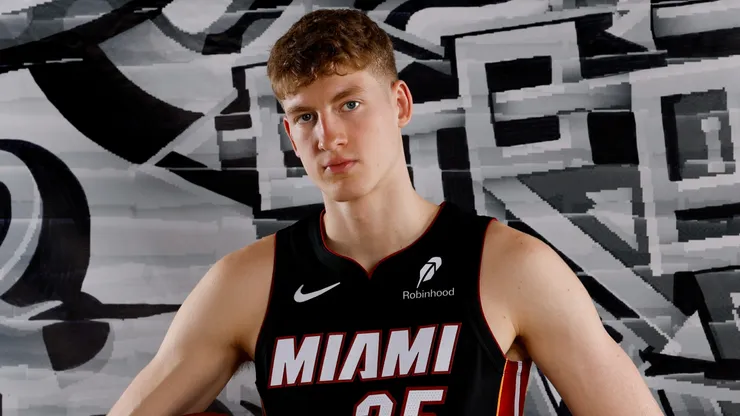
Kasparas Jakučionis has quickly become one of the most intriguing names in Miami Heat. The Lithuanian point guard arrives with poise, vision and a game that blends European fundamentals with youthful energy.
Drafted by the franchise in 2025, he represents more than just another rookie. His path from Vilnius to the NBA tells the story of a player who thrives on challenges and embraces the weight of big expectations.
While his talent is undeniable, the details of his contract add another layer to the buzz around him. What the team has invested speaks volumes about the role they envision for their new floor general.
What is Kasparas Jakucionis’ salary with Miami Heat?
Kasparas Jakucionis, the 20th overall pick in the 2025 NBA Draft, signed a four-year rookie-scale contract worth approximately $17.7 million, with 98% guaranteed, according to Miami’s official announcement and projections from SalarySwish.
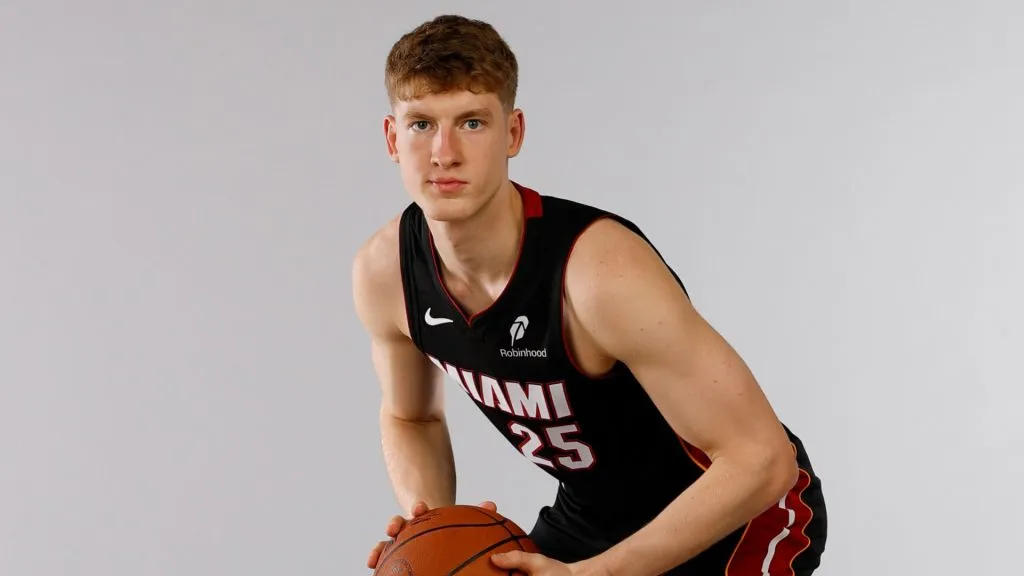
Kasparas Jakucionis #25 of the Miami Heat poses for a portrait during the 2025 NBA Rookie Photo Shoot at UNLV on July 15, 2025. (Source: Harry How/Getty Images)
In his first season (2025–26), he will earn $3.66 million (base salary), carrying a cap hit of $3.6588 million. His pay rises modestly to $3.84 million in 2026–27, while the final two years—$4.02 million and $6.21 million—are structured as team options.
These projections position him as Miami’s 12th-highest earner in 2025 and among the top-paid guards of his age group league-wide. The structured scaling reflects both his potential and the Heat’s strategic cap management.
Kasparas Jakucionis’s contract: How long will he stay in the team?
Kasparas Jakucionis officially inked his rookie deal with the Heat on July 1, 2025, joining Miami under a four-year agreement that includes club options in the final two seasons. The first two years are fully guaranteed, while the 2027–28 and 2028–29 seasons are team-controlled options.
If Miami exercises both, he remains with the Heat through the 2028–29 campaign; if not, he becomes a restricted free agent in 2029, with “Bird rights” intact for potential negotiations.
This setup gives the franchise flexibility to assess his development while retaining control. It’s a common structure for promising rookies: capped with options that allow the team to adjust based on performance and future cap strategy.