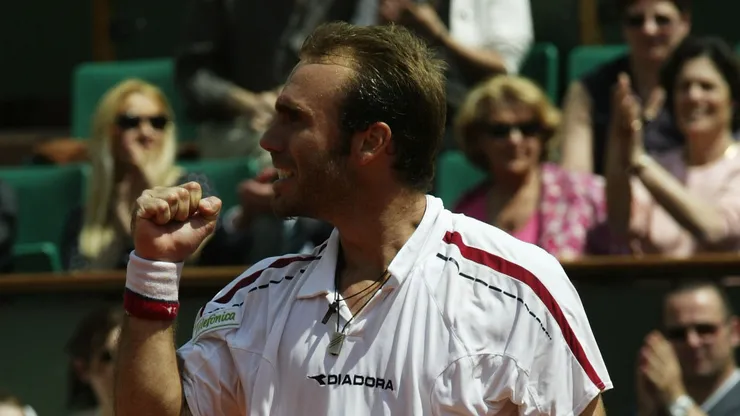
Roger Federer is, undoubtedly, one of the greatest tennis players of all time. The Swiss star was the first man to win 20 Grand Slam titles in the Open Era, has the record of most consecutive weeks as world No. 1 (237) and became a global superstar during his 20-year-career. However, before his breakthrough as Wimbledon champion in 2003, he was suffering from the weight of the world’s expectations. Just a month before, Federer endured one of the most painful defeats of his career at Roland Garros at the hands of Luis Horna.
In 2003, Federer’s promise to become one of the biggest tennis stars was in jeopardy. While 2002 had been his most successful season yet, with a Masters title in Hamburg and a semifinal appearance at the ATP Finals, he still had to prove himself at Grand Slams, especially after his win over Pete Sampras at Wimbledon in 2001.
At the 2003 Australian Open, Federer reached the quarterfinals but lost to one of his early nemesis, David Nalbadian, in four sets. However, during the clay season, the Swiss star, then 21 years old, won Munich and reached the final in Rome, making him one of the top contenders for the title in Paris, where he arrived as the fifth top seed.
Luis Horna defeated Federer to win his first Grand Slam match ever
Federer’s opponent was Luis Horna, of Peru, who was ranked number 88 in the world. He was a French Open junior champion, but, in theory, Federer should have won the match. While the Swiss star recovered from losing three games in the first set to put himself 5-3, he lost the match 6–7(6), 2–6, 6–7(3) at the Phillipe Chartier.
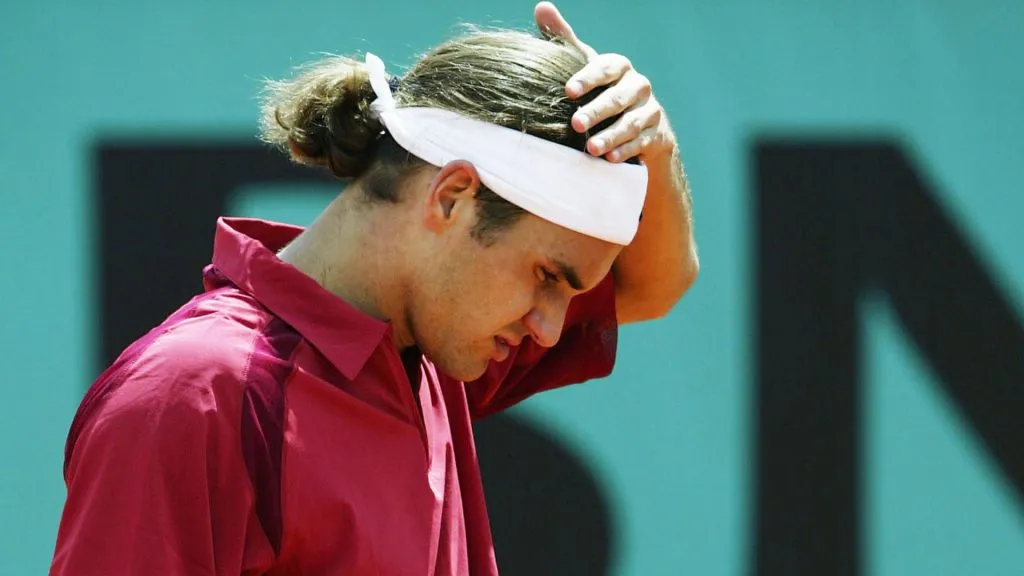
Roger Federer during the 2003 French Open first round match against Luis Horna (Clive Brunskill/Getty Images)
According to Christopher Clarey’s recount of the game in his book “Master: Roger Federer,” Federer was “confused by the tactics, he missed backhands and cast agonized looks at Peter Lundgren in the stands.” That same season, Federer had defeated him in the second round of the Miami Open, winning in two sets. However, in Paris, he lost the match with 88 unforced errors.
“I don’t know how long I’ll need to get over this defeat. A day, a week, a year—or my entire career,” Federer told the press after the match. L’Equipe called the match “a shipwreck in calm waters.”
However, while Federer agonized, Horna was living his best life. After the match, he told ESPN that it was the “best day of his life,” as he went to Paris just a month after the birth of his daughter. It was his first victory in a major.
“A month ago, I became a father, and now I win this match, which is the biggest thing that has happened to me professionally. All of this is fantastic,” said the Peruvian player, who admitted that he was nervous before the match.
“Before today’s match, I was very scared. I knew I was facing a tough opponent. But my coach told me it was the best opportunity I had—to play against a favorite, in a Grand Slam, with a lot of people watching me, and on the center court. He convinced me that I had nothing to lose,“ he said.
Luis Horna won the French Open in doubles
Horna became a key figure in Peruvian tennis, breaking into the ATP Top 100 in 2002 and becoming the first Peruvian since Jaime Yzaga to achieve that milestone. His best singles ranking came in 2004 when he reached No. 33 in the world. Horna found success on the ATP Tour, winning titles at the 2006 Acapulco Open and the 2007 Viña del Mar Open.
The highlight of his career came in 2008 when he won the French Open men’s doubles title alongside Uruguayan Pablo Cuevas. The unseeded duo became the first all-South American team to win a Grand Slam doubles title, defeating several top-seeded teams, including the No. 1 ranked Bob and Mike Bryan in the quarterfinals and the No. 2 seeds Nenad Zimonjić and Daniel Nestor in the final.
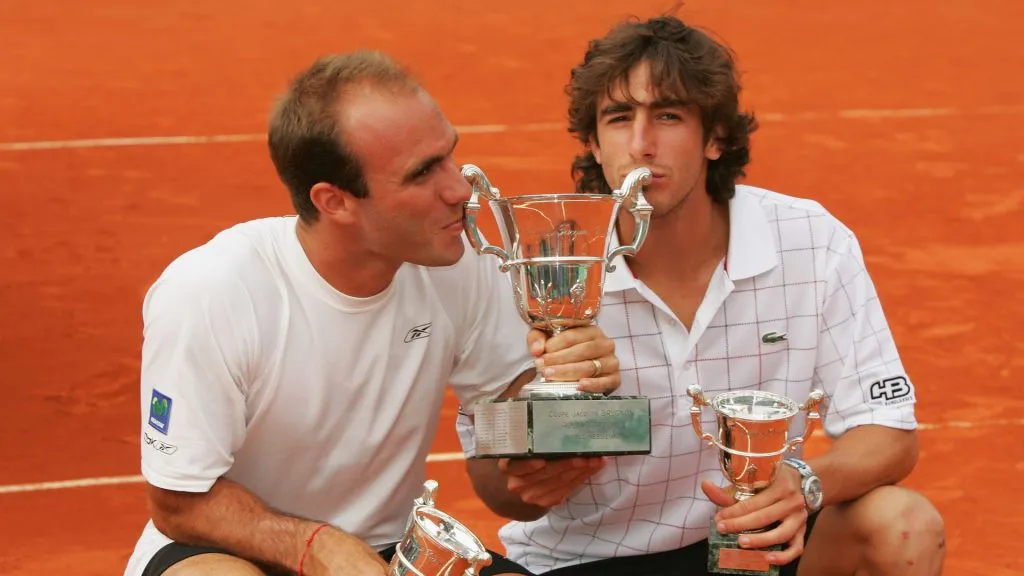
Luis Horna and Pablo Cuevas with the 2008 French Open doubles title (Matthew Stockman/Getty Images)
Recurring injuries forced Horna to retire from professional tennis in 2009 at just 29 years old. Over his career, he played 246 matches, winning 140 and losing 146. After retiring, he remained involved in Peruvian tennis, serving as Peru’s Davis Cup captain in 2010 and later returning as an assistant coach in 2019.