
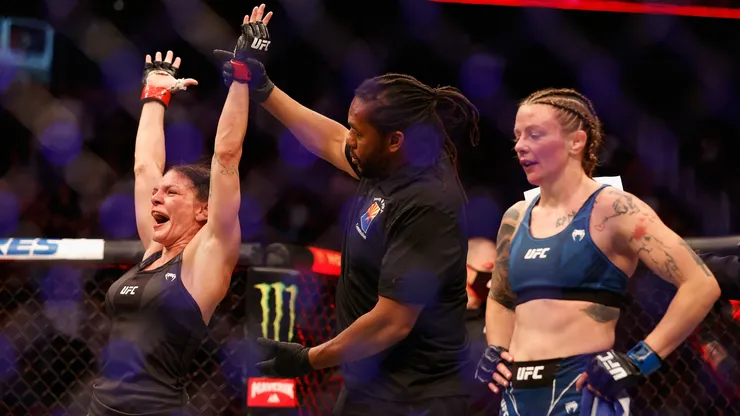
In MMA, a split decision isn’t just a result—it’s drama in real time. When the judges don’t all agree, tension rises and debate begins. These calls often mark the difference between glory and frustration for fighters.
Unlike a unanimous decision, a split means two judges scored the fight for one fighter, while the third saw it the other way. It reflects how tight—and subjective—MMA bouts can be, especially when both sides leave it all in the cage.
Split decisions can shake rankings, stir controversy and keep fans buzzing long after the final bell. They’re a reminder that in this sport, the story doesn’t end when the fight does—it continues on the scorecards.
10-point must system
MMA fights are scored using the 10-point must system, a model borrowed from boxing. Under this format, the winner of each round is awarded 10 points, while the loser receives 9 or fewer.

Ciryl Gane of France celebrates after his victory by split decision against Alexander Volkov of Russia in a heavyweight fight during UFC 310 at T-Mobile Arena on December 07, 2024. (Source: Steve Marcus/Getty Images)
A 10-9 round is the most common, reflecting a round that was clearly won but not dominated. More dominant performances might warrant a 10-8, while rare 10-7s are reserved for near-total wipeouts.
The issue? MMA is a far more complex sport than boxing. While boxing is largely about striking, it involves takedowns, grappling, ground control, submission attempts and striking across multiple styles.
Judge breakdown
Every UFC bout is scored by three judges seated cage-side, usually appointed by the local athletic commission. Their task? Evaluate each round based on four key criteria in descending order of importance: effective striking and grappling, effective aggression and control of the fighting area.
The problem is, what qualifies as “effective” can vary wildly between judges. Judges come from a variety of backgrounds, and not all of them are seasoned martial artists. While some are former fighters or have training in various disciplines, others are long-time boxing judges with limited MMA knowledge.

Frankie Edgar reacts after his split-decision victory over Pedro Munhoz of Brazil in their bantamweight fight during the UFC Fight Night event at UFC APEX on August 22, 2020. (Source: Chris Unger/Zuffa LLC via Getty Images)
This has raised concerns about the consistency—and competency—of scoring in high-stakes matches. The result is a growing call for better judge education and the inclusion of specialists who understand the full scope of MMA.
Controversies
Split decisions—where two judges score the fight for one fighter and the third scores it for the opponent—are often where controversies explode. These calls tend to happen in razor-close fights, but sometimes they come in bouts where fans, fighters, and analysts believe the winner was obvious.
Take UFC 307, where Raquel Pennington lost a razor-thin decision to Julianna Peña. Many, including Dana White and Joe Rogan, believed Pennington had done enough to win. Similarly, at UFC 305, Michael Bisping went on an impassioned rant after Jairzinho Rozenstruik lost to Tai Tuivasa via split decision.
Impact on rankings
In MMA, a split decision isn’t just a blemish on a record—it can reshape careers. A controversial loss can stall momentum, lower rankings and delay a title shot. On the flip side, a narrow win might launch a fighter into contention, even if public opinion sees it as undeserved.
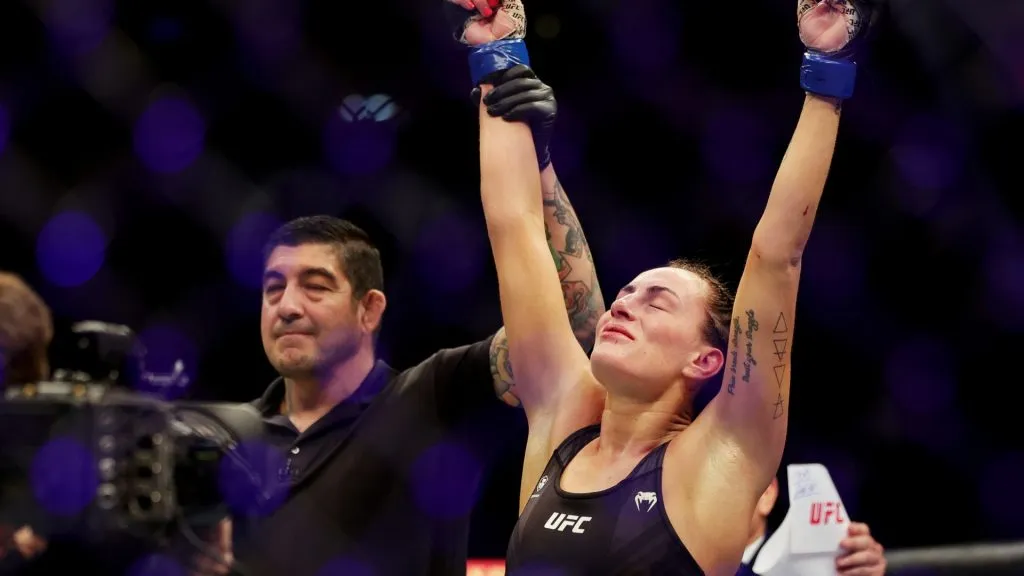
Casey O’Neill of Scotland reacts after winning her women’s flyweight fight against Roxanne Modafferi via split decision during UFC 271 at Toyota Center on February 12, 2022. (Source: Carmen Mandato/Getty Images)
For rising contenders, this is particularly damaging. A bad scorecard might drop them out of the top 10, reduce media buzz, and limit future opportunities. In divisions as stacked as lightweight or bantamweight, that can mean the difference between a Pay-Per-View spot and being buried on a prelim card.
Moreover, rankings are influenced by perception as much as performance. A fighter who “won” a fight but lost by split decision might still be seen as top-tier by fans and analysts—but matchmaking, contracts, and UFC promotion often follow the official record.