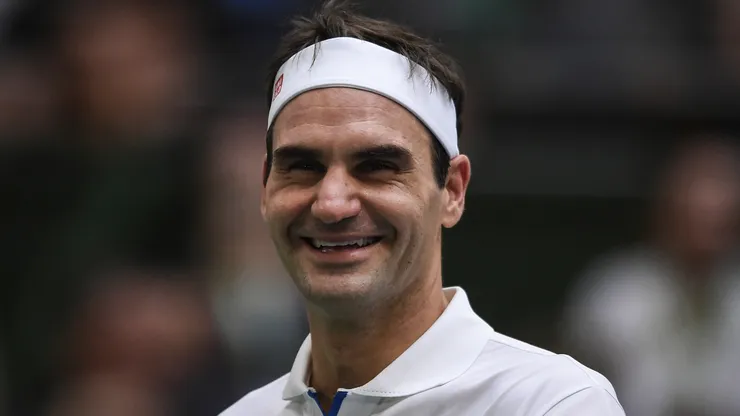
When Roger Federer burst onto the scene in the late 1990s, he quickly stood out as a rare talent — a Swiss prodigy with a graceful one-handed backhand, effortless movement, and a fiery competitive edge that hinted at future greatness. Over time, Federer refined his temperament and became a complete player, mastering every surface and redefining what excellence in tennis looked like.
With 103 career titles, including 20 Grand Slam trophies, Federer’s impact goes far beyond the record books. Alongside Novak Djokovic and Rafael Nadal, he formed the legendary “Big Three,” a trio that dominated the sport for over two decades. But perhaps his greatest contribution was inspiring an entire generation to pick up a racket and fall in love with the game.
Speaking in an interview with Burna Boy, Federer revealed the five players he considers the greatest: “I needed my own GOAT — I had posters of my favorite players on my walls and wanted to be like them. For me, my idol at that time was the Swedish player Stefan Edberg. He always attacked, came to the net, and played with such elegance. He was a wonderful player to watch, and I loved seeing his matches”.
“Then I’d include Boris Becker. He and Edberg always played each other, so I watched them all the time. Next would be Pete Sampras, and of course, Rafael Nadal and Novak Djokovic,” he added.
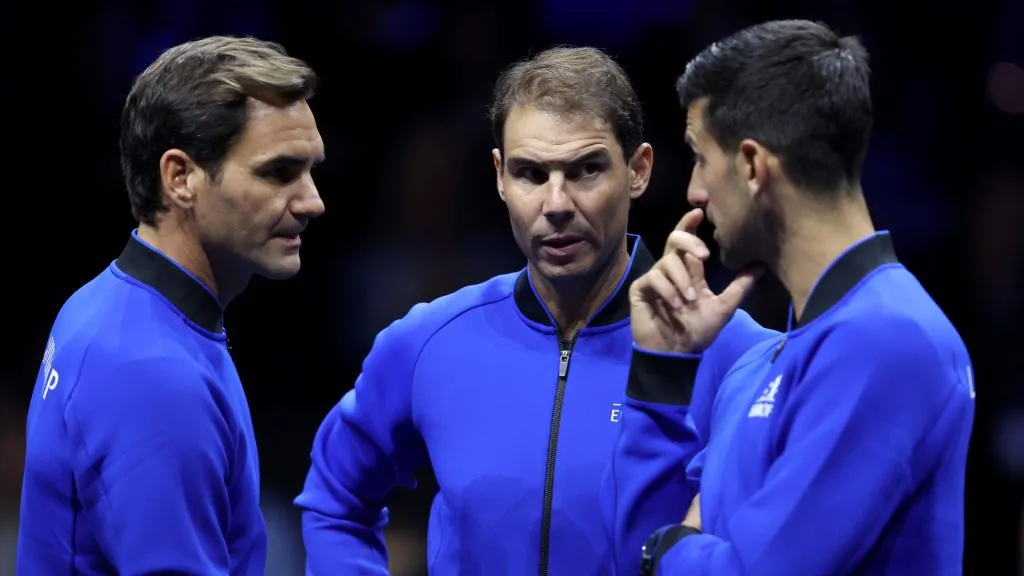
Roger Federer, Rafael Nadal and Novak Djokovic talking during the Laver Cup. (Getty Images)
The enduring brilliance of tennis’ Big Three
Few eras in sports history compare to the dominance of tennis’ Big Three — Djokovic, Nadal, and Federer. Together, they reshaped the modern game, setting new standards of excellence, consistency, and longevity.
For more than twenty years, they traded titles, rewrote record books, and faced each other on the sport’s biggest stages. Collectively, they’ve amassed an astonishing 66 Grand Slam trophies, a benchmark that may never be matched.
Their rivalries produced unforgettable moments that defined a generation of tennis fans. One of the most memorable came at the 2012 Australian Open, when Djokovic outlasted Nadal in an epic five-hour, 53-minute battle — still the longest Grand Slam final ever played.
In head-to-head competition, Djokovic holds a slight upper hand against both rivals. He leads Nadal 31–29 in their 60 encounters and has a 27–23 advantage over Federer across their 50 clashes. Meanwhile, the Nadal–Federer rivalry, perhaps the most beloved in tennis, tilts in favor of the Spaniard, who leads 24–16 over the Swiss legend.
Together, Djokovic, Nadal, and Federer have left a legacy that transcends statistics — a golden era defined by mutual respect, relentless competition, and timeless greatness that will echo through the sport for decades to come.