March Madness is not just an opportunity to watch the best universities in the country battling for glory: it’s a stage where the limits of basketball are stretched, broken and, at times, completely reinvented.
Each March, the spotlight shines not only on the teams but also on players willing to write their names into the history of the sport with performances that transcend statistics and become epic moments.
What’s fascinating about these moments is not just the magnitude of the numbers, but the audacity with which these players dared to dream big. In this world, the unpredictable and the extraordinary are the norm.
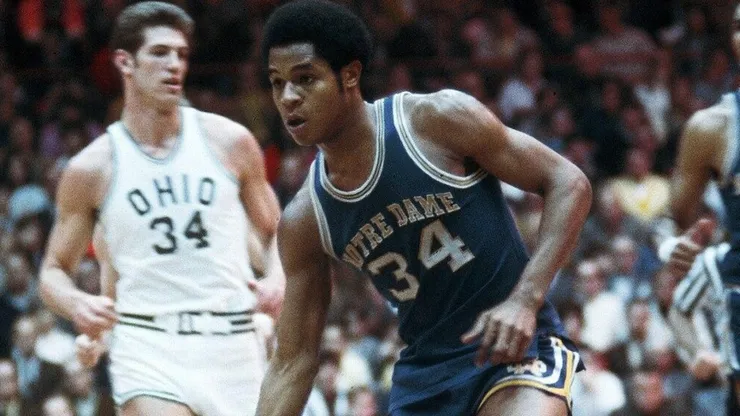
Austin Carr, 61 points | 1970 NCAA tournament
One of the most iconic performances in NCAA Tournament history came in 1970 when Austin Carr, a star guard for Notre Dame, scored 61 points against Ohio University. This record remains unbroken to this day, even without the advantage of a three-point line.
His performance was a display of extraordinary skill—his points came from a mix of jump shots, layups, and his ability to create opportunities from fast breaks. What makes this feat even more remarkable is the efficiency with which he played.
Despite being heavily guarded, he consistently found ways to score, making him one of the greatest individual performers in the history of the tournament. His 61 points led the Irish to a dominating victory, and though they didn’t win the championship that year, his performance cemented his place as a legend in college basketball.
Bill Bradley, 58 points | 1965 NCAA tournament
In 1965, Princeton’s Bill Bradley, who would go on to have a storied career in the NBA and politics, delivered an unforgettable performance in a consolation game of the NCAA Tournament. He scored 58 points against Wichita State, showcasing his scoring prowess and ability to take over a game.
Known for his basketball IQ and versatility, his performance against Wichita State demonstrated both his shooting ability and his capacity to perform under immense pressure. His efforts helped solidify his reputation as one of college basketball’s brightest stars of the era, with his efficiency from the field and cool demeanor setting the stage for his future success.
Oscar Robertson, 56 points | 1958 NCAA tournament
Oscar “The Big O” Robertson is a name synonymous with greatness in basketball, and his 56-point outing in the 1958 NCAA Tournament helped cement his place as one of the sport’s true pioneers. Playing for the University of Cincinnati, he was a force on both ends of the floor.
Against Arkansas, he put on a scoring display that left spectators in awe, hitting nearly every shot he took while also contributing in other areas such as rebounding and assists.
What makes his performance especially notable is that he did it in an era where scoring wasn’t as high-paced as it is today, making his 56 points all the more impressive. He would go on to revolutionize the game in the NBA, but it was this kind of performance that showcased his immense talent and set the foundation for his Hall of Fame career.
Austin Carr, 52 Points | 1971 NCAA Tournament
Austin Carr wasn’t finished yet. In 1971, he delivered yet another stunning performance, this time scoring 52 points against Texas Christian University (TCU). While his scoring feats were becoming the stuff of legend, this game further cemented his status as one of the best individual performers in NCAA Tournament history.
Once again, his scoring versatility was on full display, as he drained shots from all over the court, showcasing his impeccable skill set. His 52-point game against TCU was a testament to his consistent excellence in the NCAA Tournament, a run that would be remembered for years to come as one of the best individual performances ever seen on the March Madness stage.
David Robinson, 50 points | 1987 NCAA tournament
David Robinson, one of the most dominant big men in college basketball history, delivered a legendary performance in the 1987 NCAA Tournament when he scored 50 points against Michigan. His size, athleticism and skill set made him a nightmare for defenders, and in this game, he proved just how unstoppable he could be.
He scored from the low post, the mid-range and even showed off his ability to hit free throws with a smooth stroke. His 50-point game helped propel his Navy team to victory and showcased his status as one of the best players in college basketball during the late 1980s.
Elvin Hayes, 49 points | 1968 NCAA tournament
In what would become known as the “Game of the Century”, Houston’s Elvin Hayes led his team to an epic victory over UCLA in 1968, a game that would go down in NCAA history. He scored 49 points in the game, showcasing not only his offensive firepower but also his defensive prowess.
He battled fiercely against UCLA’s legendary coach John Wooden and his dominant players, including Lew Alcindor (later known as Kareem Abdul-Jabbar), in a game that was watched by millions.
His performance helped Houston secure a historic 71-69 win, making it one of the most iconic moments in college basketball. His 49-point game remains a testament to his ability to rise to the occasion, even when facing one of the most successful teams in NCAA history.
Hal Lear, 48 points | 1956 NCAA tournament
Temple University’s Hal Lear put on a show in the 1956 NCAA Tournament, scoring 48 points in a third-place game against Southern Methodist University. His performance was one of the most impressive scoring feats of the era, as he dominated on offense with his ability to score from all angles. In a time when the game was much slower-paced and scoring wasn’t as high, his 48-point outburst was a clear indication of his immense talent.
Dave Corzine, 46 points | 1978 NCAA tournament
Dave Corzine, playing for DePaul, delivered one of the most impressive individual performances of the 1978 NCAA Tournament when he scored 46 points against the University of Wisconsin. His scoring clinic was a mixture of finesse and power, as he dominated in the paint while also knocking down mid-range shots.
His 46-point game helped DePaul advance further into the tournament and remains one of the most memorable moments of that year. Corzine’s effort stood out not just for the quantity of points, but for the way he carried his team to victory in a high-pressure tournament setting.