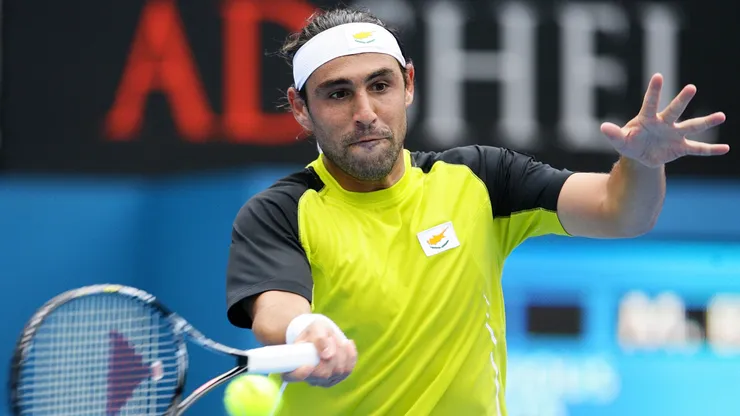
For a brief moment in the mid-2000s, Marcos Baghdatis was one of the brightest stars in tennis. With a magnetic personality, a flair for the unexpected, and a booming forehand, the Cypriot had fans believing he could crack the sport’s elite.
His 2006 run to the Australian Open final turned him into a household name, and his Wimbledon semifinal that same year proved it wasn’t a fluke. But while the talent was undeniable, injuries and motivation would ultimately limit what might have been a longer stay near the top.
Born in Limassol in 1985, Baghdatis picked up a racket at five. By 2003, he was the top junior in the world and the Australian Open boys’ champion. His rise was steep, and it didn’t take long for him to make a mark on the ATP Tour.
His remarkable 2006 season
In an era filled with great champions and talents, such as Roger Federer, Andy Roddick, Lleyton Hewitt and more, Baghdatis announced himself in 2006 with a remarkable season in which he reached his first (and only) Grand Slam final.
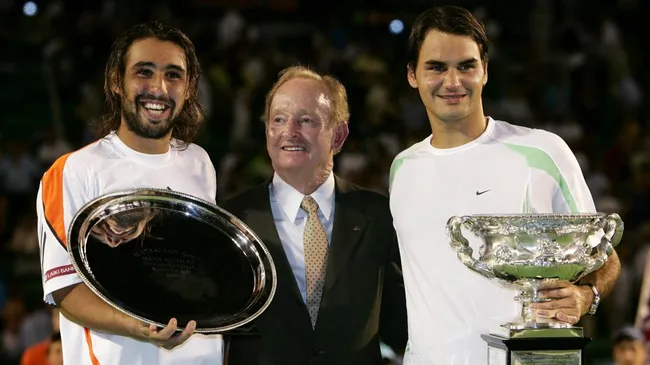
Roger Federer poses with Rod Laver and Marcos Baghdatis after winning the Australian Open (Phil Walter/Getty Images)
At the Australian Open, Baghdatis stunned Roddick, Ivan Ljubičić, and David Nalbandian in a fairytale run to the final. Backed by Melbourne’s Greek community, his matches felt like home games. However, in the final, he couldn’t beat an inspired Federer, who took the trophy with a 5–7, 7–5, 6–0, 6–2 victory.
That same year, he also reached the Wimbledon semifinals, beating Andy Murray and Lleyton Hewitt before losing to Rafael Nadal. Baghdatis climbed to No. 8, his highest-career ranking, that August. He had the tools: touch, timing, and an ability to mix things up.
Among his wins over Top 10 players, he recorded wins over Federer (2010 Indian Wells) and Nadal (2010 Cincinnati), when they both were number one players. However, the Swiss (7-1) and the Spaniard (8-1) still had the upper-hand in the head-to-head. He never beat Djokovic, going 0-8.
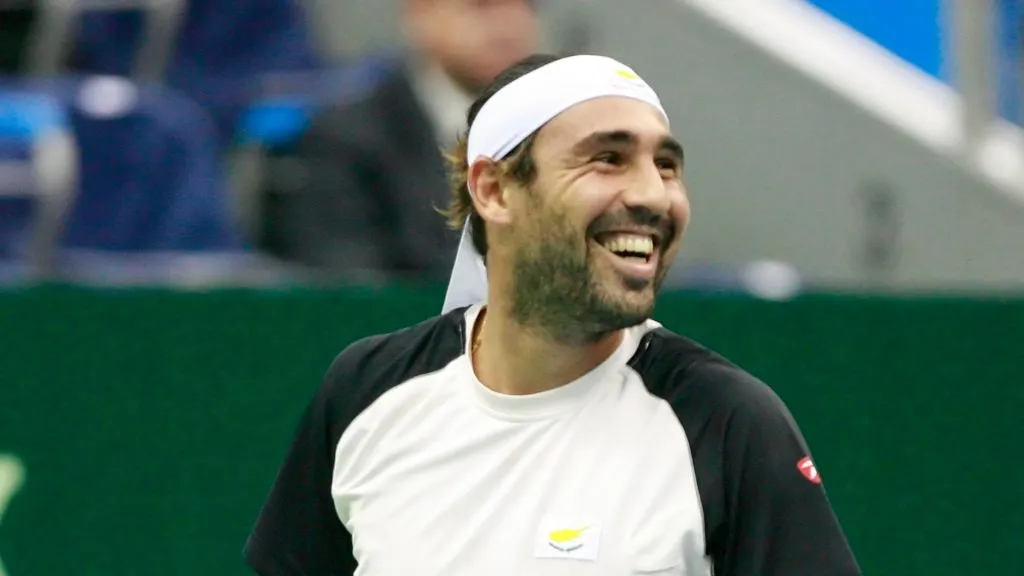
Baghdatis in 2010 (Dima Korotayev/Epsilon/Getty Images)
A complex character
Like many talented players, Baghdati was also unstable on court. He was known for some tantrums, probably the most famous being the time he broke several rackets in a row during a changeover in the 2012 Australian Open while facing Stan Wawrinka. He lost the match, and was fined $800.
While he suffered from several injuries during his career, many experts and fans also questioned his motivation. “When a guy gets to a (Grand Slam) final and semifinal in the same year, you figure he’s going to be a perennial Top-10 player,” Brad Gilbert, Agassi’s longtime former coach, said to Tennis Channel in 2014. “He hasn’t lived up to that 2006 season. But the talent is there. He’s a great ball striker.”
Meanwhile, his former coach Patrick Mouratoglou also described him as “unbelievably complex.” Baghdatis himself admitted he didn’t always enjoy the hyper-professional nature of the modern game.
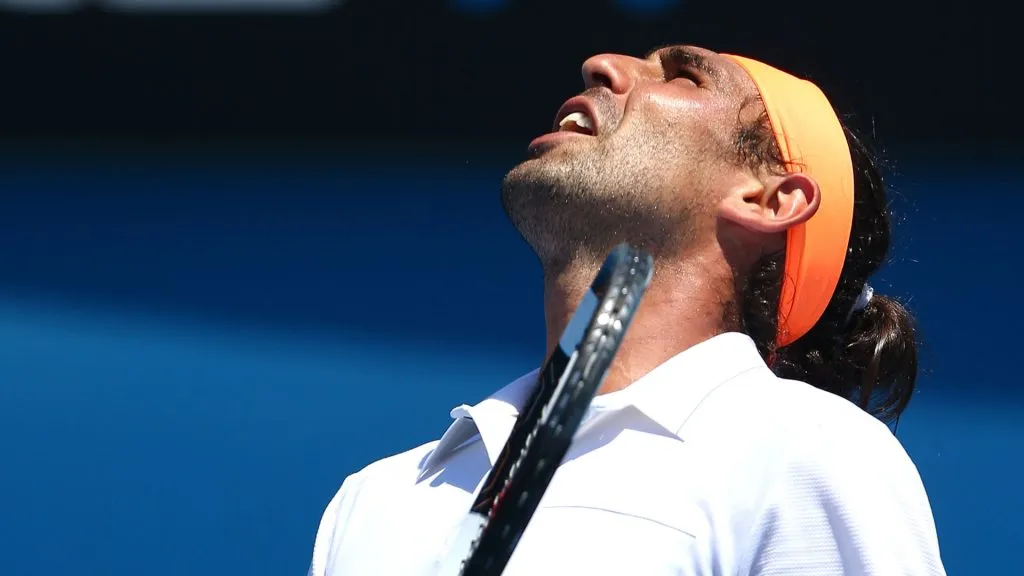
Baghdatis reacts during the 2015 Australian Open (Robert Prezioso/Getty Images)
“What I love about tennis is when there’s emotion on court,” Baghadatis said to Tennis Channel in 2014. “I think they don’t get much now in tennis. Before there was (John) McEnroe, (Jimmy) Connors, Agassi, that gave so much to the sport. On the court there was always something happening,” he explained.
“But now I feel it’s getting a bit boring. It’s getting a bit too much in professionalism and there’s too much focus on just winning and stuff like that. I think it should be an entertainment sport,” he concluded.
Injuries and farewell at Wimbledon
Injuries took their toll. He had arm surgery in 2005 and struggled with hip, ankle, foot, and back issues over the years. In 2017 alone, he retired from five matches and withdrew from nine events. By the end, the grind was too much.
In 2019, he announced his retirement ahead of Wimbledon, in which he was granted a wildcard. His last match was a loss to Matteo Berrettini in the second round. It was a fitting place to say goodbye.
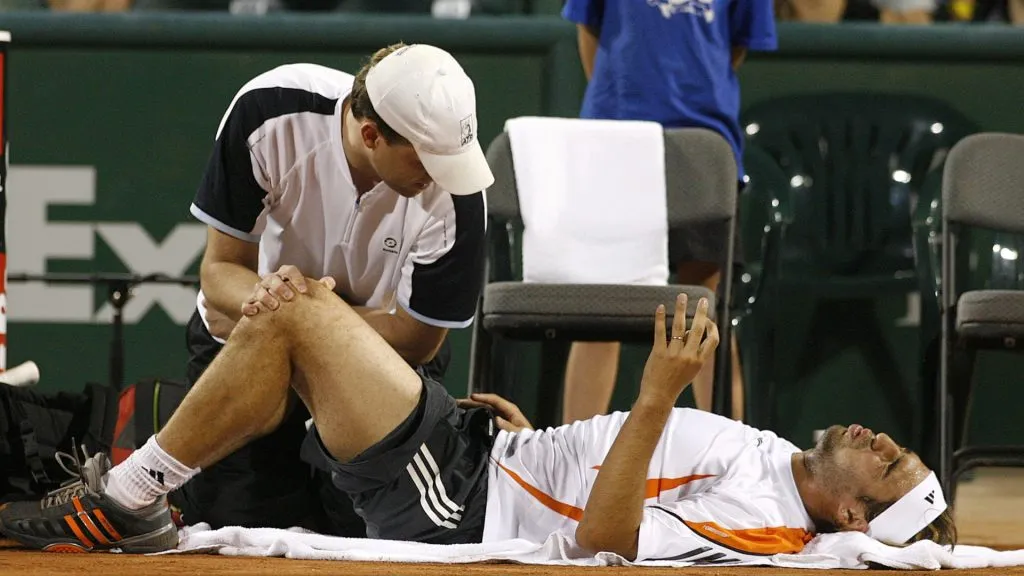
Baghdatis receives medical attention on court in 2006 (Bob Levey/Getty Images)
“I’m grateful for finishing my career at one of the best tournaments. I miss the audience, the fans, the atmosphere in a tennis stadium,” he told tenninet.com after retiring. “Sometimes I felt really depressed because I could not act the way I wanted. But I fought.”
Legacy in Cyprus and beyond: His Davis Cup record
While he never won a major title, he won 14 ATP titles and has a Davis Cup record: 36 consecutive singles wins, the longest streak ever, surpassing Björn Borg (33). Apart from that, he is regarded as a national hero.
“I brought a lot of kids to play tennis,” he told The Sydney Morning Herald amid the 2015 Australian Open. “It’s one thing nobody can take away from me,” he said, about gaining a beloved following in his home country.

(L-R) Zahara Baghdatis and Marcos Baghdatis in 2023 ( Ilya S. Savenok/Getty Images for PTPA)
Life after tennis
Baghdatis married former WTA player Karolina Šprem in 2012. They have three children: Zahara, India, and Zeus. However, he remains close to the sport, while occasionally coaching stars such as Elina Svitolina and occasionally appearing in legends events.