
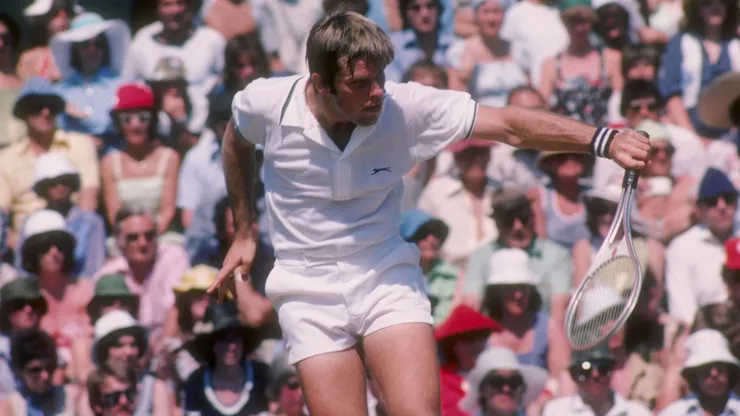
The United States has produced countless tennis greats, with legends like Jimmy Connors and John McEnroe dominating the sport during the 1970s and 1980s. Yet among these giants was Roscoe Tanner, a serving powerhouse who carved out his place in the history books. Tanner achieved remarkable success, reaching as high as World No. 4, winning a Grand Slam title, and setting a record that stood for over two decades.
Tanner turned professional in 1972 and quickly ascended to the sport’s elite. In an era dominated by finesse and spin, his booming serve set him apart, enabling him to challenge some of the biggest names of the time. His first major breakthrough came at the 1974 U.S. Open, where he reached the quarterfinals.
But Tanner’s crowning achievement came in January 1977 at the Australian Open. Facing Argentine great Guillermo Vilas in the final, Tanner claimed his lone Grand Slam title, cementing his place among the sport’s elite.
By 1979, Tanner was on the cusp of even greater glory. He reached the Wimbledon final, pushing the legendary Bjorn Borg to five sets before falling short. Borg, who had already won three consecutive titles at the All England Club, narrowly denied Tanner what would have been a career-defining triumph. Tanner’s form began to decline in the early 1980s, and he retired from professional tennis in 1985.

Bjorn Borg celebrates after defeating Roscoe Tanner in 1979 Wimbledon. (Getty Images)
A record-setting serve
Tanner’s legacy includes a serve that was ahead of its time. In the 1978 Palm Springs final, he launched a serve clocked at 153 mph, a record that stood for 26 years.
It wasn’t until 2004 that Andy Roddick surpassed Tanner’s mark with a 155 mph serve during the Davis Cup. Today, even faster serves have been recorded, with Sam Groth holding the current record at 163 mph since 2012.
Financial woes and legal troubles
While Tanner earned over $8 million during his career, his financial management post-retirement left him bankrupt. His personal life became increasingly tumultuous. Tanner’s first marriage to Nancy Tanner ended in divorce, costing him $500,000, a house, and $10,000 per month in child support for their daughter, Lauren.
Tanner later married Charlotte, with whom he had two daughters. However, revelations of an extramarital child led to his first arrest for failure to pay child support.
In the 1990s, Tanner and Charlotte declared bankruptcy. After their 1999 divorce, Tanner was ordered to pay $7,000 per month in child support for their daughters. He later married Margaret Barna, but the pattern of scandals persisted.
Prison time and life after tennis
Tanner’s most notorious incident involved the purchase of a yacht in Germany using a check with insufficient funds. The fraud led to a two-year prison sentence, served in Lake Butler, Florida.
In recent years, Tanner has sought to rebuild his life. Now residing in Vero Beach, Florida, he has returned to tennis as a coach, sharing his knowledge with a new generation of players.