The UEFA Women’s Euro 2025 will bring together Europe’s best in Switzerland, a tournament where every match carries enormous weight. But as the knockout rounds approach, there’s an element of its format that still surprises many.
For those who reach the semifinals, the dream of lifting the trophy burns brightest — yet for the ones who fall short, there’s no extra chance to fight. The journey ends there, with no curtain call to soften the blow of elimination.
This structure has been part of the competition for years, sparking quiet debates about its fairness and its impact on teams and fans. It makes the semifinals a gateway and the definitive dividing line between history and heartbreak.
Why isn’t there a third‑place match at the UEFA Women’s Euro 2025?
UEFA abolished the third-place playoff after the men’s 1980 tournament, citing low fan attendance and TV interest for a non-title fixture. That format change carried over into both men’s and women’s Euros, and despite other international tournaments keeping the bronze medal match, the Women’s Euro has never reinstated it.
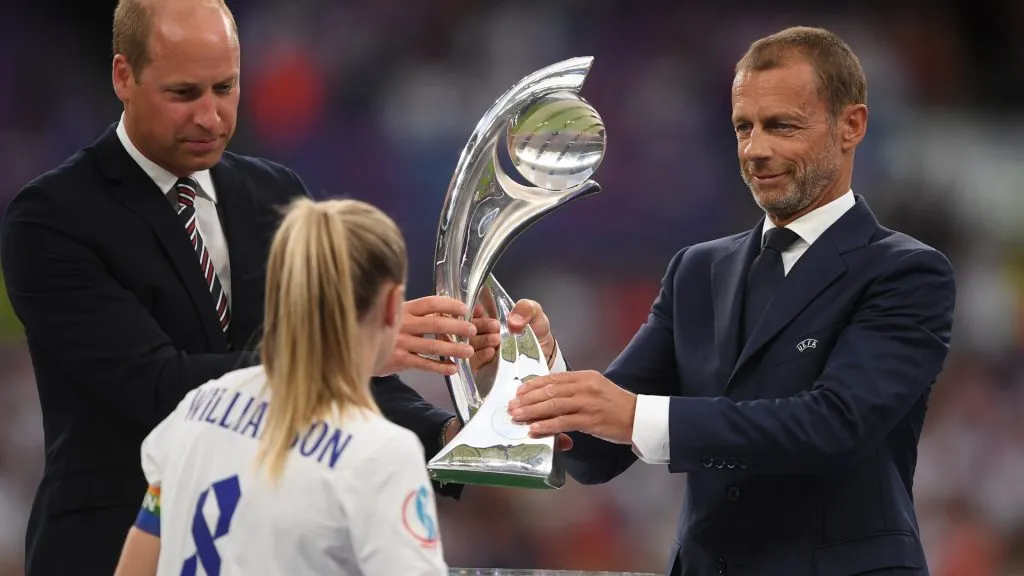
Prince William, Duke of Cambridge, and Aleksander Ceferin, President of UEFA, present Leah Williamson of England with the the UEFA Women’s EURO 2022 Trophy. (Source: Harriet Lander/Getty Images)
UEFA leaders have maintained that a third-place match adds little competitive or commercial value. Since the tournament’s structure is designed to culminate in a single final, semifinal losers simply exit without a consolation fixture.
As a result, the 2025 edition in Switzerland will once again close the door at the semifinal stage for non-finalists—no extra fixture, no bronze medal, just the bitter sweetness of elimination.
How does the tournament format affect the absence of a playoff?
Women’s Euro is a compact tournament: with just 16 teams and a tight schedule from July 2 to 27, every round must fit within limited stadium availability and player recovery time. Adding another game would upset match flow and increase player fatigue.
Without the third-place match, the calendar stays streamlined: quarter-finals, semifinals and then the final. That leaves players exiting in the semis with no further game—making that fixture the full stop in their campaign. That structural choice keeps attention firmly on the winner’s narrative.
What does skipping the third‑place game mean for players and fans?
For players, especially those who reach the semifinal, the lack of a third-place game eliminates any chance at a final positive note. There’s no consolation prize—only exit, regardless of the path taken.
Fans don’t get the classic redemption storyline either. There’s no “Cinderella” ending or bittersweet narrative to cheer when a dark horse can still salvage a bronze. Instead, the focus swiftly shifts to the final and the champions.
Cultural debates persist, some view third-place games as devaluing defeats, others see them as valuable recognition. But UEFA’s preference remains firm: the Women’s Euro, unlike global tournaments, silences the bronze match entirely.
What happens after a semifinal defeat in the Women’s Euro?
Once a team loses in the semifinals, their journey ends—without additional games or medal tier distinctions. There’s no formal ranking between the two semifinal losers; both are simply recorded as semifinalists.
UEFA doesn’t designate third or fourth place. Instead, performance is informally compared using group and knockout results. That means official placement stops at “finalist”, leaving semifinalists grouped together rather than ranked.
Emotionally, that seals the narrative arc. Some players depart with disappointment, others with pride in progress. But regardless, the semifinal marks the unmistakable end of their tournament.