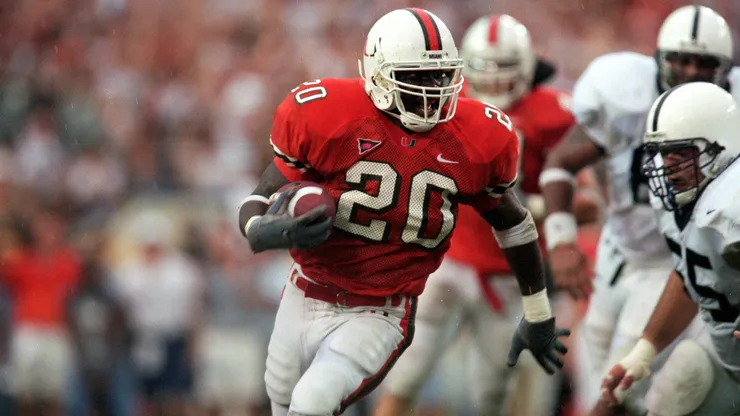
From the scorching heat of South Florida emerged a program that redefined the swagger. The Miami Hurricanes built a legacy on speed, power, and relentless confidence, turning the “U” into one of the sport’s most recognizable symbols.
They didn’t just win games; they created moments that shaped the culture of college football. Their stars became household names, their rivalries legendary, and their impact stretched far beyond the orange and green of Coral Gables.
They produced icons who dominated Saturdays and then conquered Sundays in the NFL. Their stories form a tapestry of triumph, controversy and unforgettable talent—an evolution that turned Miami into a true factory of greatness.
Ed Reed, DB
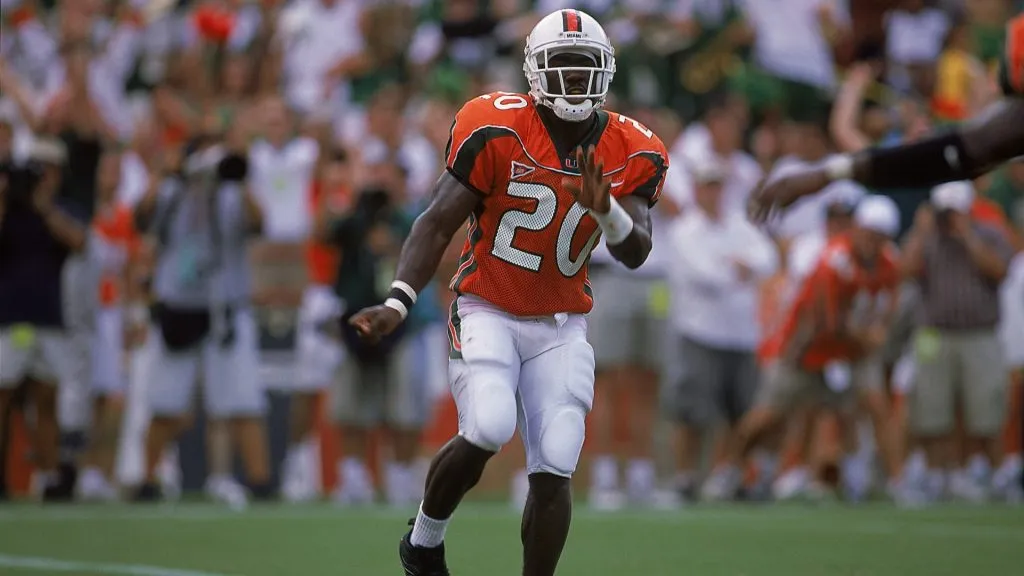
Edward Reed #20 of the Miami Hurricanes moves on the field during the game against the Pittsburgh Panthers at the Orange Bowl in 2000. (Source: Andy Lyons /Allsport)
Ed Reed arrived in Coral Gables just as Miami was emerging from the shadow of NCAA sanctions—and rode that rebirth to football immortality. Over four seasons (1998–2001), hr rewrote Hurricanes history: 21 career interceptions, 389 return yards, and a confidence that transformed his unit.
His knack for timing—he famously snagged an interception from a teammate’s hands and returned it 80 yards for a score—was as unpredictable as it was electrifying.
In ’01, he was a unanimous First-Team All-American, Big East Defensive Co-Player of the Year, and helped deliver Miami’s last national championship. The College Football Hall of Fame followed in 2018, capping a legacy built on instincts, poise, and unapologetic excellence.
Ray Lewis, LB
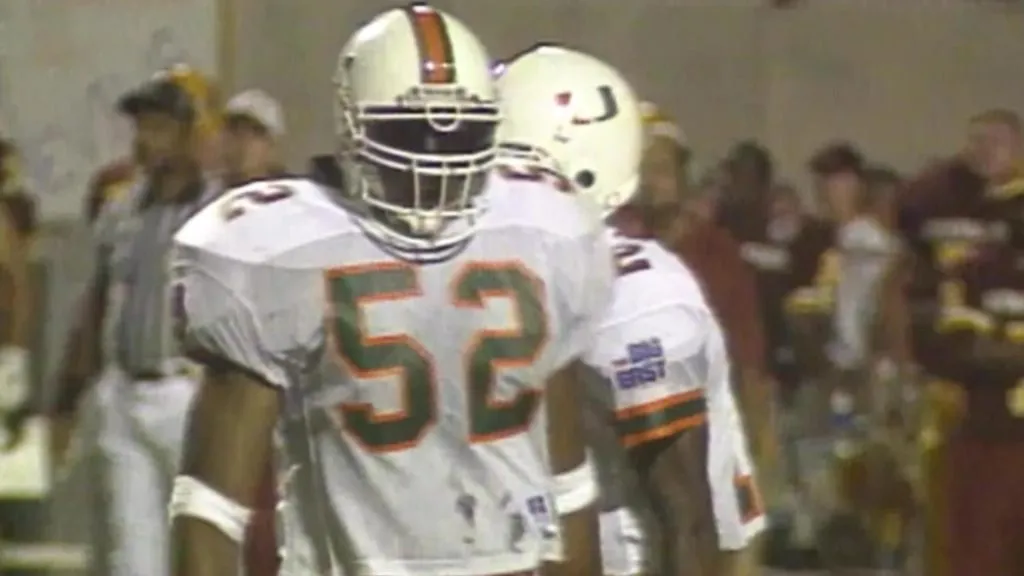
Ray Lewis (Source: Baltimore Ravens)
Ray Lewis’ time in Coral Gables was brief but seismic. From the moment he grabbed a starting spot as a freshman, his presence defined Miami’s defense. He racked up 81 tackles that rookie year, then followed with back-to-back monster seasons—153 and 160 tackles—finishing among the most prolific defenders in program history in just three years.
His 160-tackle campaign remains a benchmark. More than stats, though, it was his aura and intensity that left an indelible mark—Miami coaches still recall how opponents had to scheme specifically to contain him. His leadership on and off the field foreshadowed his Hall of Fame NFL career—and offered a template of ferocity for future Hurricanes.
Michael Irvin, WR
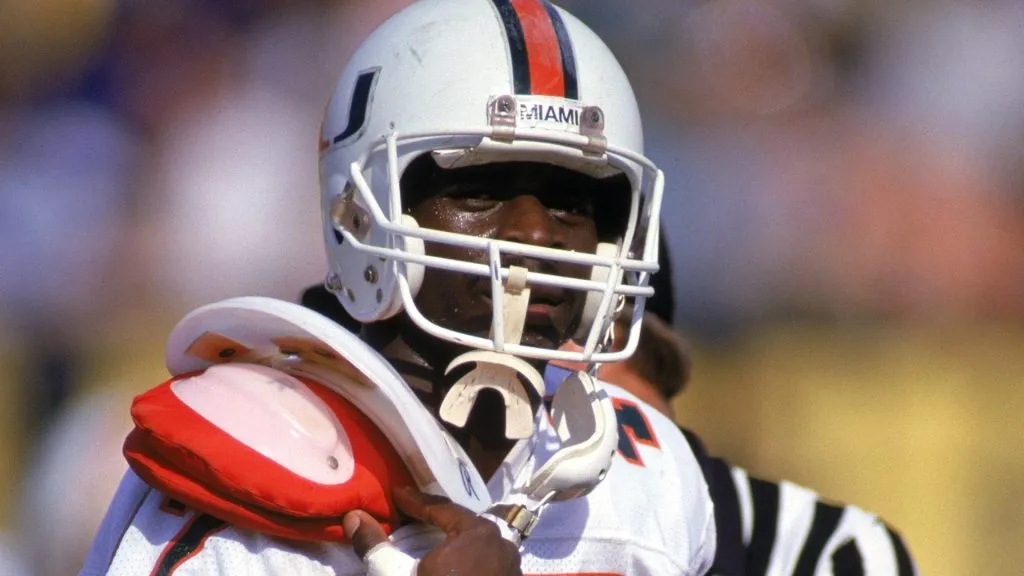
Wide receiver Michael Irving #47 of the University of Miami Hurricanes runs on the field as he tries to adjust his uniform over his shoulder pads during a 1987 NCAA game. (Source: Allen Steele/Getty Images)
Michael Irvin took Coral Gables by storm in the mid-’80s, turning Miami from a rising program into a national force. Across three collegiate seasons, he set school records for receptions (143), receiving yards (2,423), and touchdowns (26)—records that stood as testament to his consistency and big-play ability.
Yet perhaps his signature moment—one for the ages—was the 73-yard touchdown reception in the fourth quarter against Florida State in 1987. That catch didn’t just win a game; it altered the trajectory of a season and helped carry Miami to an undefeated national championship.
He brought swagger, explosiveness, and a sense that Miami was on its way to becoming “Quarterback U”—his legacy forever entwined with a turning point in Hurricanes history.
Warren Sapp, DT
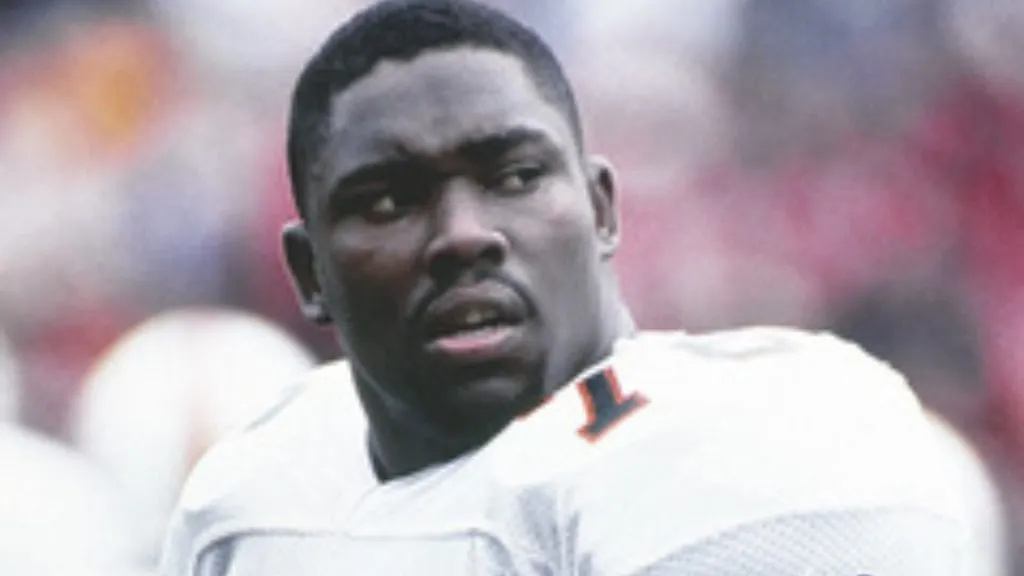
Warren Sapp (Source: UM Sports Hall of Fame)
From the moment Sapp stepped onto Coral Gables, Warren Sapp’s presence reshaped Miami’s trench identity. By the end of his collegiate tenure, he amassed 176 tackles with 19.5 sacks—enough to earn Lombardi and Bronko Nagurski Trophies in 1994, capping a Big East Defensive Player of the Year season. That season felt seismic—offensive lines trembled under his weight, and his pro-ready explosiveness foreshadowed his future Hall of Fame trajectory in the NFL.
Sean Taylor, S
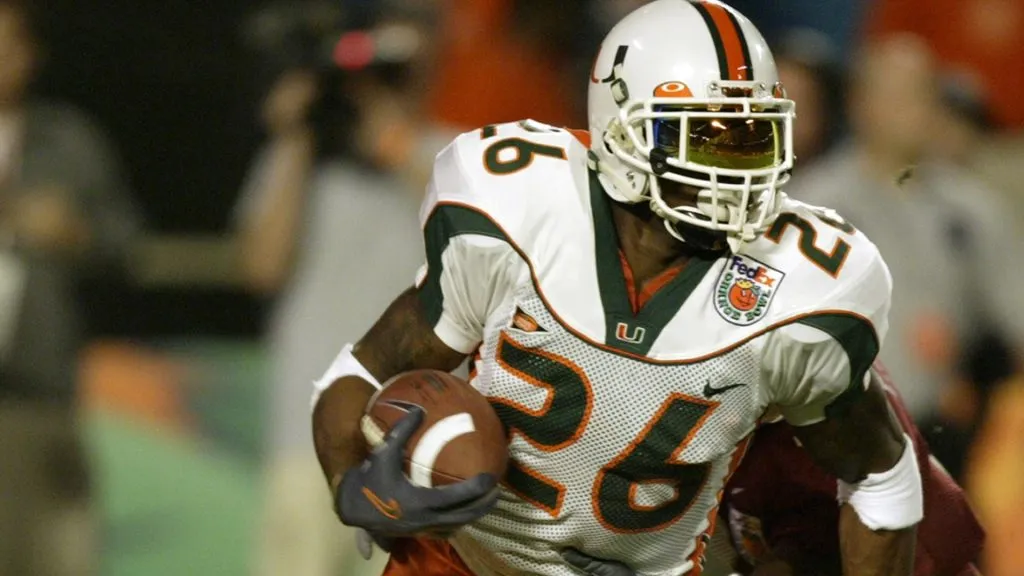
Defensive back Sean Taylor #26 of the Miami Hurricanes attempts to elude wide receiver P.K. Sam #4 of the Florida State Seminoles during the 2004 Orange Bowl game. (Source: Matthew Stockman/Getty Images)
Sean Taylor‘s sophomore eruption in 2002 was nothing short of cinematic. Armed with 85 tackles, four interceptions, 15 pass breakups, a forced fumble, a blocked kick, and a punt-return touchdown, he became the heartbeat of the Miami secondary. His game against Ohio State in the Fiesta Bowl—11 tackles and two picks—cemented a rise from reserve to defensive cornerstone by sheer talent and timing.
Vince Wilfork, DT
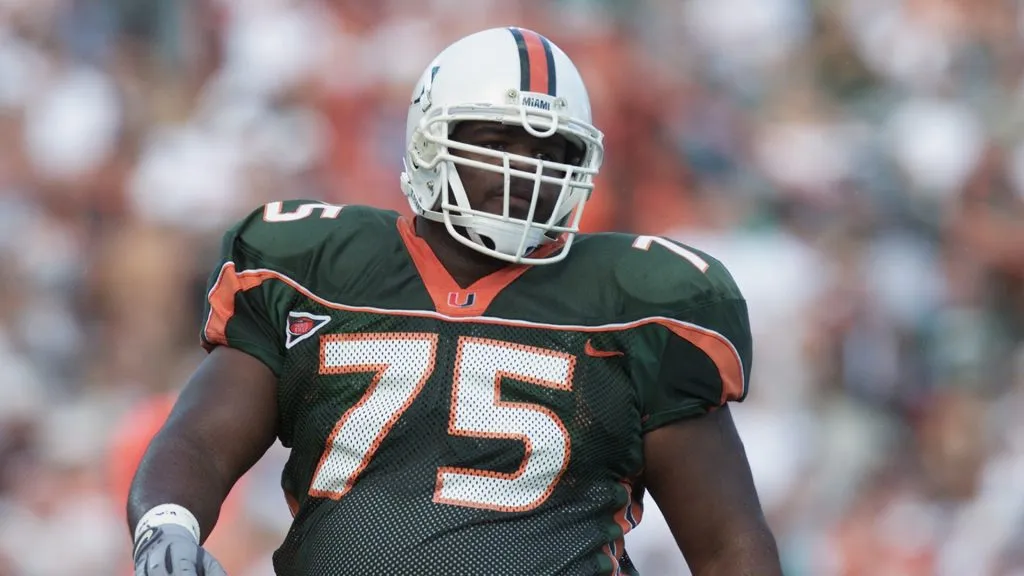
Defensive end Vince Wilfork #75 of the Miami Hurricanes stands on the field during the Big East Conference football game against the Syracuse Orangemen on November 17, 2001. (Source: Eliot Schechter/Getty Images)
A hulking freshman phenom in 2001, Vince Wilfork was unexpectedly on the field—and imposing. Though not yet a starter, he delivered 41 tackles, 11 stops for loss, three forced fumbles, two recoveries, and 15 quarterback hurries as Miami claimed the national title. The line shook when he came off it—a preview of how he would redefine interior dominance at both college and pro levels.
Jim Kelly, QB
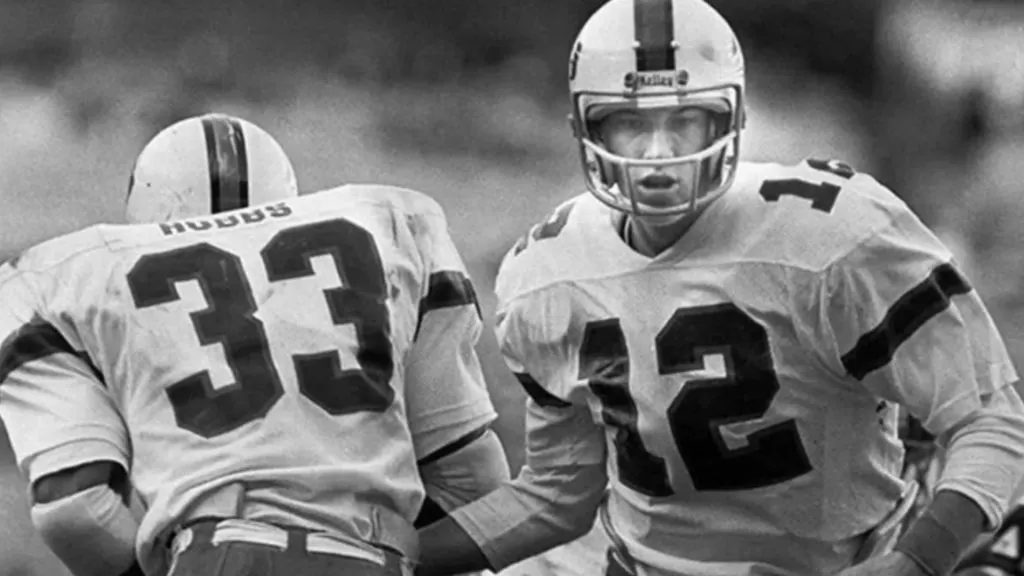
Jim Kelly (Source: NFL)
Jim Kelly’s return to Florida in 1979 carried the significance of a resurrection. A redshirt freshman, he led Miami past No. 1 Penn State in his first starring performance—and years later, pulled upset again in the Orange Bowl, earning MVP honors in Miami’s first bowl run in over a decade. Despite injuries, he left Coral Gables as a record-setter (5,233 yards, 32 touchdowns) and as the original spark of what would become “Quarterback U”.
Clinton Portis, RB
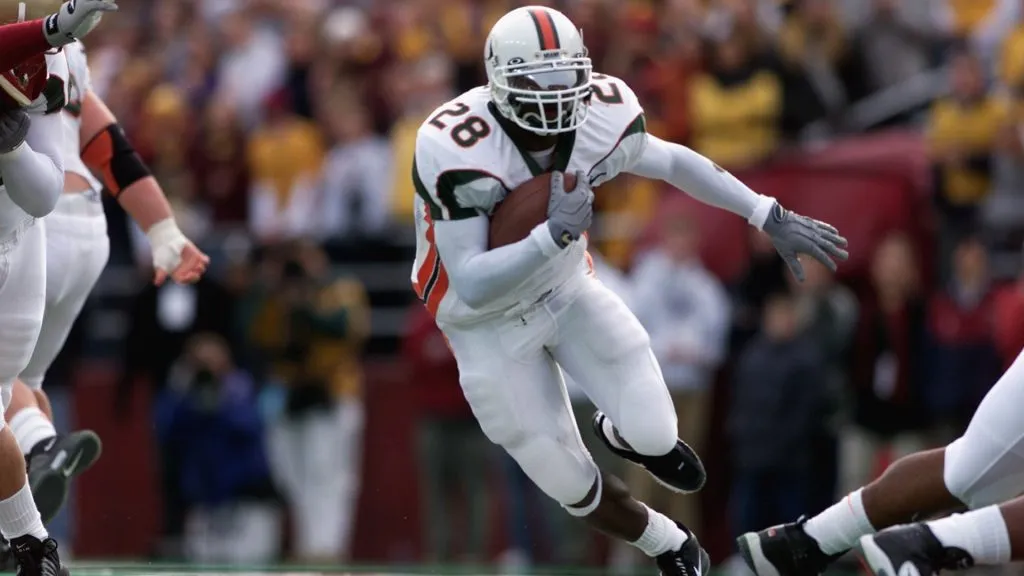
Clinton Portis #28 of the Miami Hurricanes runs with the ball against the Boston College Eagles during the game on November 10, 2001. (Source: Jamie Squire/Getty Images)
Clinton Portis arrived with a chip on his shoulder—and delivered immediately. As a true freshman, he set a school record with five 100-yard games, rushing for 838 yards and eight scores. He exploded in 2001: 1,200 yards, 10 touchdowns, and a pivotal Rose Bowl run that ended in glory—then vaulted his way into the UM Sports Hall of Fame.
Willis McGahee, RB
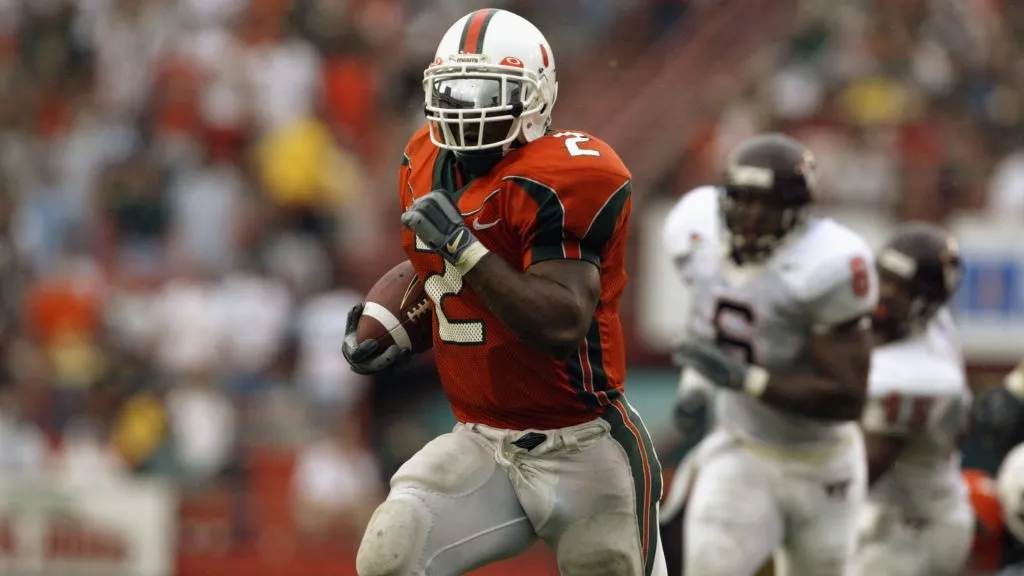
Willis McGahee carries the ball against the Virginia Polytechnic Institute and State University Hokies during the game at the Orange Bowl on December 7, 2002. (Source: Jed Jacobsohn/Getty Images)
No athlete embodied Miami grit more than Willis McGahee in 2002. Carrying the ball 282 times for 1,753 yards and 28 touchdowns, he nearly rewrote the Hurricanes’ record book. His 39-carry, 6-touchdown onslaught against Virginia Tech live-wired the Heisman chatter—and his collegiate finale remains one of college football’s most unforgettable displays.
Frank Gore, RB
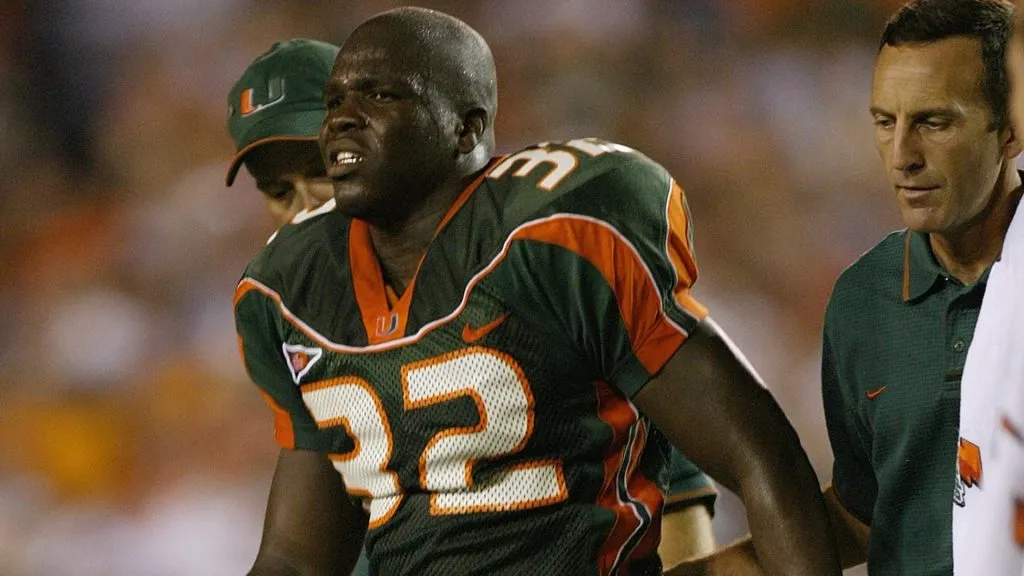
Running back Frank Gore #32 of the University of Miami Hurricanes limps off the field during a game against the West Virgina Mountaineers October 2, 2003. (Source: Eliot J. Schechter/Getty Images)
Though injuries clipped his college lifespan, Frank Gore made every carry count. In just 28 games, he amassed 1,975 yards—the 10th-best in school history—and averaged 5.68 yards per carry, ranking sixth in school annals. His electrifying 9.1-yard average as a freshman, the second-highest ever at Miami, hinted at the longevity he would achieve in the NFL.
Gino Torretta, QB
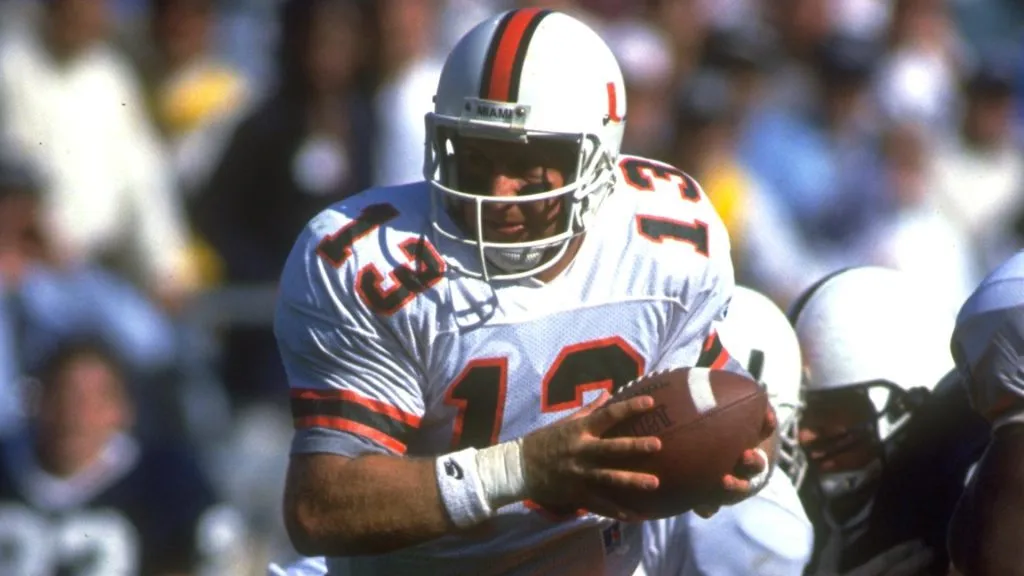
QB Gino Torretta looks to hand off during the Hurricanes 17-14 win over the Penn State Nittary Lions in 1992. (Source: Getty Images)
Gino Torretta’s 1992 was a coronation. He threw for 3,060 yards and 19 touchdowns, leading Miami to perfection and bringing the Heisman Trophy back to Coral Gables. That season also earned him the Maxwell, Davey O’Brien, Unitas, and Walter Camp awards—making him arguably the most decorated Cane at the helm.
Jonathan Vilma, LB
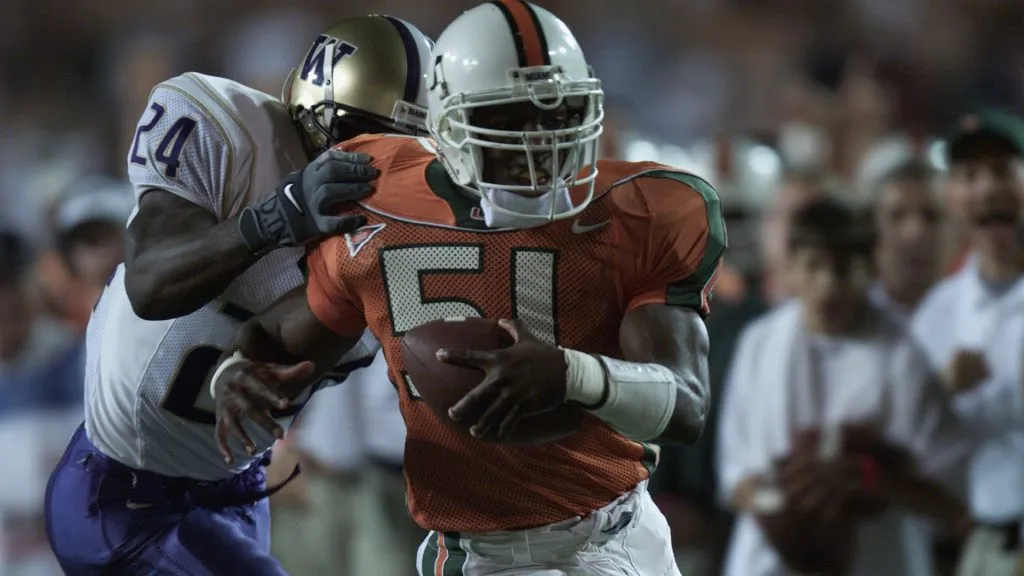
Jonathan Vilma # 51 of the Miami Hurricanes makes an interception with tailback Rich Alexis #24 of the Washington Huskies in tow during the first quarter of the game in 2001. (Source: Eliot Schechter/Getty Images)
Few players embodied Miami’s early-2000s dominance like Jonathan Vilma. A three-year starter, he became the defensive conscience of a Hurricanes squad overflowing with NFL talent. From 2001 to 2003, he piled up 377 tackles—fourth most in school history—while captaining a unit that ranked among the nation’s best.
His leadership peaked during the 2001 national championship run, where he not only led Miami in stops but also served as the voice in the huddle, a steadying presence amid the chaos of an unbeaten season. By 2003, he was a First-Team All-American and finalist for the Butkus Award, confirming his status among the game’s elite.
Bernie Kosar, QB
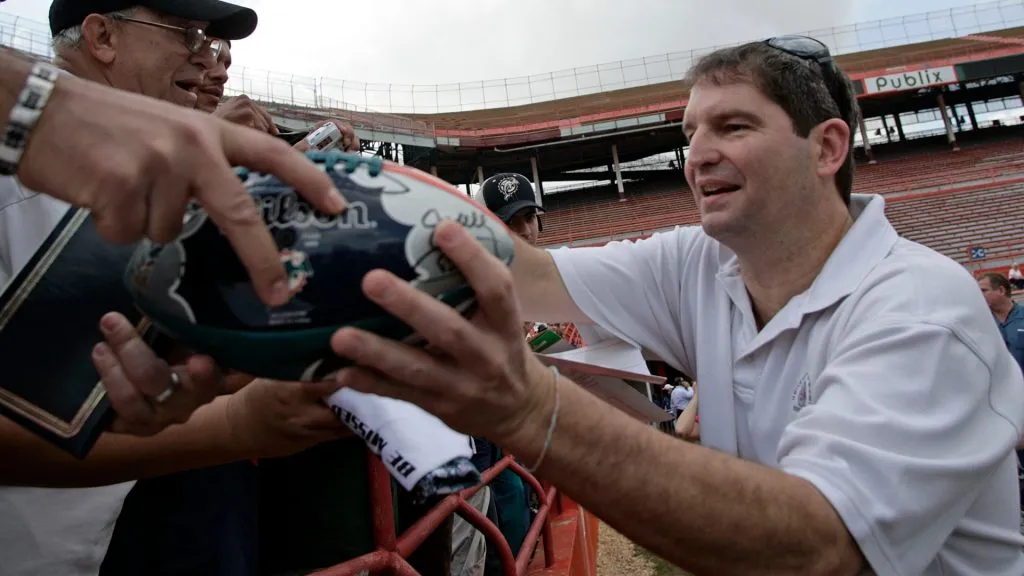
Former University of Miami Hurricanes Quarterback Bernie Kosar signs autographs for fans prior to the start of the final game at the Orange Bowl against the Miami Dolphins in 2008. (Source: Eliot J. Schechter/Getty Images)
Bernie Kosar’s brief stay—just 1983 and ’84—was nothing short of catalytic. He threw for 5,971 yards and 40 touchdowns, guiding UM to its first national championship as a starter in 1983 and winning MVP honors in the Orange Bowl against Nebraska. His career completion percentage record still stands, and those two electrifying seasons helped build Quarterback U’s foundation.
Bennie Blades, S
Bennie Blades (Source: Florida Sports Hall of Fame)
A native of Fort Lauderdale, Bennie Blades was Miami’s lockdown maestro in the mid-1980s. A two-time All-American (1986–87), Jim Thorpe Award winner, and captain of the ’87 national champs, he finished with school-record 19 interceptions, 286 tackles, and five touchdown returns. As one former coach put it, he was “the best player at his position I ever coached.”
Don Bosseler, RB
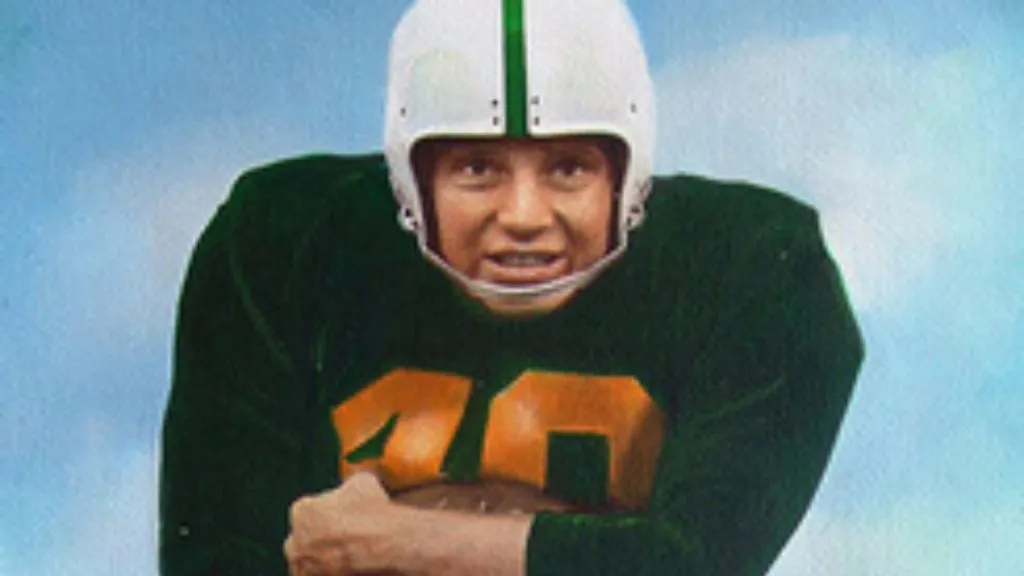
Don Bosseler (Source: UM Sports Hall of Fame)
In the mid-1950s, Don “Bull” Bosseler became the embodiment of Miami football—so popular that legends say he was as familiar to Hurricanes fans as Elvis Presley was to his youth. four-year starter from 1953 to 1956, his hallmark senior season delivered an 8–1–1 record, a first-team All-America selection, and MVP honors at the Senior Bowl. His legacy went further than Coral Gables when he entered the College Football Hall of Fame in 1990.
Ottis Anderson, RB
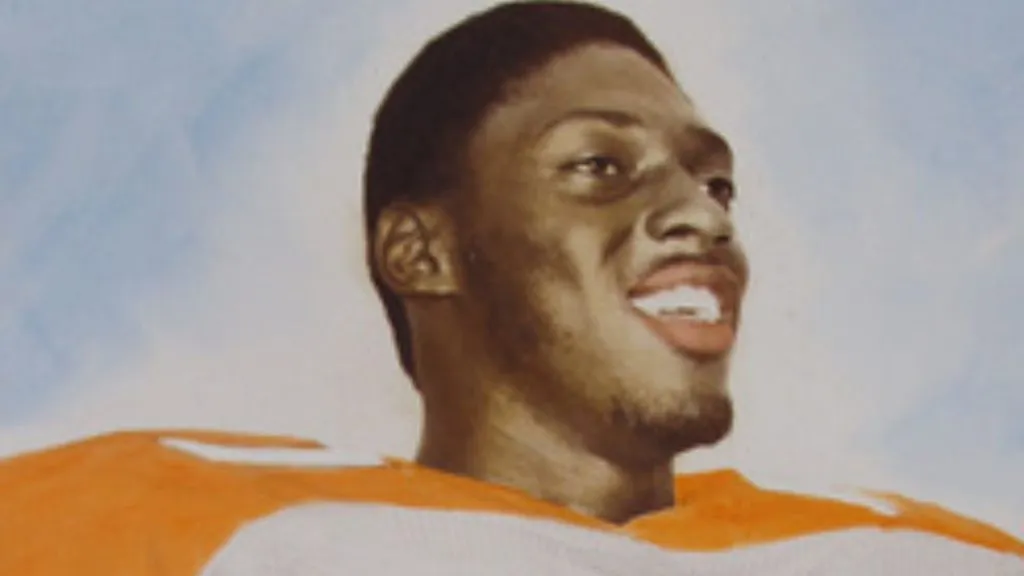
Ottis Anderson (Source: UM Sports Hall of Fame)
Ottis “OJ” Anderson brought a new dimension to Miami in the late 1970s. In 1978, he became the first Hurricane to rush for over 1,000 yards (1,266)—a feat still standing among the school’s top performances.
By career’s end, he led the program with 3,331 rushing yards, 13 games of 100 or more yards, and impressive all-purpose yardage. Often overlooked yet pivotal, he later delivered his greatest moment as Super Bowl XXV MVP with the Giants—a stunning college-to-pro narrative.
Edgerrin James, RB
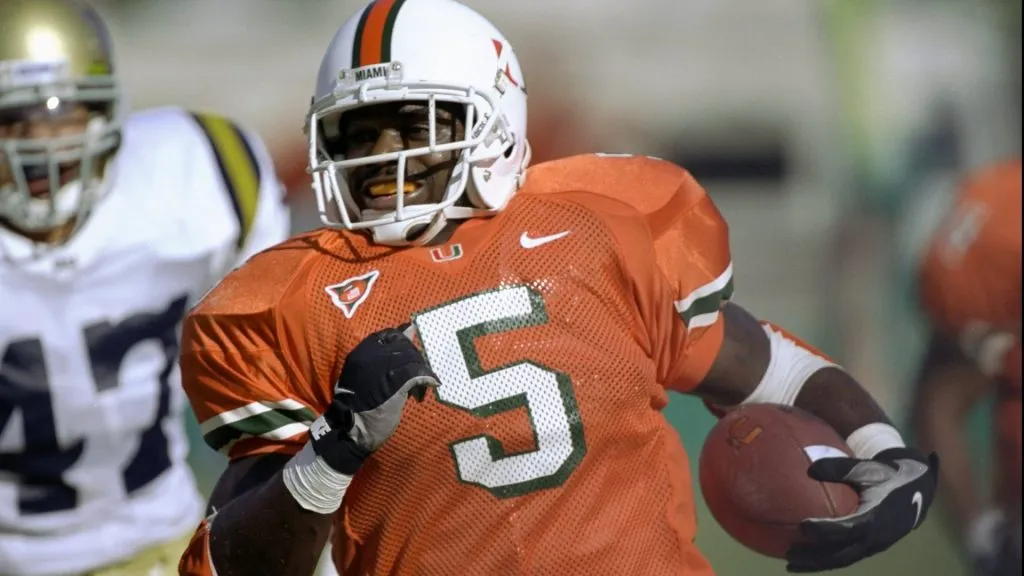
Running back Edgerrin James #5 of the University of Miami Hurricanes in action during the game against the UCLA Bruins at the Orange Bowl in 1998. (Source: Eliot Schecter /Allsport)
When Edgerrin James arrived at Miami in 1996, his freshman spark included 446 yards and two touchdowns in limited action—hinting at a breakout to come. Over three seasons, he amassed 2,960 rushing yards and 32 touchdowns: third in career Miami rushing marks, with unmatched consistency—14 career 100-yard games and the program’s top yards-per-game average. His dominance earned Pro Football Hall of Fame honors in 2020.
Reggie Wayne, WR
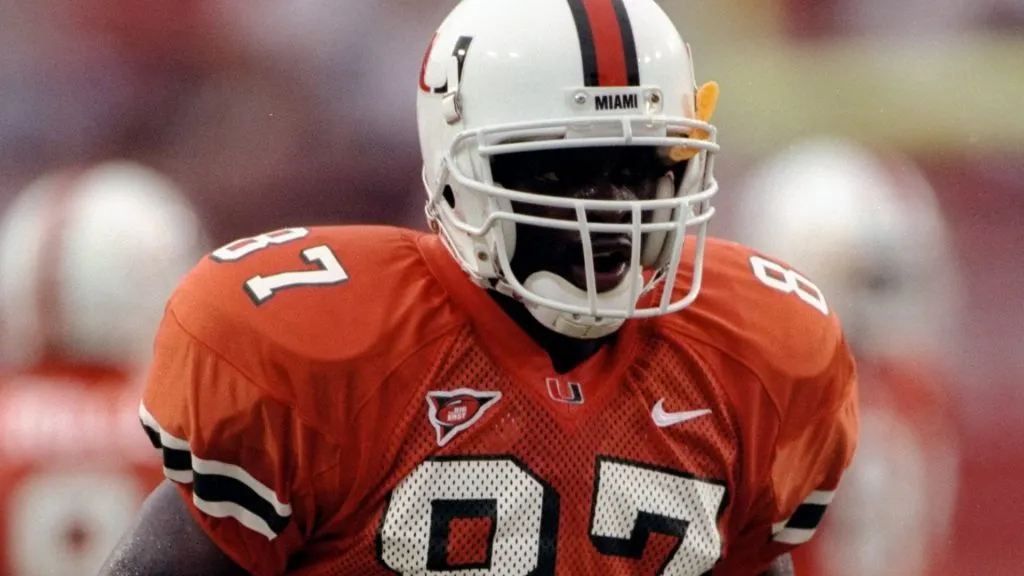
Split end Reggie Wayne #87 of the Miami Hurricanes in action during a game against the Eastern Tennessee State Buccaneers at the Orange Bowl in 1998. (Source: Eliot J. Schechter)
Reggie Wayne arrived in Coral Gables and became a model of consistency. As a freshman in 1997, he set a school record with 48 receptions (640 yards) and earned Big East Rookie of the Year honors.
By the end of his career, he held Miami’s record for receptions (173), yards (2,510), and 20 receiving touchdowns—all while showing remarkable reliability with receptions in 36 consecutive games.
Ken Dorsey, QB
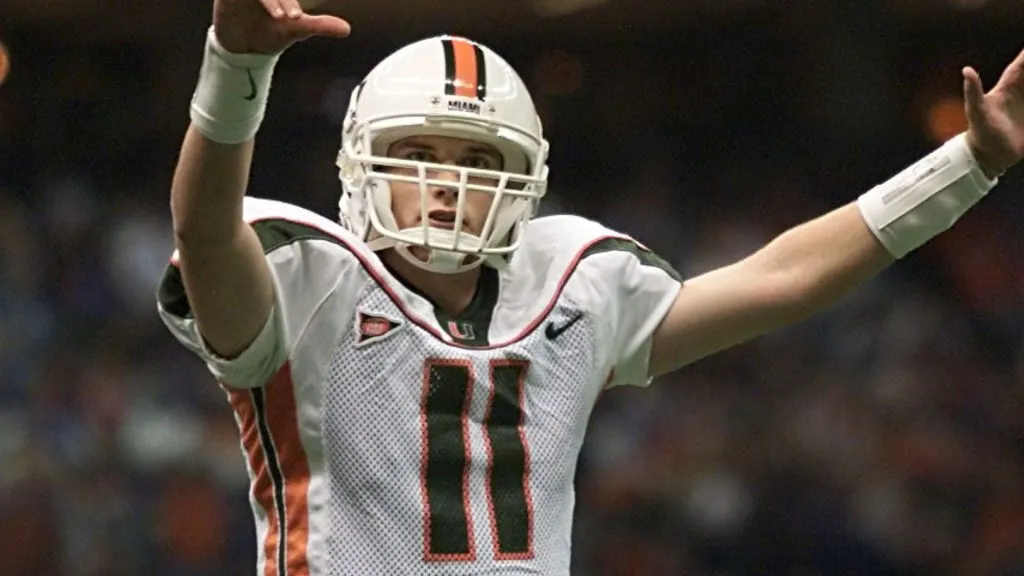
Ken Dorsey #11 of the Miami Hurricanes signals number one to the fans after scoring their last touchdown against the Florida Gators in the fourth quarter of the Sugar Bowl in 2001. (Source: Brian Bahr/ALLSPORT)
Ken Dorsey’s command under center helped script one of the most legendary seasons in Hurricanes lore. In 2001, he led Miami to an undefeated season and a BCS National Championship—earning co-MVP honors in the 2002 Rose Bowl.
Over his career, he set Miami (and Big East) records with 86 touchdown passes, nearly 9,600 passing yards, and over 9,100 total offense yards—finishing as the winningest QB in program history at 38–2.
Brett Romberg, C
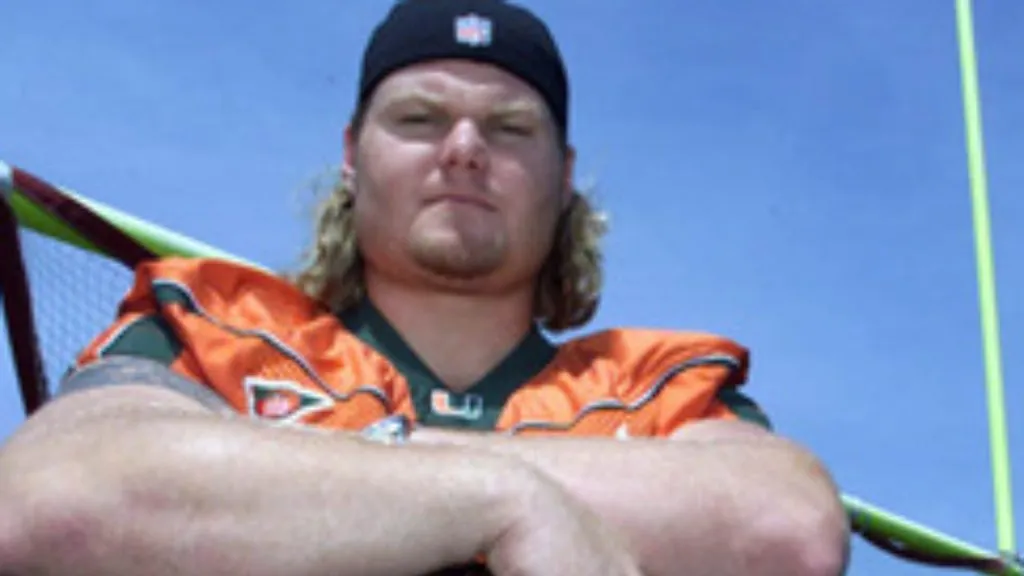
Brett Romberg (Source: UM Sports Hall of Fame)
Less celebrated but vital to Miami’s powerhouse offense of the early 2000s, Brett Romberg anchored a line that powered 35 wins in 37 games—including the 2001 national title and BCS bowls.
A consensus All-American in 2002, he won the Rimington Trophy as the nation’s top center and rarely allowed a sack—except the famed break against Ohio State in the Fiesta Bowl.
Cam Ward, QB
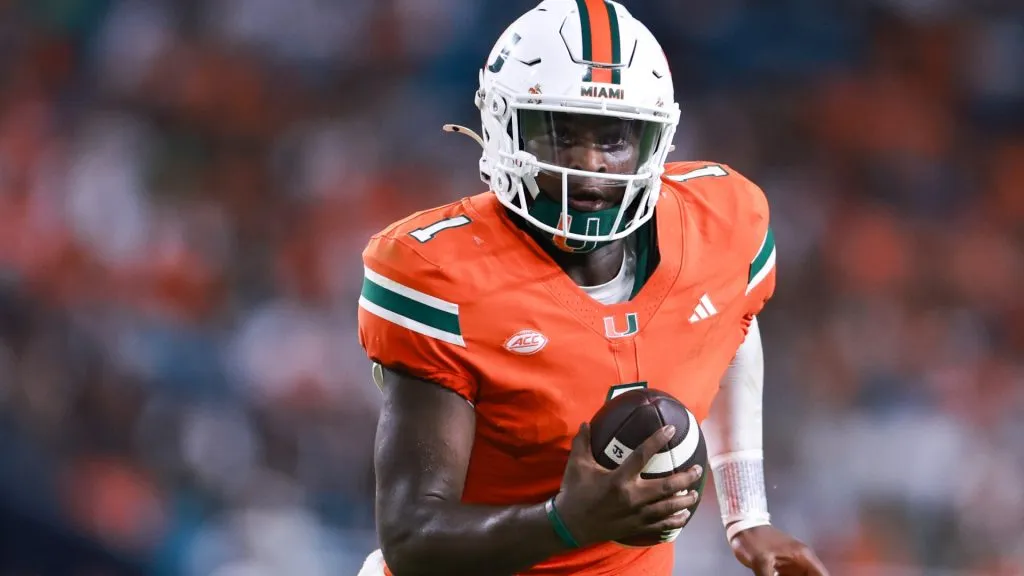
Quarterback Cam Ward #1 of the Miami Hurricanes rushes for a touchdown against the Florida A&M Rattlers during the second half at Hard Rock Stadium on September 07, 2024. (Source: Carmen Mandato/Getty Images)
Though just beyond your original list, Cam Ward’s recent Miami legacy is impossible to ignore. A zero-star recruit turned first-overall NFL Draft pick in 2025, he shattered Miami’s passing records and earned ACC Player of the Year and Davey O’Brien Award honors in a breakout season. His trajectory—from overlooked to elite—caps the “Coral Gables to glory” narrative with a modern flourish.