
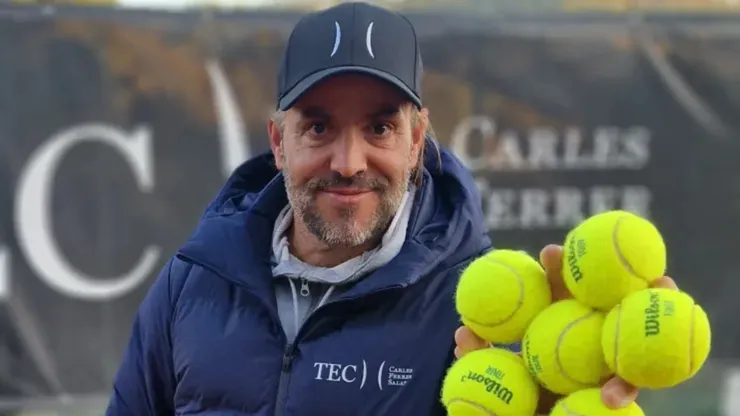
Spain has long been a tennis powerhouse, producing legends like Manuel Santana, Carlos Moyá, and Albert Costa. Rafael Nadal stands as the crown jewel of Spanish tennis, with a career that rewrote the sport’s history. Today, young sensation Carlos Alcaraz carries the torch, aiming to cement his place among the all-time greats. Yet, among the stars, there’s a story often overlooked—that of Roberto Carretero, a talented player whose career was derailed by injuries.
Carretero, who captured the junior title at Roland Garros in 1993, was hailed as a future clay-court star. However, injuries and mental health struggles forced him to retire at just 26 years old. Despite his abbreviated career, Carretero remains connected to the sport, contributing as a broadcaster and staying active in the tennis community.
Roberto Carretero first made headlines in 1993 when he won the Roland Garros junior title, a moment he described as life-changing. “That moment changed my life,” Carretero told Relevo in 2024. “Until then, my parents had financed my career. Winning Roland Garros at 17 transformed everything, both financially and professionally. I wasn’t even the favorite, but I went there and won”.
Transitioning to the professional circuit proved more challenging. By 1996, Carretero achieved his lone ATP title, winning the Hamburg Masters 1000 in a surprising run. “The transition from junior to pro wasn’t easy,” he explained. “It took longer for me than for players like Albert Costa or Marcelo Ríos. Hamburg came out of nowhere—I wasn’t even a favorite. I played qualifiers and went on an incredible run”.
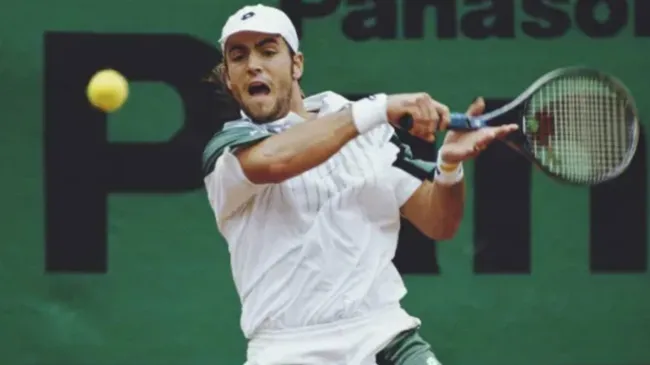
Roberto Carretero during the 1996 Hamburg Open against Alex Corrretja. (Stu Forster/Allsport/Getty Images)
Retiring at 26: Injuries and mental health
Carretero’s career was plagued by injuries, particularly recurring shoulder issues that required four surgeries. The constant setbacks left him ranked no higher than 53 in the ATP standings and eventually led to his early retirement. Reflecting on his struggles, Carretero shared, “I’ve had shoulder problems since I was 13, and in this sport, if you don’t have continuity, it’s incredibly tough”.
He also opened up about the mental health challenges he faced. “What today is diagnosed as mental health issues wasn’t even recognized back then. People just said, ‘What’s wrong with this guy?’ But I was dealing with something very real. I started doubting myself, thinking I wasn’t cut out for this, even though I had top-ten potential. That’s a hard thing for a 20-year-old to handle”.
A close friendship with Rafael Nadal
Despite an 11-year age gap, Carretero and Rafael Nadal share a close bond. “Rafa is a great person and a great friend,” Carretero said. “I’ve known him since he was 14. We’ve shared a lot of moments together. As a tennis player, he’s a true example at every level. If we’re talking about role models, he’s possibly the greatest”.
Carretero also explained why he places Nadal above Roger Federer and Novak Djokovic in tennis history. “Federer is flawless on the court, but given how good he is, he’s won relatively little. Djokovic never misses, never gets injured. But Rafa? He’s had to overcome so much—injuries, adversity, and more. He’s had to be more strategic and work harder than anyone to reach the top. For me, that puts him above the rest”.
Staying connected to tennis
Since retiring in 2001, Carretero has stayed deeply involved in tennis. He transitioned into media, working as a commentator for Movistar+. A regular presence at major tournaments worldwide, Carretero has also embraced social media, sharing photos with past and present stars, including young phenom Carlos Alcaraz.
While his playing days ended prematurely, Carretero’s contributions to the sport endure—whether in the broadcast booth or through his enduring friendship with Nadal. A player who once showed immense promise, Carretero remains a respected voice in the tennis world and a proud ambassador for Spanish tennis.