
The College Football Playoff National Championship brings more than a trophy to Miami. As Indiana and Miami meet on the NCAAF’s biggest stage, the financial stakes quietly rise alongside the pressure of the moment.
Behind the celebration and confetti lies a complex system of payouts, conferences and incentives. Winning the title doesn’t just secure a place in history, it triggers financial rewards that ripple far beyond the locker room.
Numbers are shaped by revenue sharing, conference structures and postseason performance, creating a financial map that reaches athletic departments, future investments and even recruiting power long after the game is decided.
2026 College Football Playoff National Championship prize money
Unlike professional sports with a single “winner’s purse,” the College Football Playoff distributes revenue based on how far a team advances through the postseason.
For the 2025–26 CFP season, each participating school’s conference earns $4 million simply for making the 12-team playoff field, then another $4 million for reaching the quarterfinals, $6 million for advancing to the semifinals, and an additional $6 million for earning a spot in the national title game itself.

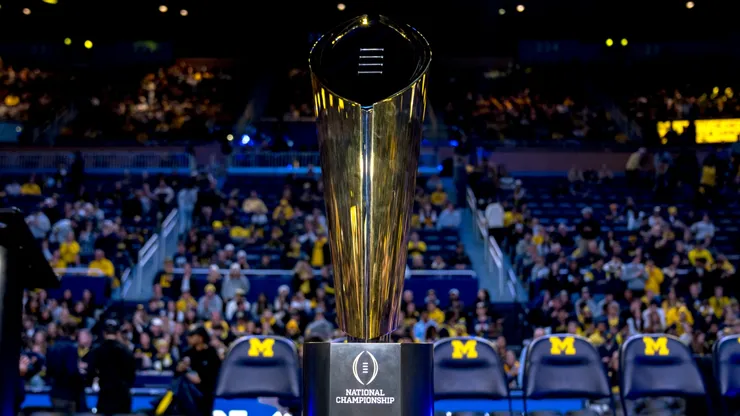
The College Football Playoff National Championship Trophy (Source: Maddie Meyer/Getty Images)
That system means that a school playing in the 2026 National Championship between Miami and Indiana will have generated a total of $20 million in CFP revenue for its conference from performance alone. On top of that, teams also receive about $3 million per round in travel and operational stipends as part of the playoff distribution.
However, what ultimately lands in each school’s budget depends on conference revenue-sharing policies. For example, the ACC allows Miami to retain 100 % of the money it earned through its CFP run, meaning the Hurricanes stand to keep the full $20 million payout.
Other conferences, like the Big Ten or SEC, typically pool CFP earnings and redistribute them among all member schools, spreading the financial impact more widely.