

France arrive at the 2026 World Cup as one of the top title contenders, boasting a history that places them among the absolute powerhouses of global soccer. The “Bleus” competed in the first-ever World Cup in Uruguay in 1930 and have since built a journey marked by legendary generations, championship titles, unforgettable finals, and records that still stand today.
With 17 World Cup appearances, two stars, and four finals played, the French national team has established itself as one of the most successful squads of all time, consistently ranking as one of the best-performing teams in the tournament.
France have won the World Cup twice. The first breakthrough came on home soil in France 1998. As hosts, the team managed by Aime Jacquet conquered its first World Cup title after defeating Brazil 3-0. From there, they secured their second title with the next great crop of players in 2018, where an in-prime Kylian Mbappe and Antoine Griezmann helped them defeat Croatia 4-2 in the final in Qatar.
France’s World Cup history
Their bond with the World Cup began in Uruguay 1930, where they starred in a historic moment, defeating Mexico 4-1 in the first match in tournament history as Lucien Laurent scored the first-ever recorded World Cup goal. However, the early decades were defined by inconsistency. France alternated between qualification and early exits in 1934, 1938, 1954, 1966, and 1978, struggling to establish themselves among the world’s elite national teams.
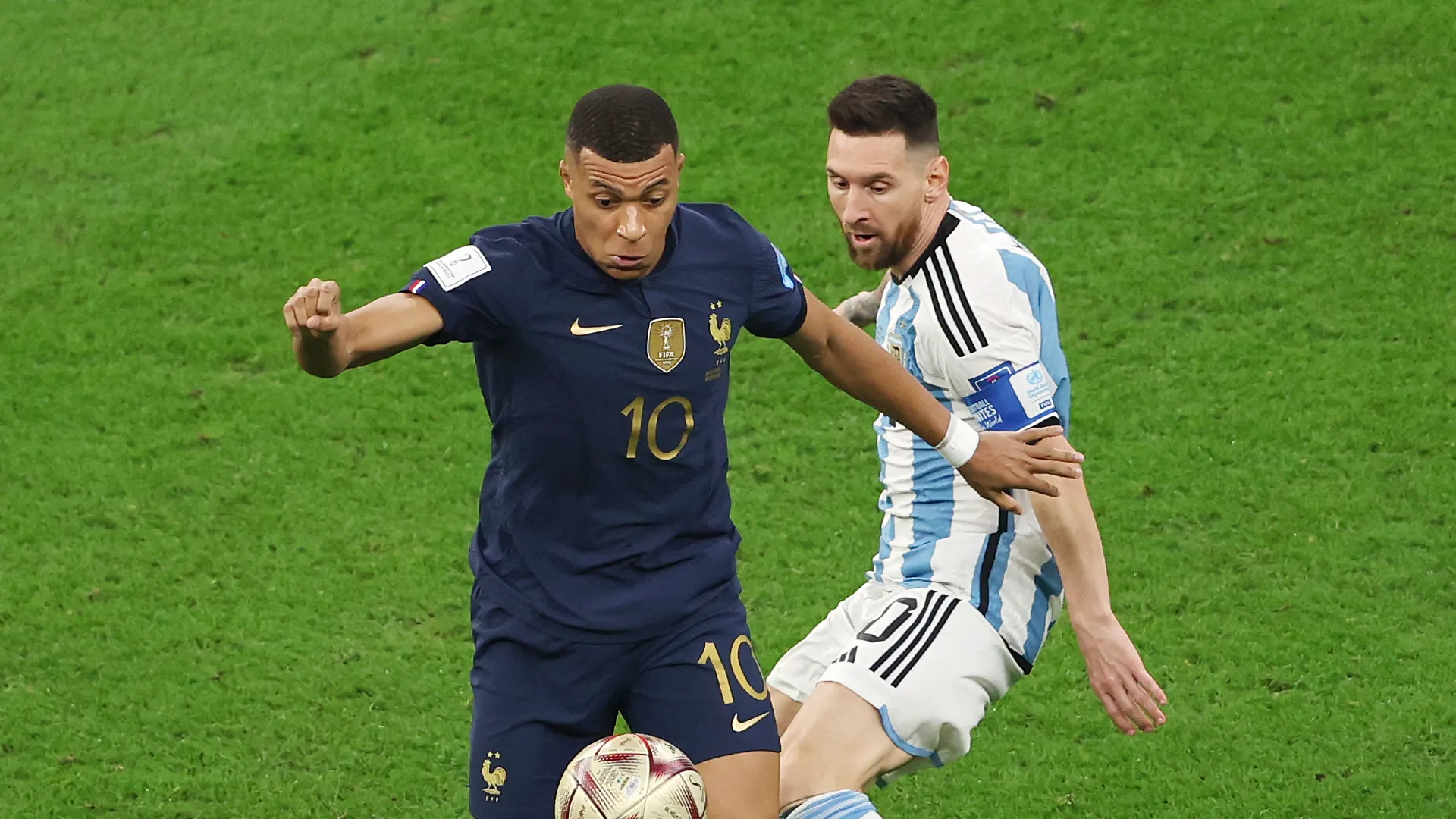
Kylian Mbappe of France and Lionel Messi of Argentina.
The first major leap forward came in Sweden 1958, when they secured a third-place finish thanks to one of the most extraordinary individual performances in World Cup history. Just Fontaine scored 13 goals in just six matches, a record that no player has managed to break to this day. That generation, led by Fontaine and Raymond Kopa, paved the way for France to be recognized as an international powerhouse.
Definitive consolidation arrived in the 1980s with a generation spearheaded by Michel Platini, Alain Giresse, Jean Tigana, and Luis Fernandez. In Spain 1982, they reached the semifinals after a memorable campaign that featured a historic clash against West Germany in Seville—widely considered one of the greatest games ever—where they fell on penalties after a 3-3 draw. Four years later at Mexico 1986, they again finished among the top four teams in the world, starring in another unforgettable match by eliminating Brazil on penalties in the quarterfinals before falling once more to Germany.
The golden generations
The ultimate explosion occurred in France 1998. As tournament hosts, the team led by Aime Jacquet captured its first World Cup by defeating Brazil 3-0 in the final at the Stade de France. Zinedine Zidane, who scored twice in that championship match, became the symbol of an unrepeatable generation that permanently altered the course of French soccer. That title marked the start of a golden era that firmly placed France within the global elite.
Success returned in Russia 2018 with a new generation of stars. Under the guidance of Didier Deschamps, France conquered their second World Cup by defeating Croatia 4-2 in the final, powered by players like Antoine Griezmann, Paul Pogba, N’Golo Kante, and a young Kylian Mbappe.
French consistency remained on full display at Qatar 2022. Despite arriving with a squad depleted by numerous injuries, they reached the final once again and came within minutes of securing back-to-back titles. In a final considered by many to be the greatest in World Cup history, they drew 3-3 with Argentina following a hat-trick from Mbappe, ultimately falling in a penalty shootout. The French forward finished as the tournament’s top scorer with eight goals, becoming the first player since Geoff Hurst to score three goals in a World Cup final.