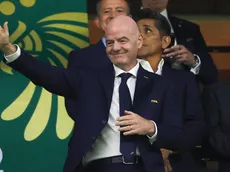

With the 2026 World Cup just months away, FIFA President Gianni Infantino has confirmed that a massive overhaul of the offside law is officially on the table. Addressing the World Sport Summit in Dubai, Infantino acknowledged that FIFA is seriously considering a proposal spearheaded by Arsene Wenger, the organization’s Chief of Global Football Development.
Specifically, the Wenger’s proposal stipulates that an attacking player is considered onside as long as any part of their body capable of legally scoring a goal is in line with the penultimate defender. This would apply even if the rest of the attacker’s body has already moved past the defensive line.
Under this new interpretation, an offside offense would only be flagged if there is total separation between the attacker and the defender. By requiring “clear daylight” between the two players, FIFA aims to eliminate the ongoing controversies surrounding goals disallowed by the width of a shoulder or a knee.
If implemented, this shift would provide a significant advantage to offensive play, theoretically increasing scoring and reducing the frequent VAR stoppages that currently plague the game.

Arsene Wenger, the FIFA’s Chief of Global Football Development. (Getty Images)
Infantino discusses the ‘Wenger Law’
During his presentation Infantino framed the potential adoption of the “Wenger Law” as the next logical step in soccer technological evolution. Reflecting on the introduction of Video Assistant Referees, Infantino noted that the goal has always been to ensure fairness.

“Years ago, we introduced VAR to make soccer fairer, to give the referee the opportunity to correct an error that millions of people, at home or even in the stadium, might have seen,” Infantino explained. He emphasized that the system is not static but rather an ongoing project. “We continue to improve VAR with increasingly advanced technology to help referees make the right decision“.
“We continue to examine the rules, asking ourselves how we can make the game more offensive, more attractive,” Infantino added. “Consider the offside rule, which has evolved over the years and requires the attacker to be behind the defender or in line with him: perhaps in the future, he will have to be completely ahead to be offside“.
Infantino also addressed one of the most common criticisms of modern officiating: the length of time it takes to reach a decision. Beyond changing the rules of the game, FIFA is looking for ways to keep the clock moving.
“We are also evaluating measures to avoid time-wasting,” he cautioned. “It is important for the game to flow smoothly, so interruptions must be minimized”. This aligns with recent trials of the “eight-second rule” for goalkeepers and more efficient VAR communication aimed at protecting the pace of the game.
Will the new offside rule be implemented for the 2026 World Cup?
As of now, Infantino has only confirmed that the new offside law is being discussed internally at FIFA. Like any major change to the rules of the game, the proposal must be formally approved by the International Football Association Board (IFAB)—the body composed of FIFA and the four historic British associations (England, Scotland, Wales, and Northern Ireland).
If the rule receives a “green light” from the board, FIFA will then have to decide the timing of the rollout. While the goal is to revolutionize the sport, the governing body must weigh whether to implement such a massive change just months before the 2026 World Cup or wait until the start of the 2026-27 domestic season.