

The 2025 Concacaf Gold Cup is underway in the United States, featuring national teams from North America, Central America, and the Caribbean. While the tournament is still in its opening stage, knockout matches are just around the corner—and that’s when extra time could come into play.
The Gold Cup begins with a group stage, which kicked off last Saturday and will run through next Wednesday. The 16 participating teams are divided into four groups, from which eight will advance to the quarterfinals. From that point forward, all matches are single-elimination, meaning one team must win and the other must go home.
Extra time is a special period added to certain matches to break a tie after 90 minutes of regulation and determine a winner. It’s only used when a draw is not a viable outcome, such as in knockout rounds where a winner must be decided.
However, the 2025 Concacaf Gold Cup rules apply this format selectively. “If both teams are tied at the end of regular time during the Quarterfinals and Semifinal stage matches, no extra time will be played and kicks from the penalty spot procedure will take place,” states Article 12.12.
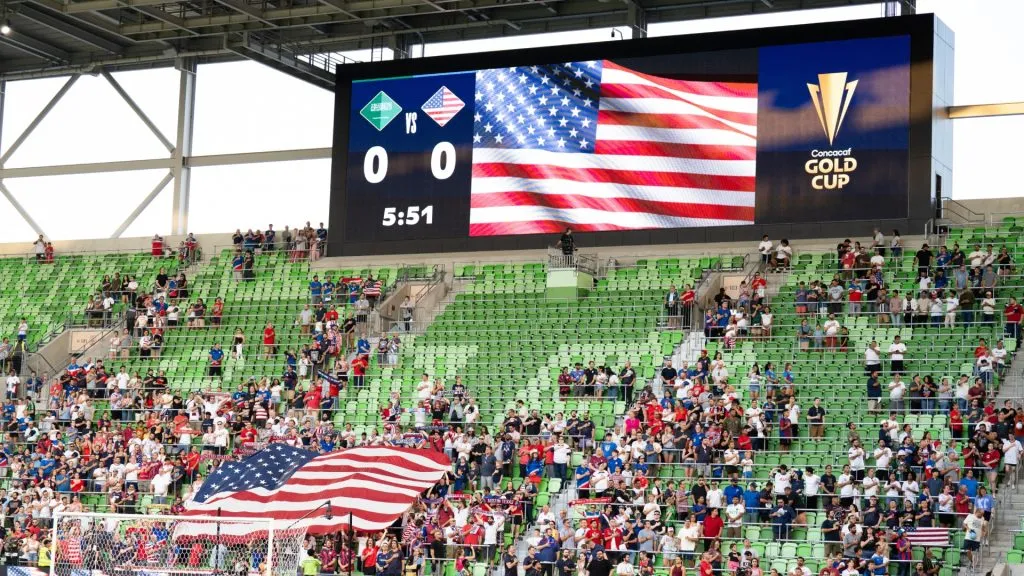
The United States is hosting the 2025 Concacaf Gold Cup.
The next clause lays out the only instance in which extra time can be used in the 2025 Gold Cup: “If both teams are tied at the end of regular time during the Final Match, extra time will be played… If the score is tied at the end of extra time the match will go straight to kicks from the penalty mark.”

How does extra time work?
The standard format for extra time in global soccer consists of 30 minutes of additional play, divided into two 15-minute halves. At the end of the first half, teams switch sides, just as they do after the first 45 minutes of regulation. Referees can also add stoppage time during extra time to account for interruptions.
It’s important to note that the full 30 minutes must be played regardless of what happens during that period. This wasn’t always the case. A few decades ago, the sport featured the “golden goal” rule, where the first team to score in extra time would win the match instantly.
There was also the “silver goal” rule, which didn’t end the match immediately after a goal. Instead, the half in which the goal was scored would be played to completion. The opposing team then had until the end of that half to equalize, or else lose the match.
Extra time details
When a match ends in a tie after regulation and extra time is required, additional provisions are allowed to help teams manage player fatigue. During regulation, each team is allowed five substitutions, which must be made across four separate stoppages (three substitution windows during play, plus halftime). Coaches can distribute those substitutions however they see fit within the allowed windows.
Extra time introduces further flexibility. “If extra time is played, each team will have one (1) additional substitution and one (1) additional substitution opportunity,” the Gold Cup regulations state. “Therefore, each team will be allowed a total of six (6) substitutions and four (4) substitution opportunities.”
SurveyWho is going to win the 2025 Gold Cup?
Who is going to win the 2025 Gold Cup?
ALREADY VOTED 0 PEOPLE