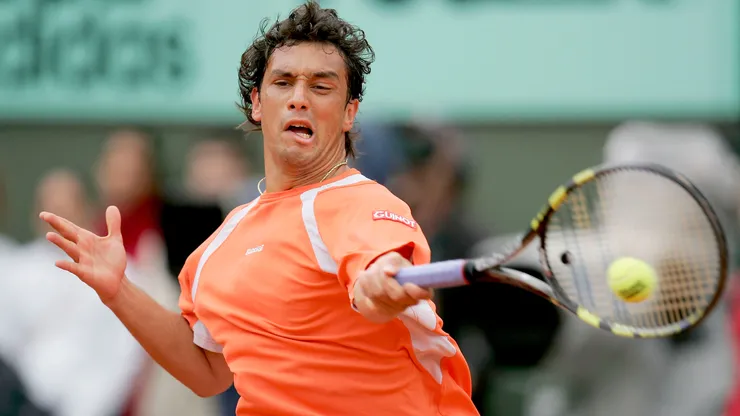
Mariano Puerta’s career was anything but ordinary. Born in Cordoba, Argentina, he moved to Buenos Aires as a teenager to pursue tennis professionally, inspired by countryman Guillermo Vilas.
Results came quickly, especially on clay. As a junior, his biggest achievement was reaching the Roland Garros boys’ final in 1995 against Mariano Zabaleta, though he fell short of the title.
Still, Puerta’s promise was clear. By 1998, he broke through on the ATP Tour, capturing his first career title in Palermo, Italy, against fellow Argentine Franco Squillari. The year 2000 marked his real emergence. He was second only to Guga Kuerten in clay-court victories, winning the Bogota Open and reaching finals in Mexico City, Santiago, Gstaad, and Umag.
Injuries and mental struggles
But Puerta’s rise was derailed by a serious wrist injury while training with coach Hernan Gumy. The setback shook him both physically and mentally. “It happened while warming up with Hernan Gumy. First ball, he hit it softly, I set up my forehand, swung, and felt a tremendous pain. That year I ended up playing with injections. The injury got worse until we decided on surgery, which I had in the United States. That’s when instability in my career began, along with mental struggles,” Puerta told La Nacion.
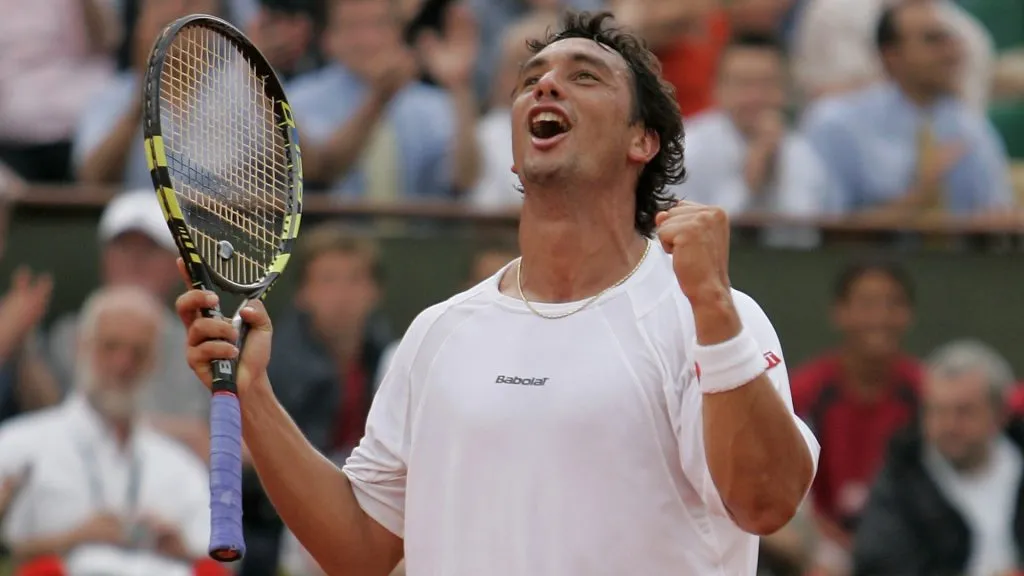
Mariano Puerta celebrates a match point against Nikolay Davydenko during the 2005 Roland Garros. (Clive Mason/Getty Images)
His return was rocky. Puerta later admitted it took him time to realize he needed psychological help. “In 2002 I wasn’t bouncing back. I felt 100 percent responsible for the failure of my comeback after surgery. I was so aware of it that during many tournaments I was hurting myself on purpose—sometimes hitting balls out deliberately, not being humble, not chasing certain shots. It takes a lot of humility to succeed. Having so much success at a young age can make you arrogant. There was a moment when I said: ‘Either I forgive myself or this ends here. I couldn’t go on like that,’” Puerta recalled.
The first doping case
By 2003, Puerta was rebuilding his form. But at the ATP tournament in Viña del Mar, after losing to fellow Argentine Agustin Calleri, he tested positive for clenbuterol, a banned substance. He was suspended for nine months.
“After that match in Chile, I had a doping test—everything seemed normal. Months later they told me it was positive. I thought, ‘What is this? Oh, the medicine!’ I cannot believe it!,” Puerta said.
The comeback and Roland Garros run
Cleared to compete again in mid-2004, Puerta mounted an impressive comeback. He reached the Buenos Aires final in 2005, then won his third ATP title in Casablanca by defeating Juan “Pico” Monaco.
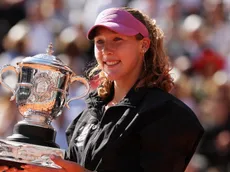
That set the stage for the best run of his career: the 2005 Roland Garros. Puerta advanced to the final, where he faced a young Rafael Nadal, who was seeking his first Grand Slam title. Puerta stunned the Spaniard by taking the opening set 7–6, but Nadal stormed back to win the next three and claim his maiden major crown.
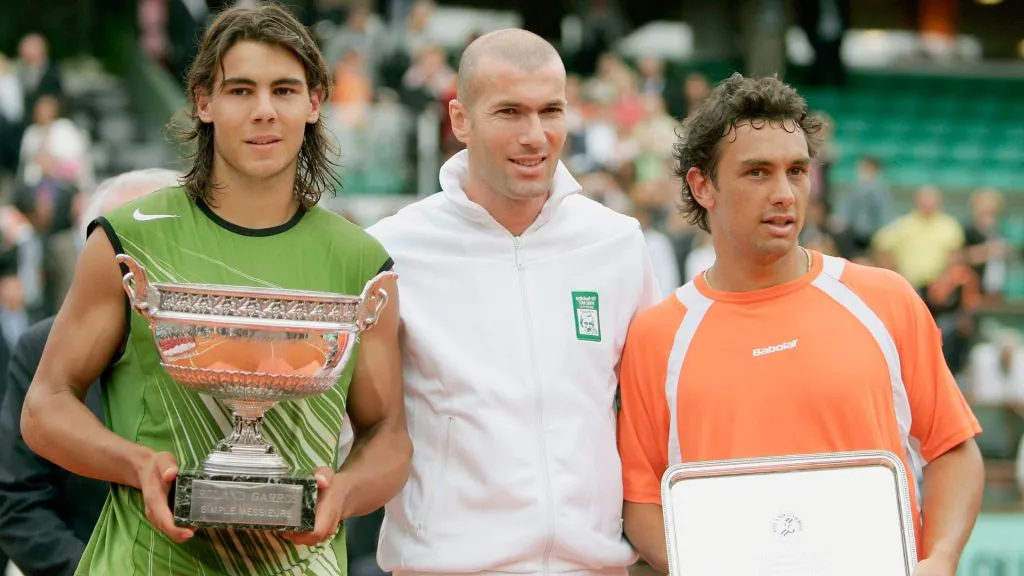
Rafael Nadal and Mariano Puerta pose with Zinedine Zidane after the 2005 Roland Garros final.(Clive Mason/Getty Images)
The second doping case and career collapse
Days later, Puerta’s career unraveled. A drug test from Roland Garros came back positive, this time for epinephrine. Puerta argued the trace amount found in his body came from accidentally drinking from his wife’s water bottle, which contained medication.
The penalty was severe: an eight-year suspension, effectively a career-ending sanction. In 2006, the Court of Arbitration for Sport reduced it to two years, allowing him to return in 2007. He won a Challenger in Bogota in 2008, but he never came close to his previous heights. In truth, that 2005 Roland Garros final would remain the defining match of his career—the peak and the turning point.
A career of highs and lows
Despite the controversies, Puerta still left his mark on Argentine tennis. He reached a career-high ranking of World No. 9 in August 2005 and played a crucial role in Argentina’s Davis Cup win over Australia that same year, teaming with David Nalbandian to defeat Wayne Arthurs and Lleyton Hewitt in doubles on grass.