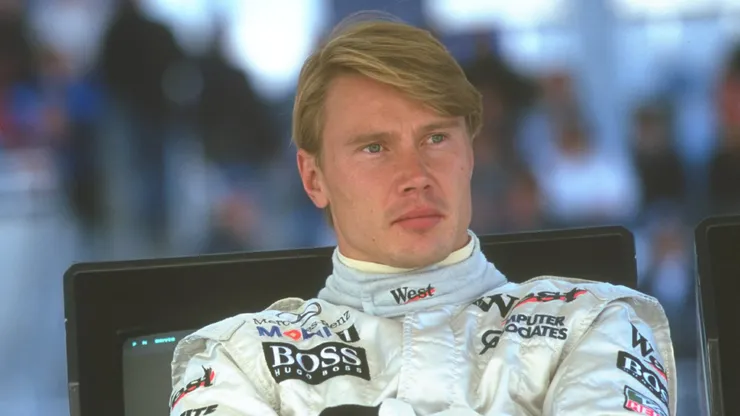
Formula 1 is widely known as one of the most dangerous sports in the world. Many drivers have endured serious accidents, leading to some of the sport’s most inspiring comebacks. One of them was Mika Häkkinen, the ‘Flying Finn,’ who nearly lost his life in 1995 but fought back to become a two-time champion.
He was born on September 28, 1968, in Vantaa, Finland. From a young age, he showed an interest in speed and competition. His parents, though not wealthy, supported his passion by buying him a used go-kart when he was just five years old.
Häkkinen quickly made a name for himself in Finnish karting championships, winning several national titles. His calm demeanor off-track and fierce determination on it made him stand out. He progressed through the ranks of junior formulas, competing in Formula Ford and Formula 3, where he became British F3 champion in 1990.
That victory opened the doors to Formula 1, and he made his debut with Team Lotus in 1991. While the car was far from competitive, he impressed with his raw speed and consistency. In 1993, he became a test driver for McLaren and soon replaced Michael Andretti in the race seat. His early years at McLaren were tough as the team was rebuilding, and victories seemed far out of reach.
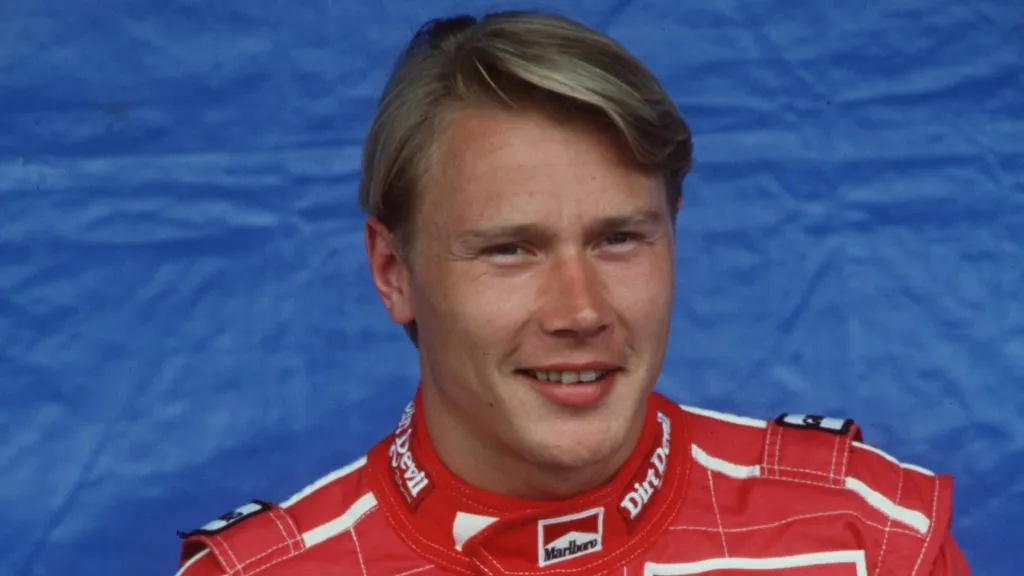
Mika Hakkinen in 1994 (Pascal Rondeau/ALLSPORT)
The 1995 crash: A fight for life
On November 10, 1995, during practice for the Australian Grand Prix in Adelaide, Häkkinen suffered one of the most frightening crashes in F1 history. A tire failure sent his McLaren into the barriers at high speed, leaving him with a fractured skull and requiring an emergency tracheotomy at the track to save his life.
“My accident in ’95 was quite a challenge,” Häkkinen said while appearing in Motorsport Heroes, a film by Manish Pandey for Motorsport.tv in 2020. “This happened in Australia, in Adelaide, I was going flat out on a long straight. Just when I was entering the corner, it didn’t explode, it just pfffffft – lost the pressure very quickly,” he explained.
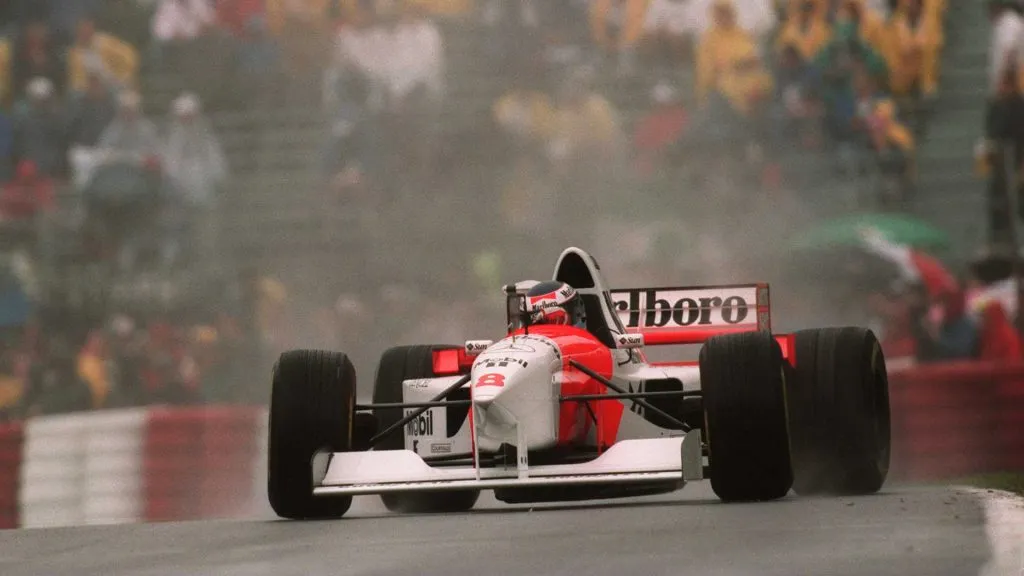
Hakkinen during the 1995 Canadian Grand Prix (Mike Powell/ALLSPORT)
“So the car started bottoming, and I lost control of course. There was a massive curb on the exit, and of course I hit the curb and the car bounced a couple of times. I hit the barrier sideways,” he said.
His process of recovery was difficult. “I was in a coma for a few days. Then the horrible things start when you wake up. You start realizing like ‘oh my God’. I banged [my head] so hard that I lost control of one side of my face, because the nerves got damaged. So when I was sleeping they had to tape over one of my eyes, to make it close,” Hakkinen revealed.
After spending five weeks in Australia, many thought his career was over. But Häkkinen not only recovered, but he returned to the grid for the following season. A few years later, he would reach glory.
Rivalry with Michael Schumacher and Championship glory
By 1998, McLaren had built a car capable of winning, and Häkkinen seized the moment. His rivalry with Ferrari’s Michael Schumacher reached its peak that year. The two pushed each other to the limit, with mutual respect despite fierce on-track battles.
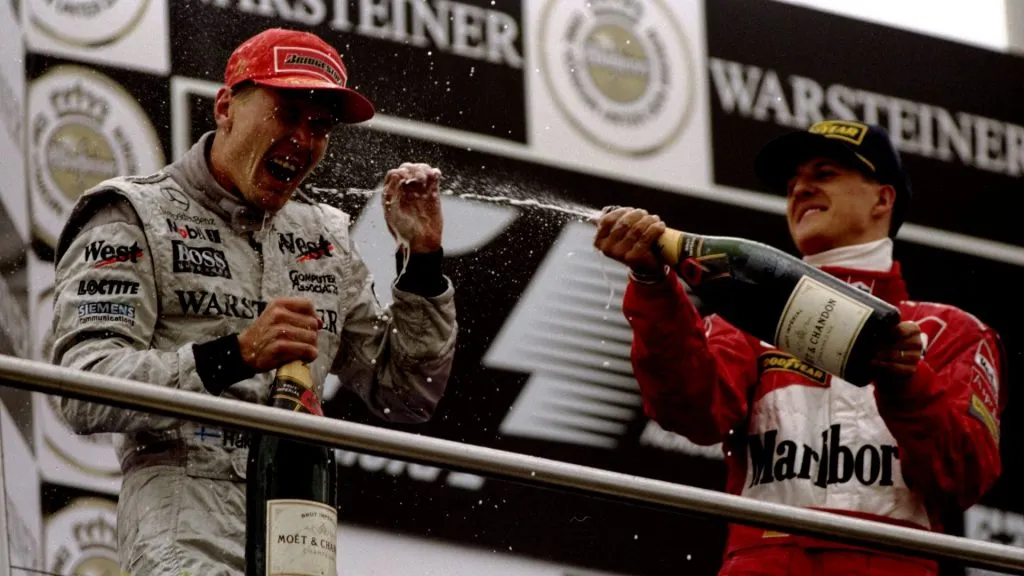
Mika Hakkinen is sprayed with champagne by championship rival Michael Schumacher after the Luxembourg Grand Prix in 1998 (Clive Mason /Allsport)
Häkkinen’s flawless driving and cool head under pressure earned him his first World Championship in 1998. He became a hero in Finland and a respected champion worldwide.
The following year, the battle intensified. Schumacher’s Ferrari was stronger. However, the German pilot suffered an accident, breaking his leg, which forced him out of six races. In the end, this helped Häkkinen clinch his second consecutive World Championship.
By the 2000, the competition between the two pilots continued and the title was decided until the last races. In one of the most iconic moments in F1 history, at the 2000 Belgian Grand Prix, Häkkinen pulled off a daring overtake on Schumacher, going around him while simultaneously passing Ricardo Zonta. However, Schumacher took the championship at the Japan Grand Prix.
His retirement was influenced by his accident
In an interview with GP Racing magazine in 2020, Hakkinen was asked if he felt that the accident had slowed him down any. “No, I don’t think I would have been quicker, but I think I would have continued my career longer,” he replied.
“It had an effect on me. It made me realise that when an accident like that happens – and it can happen at any time in F1 because motorsport is dangerous. It made me think, as soon as I won my world championships, ‘Hmmm… don’t push your luck any further,’” he admitted.
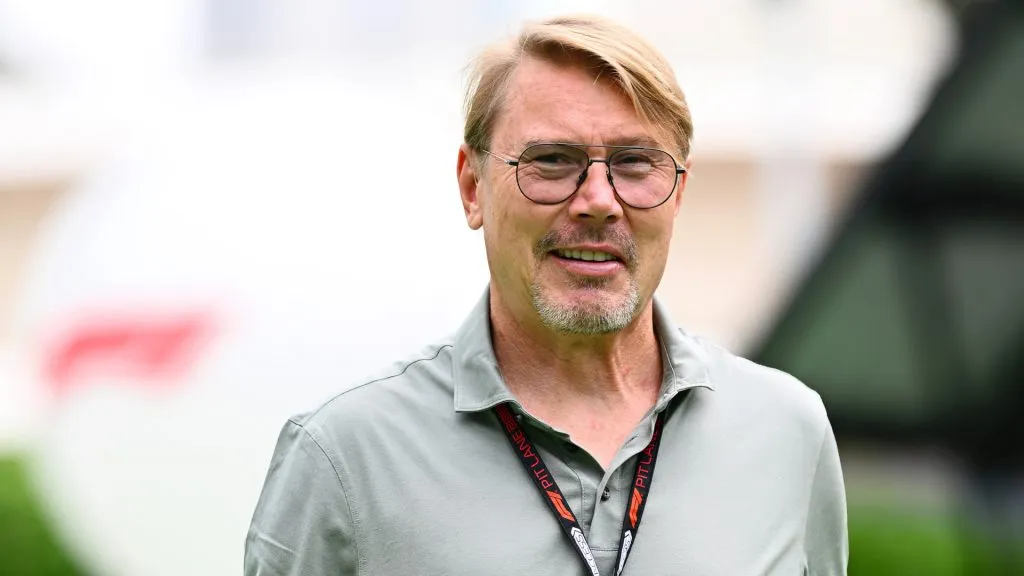
Mika Hakkinen walks on the paddock during the practices for the GP Singapure (Clive Mason/Getty Images)
So, after a difficult season in 2001, in which he couldn’t maintain the pace due to his car, he announced his retirement. However, he won his second-to-last career at the United States GP in Indianapolis. He left his seat to his countryman Kimmi Räikkönen.
Häkkinen’s story is still considered as one of the most inspiring tales in the history of F1. Today, he is remembered not just as a two-time World Champion but as a symbol of never giving up.