

FIFA has finalized plans for the 2026 World Cup, which will feature several historic changes. For the first time, the tournament will expand to 48 teams (up from 32 since France 1998), run for over five weeks, and span three host nations: the United States, Canada, and Mexico.
Despite these plans, new challenges have surfaced, particularly for some U.S. host cities. Climate change poses a significant threat, according to a study by Queen’s University Belfast, as reported by ABC News.
The study projects a sharp increase in humidity and solar radiation in the Northern Hemisphere during the summer of 2026, coinciding with the World Cup schedule. These conditions could severely impact player performance and increase the risk of heat-related health issues.
To mitigate the risk, researchers have suggested delaying game times to avoid the hottest parts of the day. Another potential solution is installing air conditioning in stadiums, as seen during the Qatar 2022 World Cup.
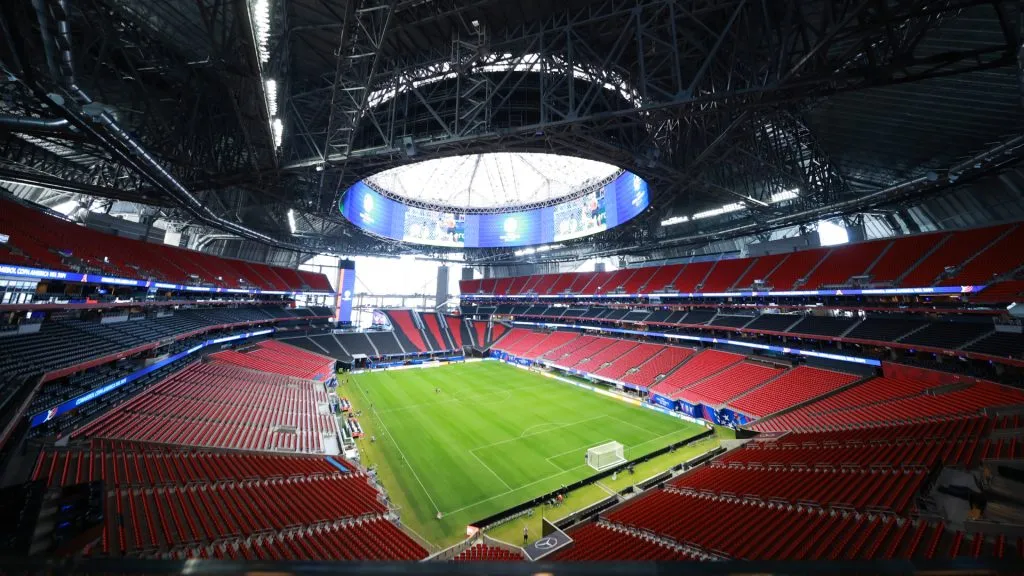
General view of Mercedes-Benz Stadium, one of the three stadiums with air conditioning. (Hector Vivas/Getty Images)
Currently, only three of the 16 selected U.S. venues—Dallas’ AT&T Stadium, Houston’s NRG Stadium, and Atlanta’s Mercedes-Benz Stadium—are equipped with such technology.

Unlike Qatar, where games were held in November and December to take advantage of cooler winter weather, the 2026 World Cup will take place in the height of summer. Temperatures are expected to exceed 40°C with oppressive humidity, presenting significant challenges for players, officials, and fans alike.
Lessons from the 2024 Copa America
The 2024 Copa America, held in the United States, provided a glimpse into what to expect in 2026. During a match between Peru and Canada, a referee collapsed due to an apparent heat-related illness.
Jessica Murfree, assistant professor of sports administration at the University of North Carolina at Chapel Hill, shared her insights with ABC News. “I think we already have the context for the 2026 FIFA World Cup because we just witnessed the Copa America tournament in North America,” Murfree said. “That competition serves as an excellent litmus test on heat-related risks we can expect in 2026”.
A look back: The 1994 World Cup final
The risks of extreme heat were not as well-documented during the 1994 World Cup, hosted by the United States. The final between Brazil and Italy at the Rose Bowl in Los Angeles kicked off at 12:30 PM to accommodate television audiences in South America and Europe.
While no heat-related incidents were reported, the temperature on that day soared to 40°C. The rising threat of climate change has made such conditions even more dangerous, highlighting the need for proactive solutions ahead of 2026.