

In 2023, the ATP Tour introduced significant changes to several Masters 1000 tournaments, expanding events like Madrid, Rome, and Shanghai to two weeks and increasing the singles draw size to 96 players. Against this backdrop, World No. 2 Carlos Alcaraz recently shared his perspective on the adjustments made by the ATP.
This year, the extended format was also implemented at Indian Wells and will roll out at the Canadian Open and Cincinnati Open. Before these changes, seven of the nine Masters tournaments were one-week events with 56-player draws, while Indian Wells and Miami lasted 10 days. Monte Carlo and Paris are the only Masters tournaments that will maintain their traditional one-week schedule.
Speaking after reaching the quarterfinals of the Barcelona Open, Alcaraz addressed the topic and expressed his preference for the original format, which he believes benefits the sport.
“The one week ones are better. Some will think that in two weeks there are days of rest, but that is not the case,” the four-time Grand Slam champion explained. “You train, you have to mentally prepare for the game, prepare for it… you’re not resting, really. It’s two full weeks. That’s why I prefer the one-week Masters 1000. For me, it’s better for tennis”.
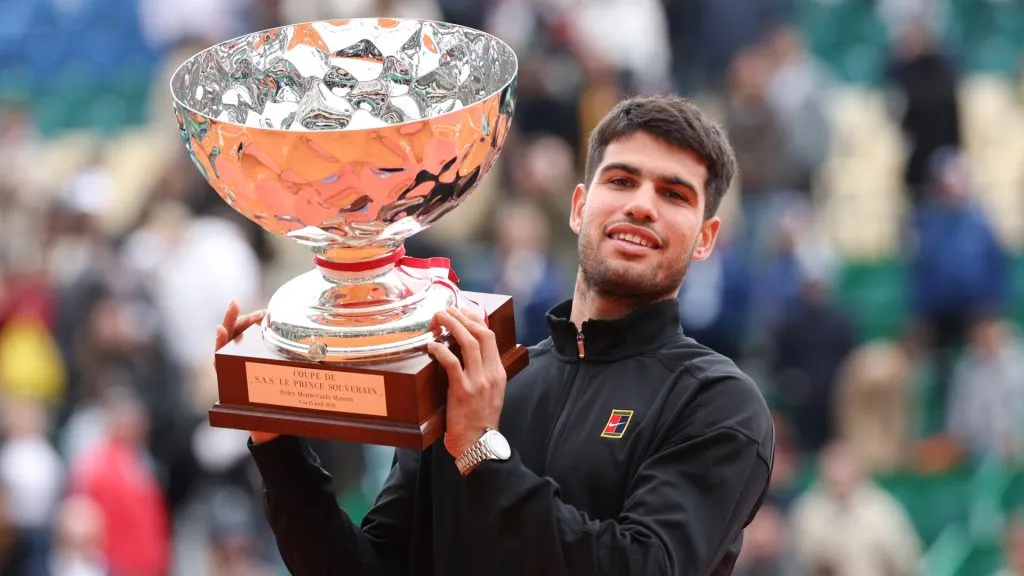
Carlos Alcaraz of Spain holds the Monte Carlo trophy after winning the final of the singles against Lorenzo Musetti of Italy. (Clive Brunskill/Getty Images)
Stefanos Tsitsipas slams two-week Masters format
Former World No. 3 Stefanos Tsitsipas offered sharp criticism of the ATP Tour’s new two-week Masters format, especially after competing in the 2024 Paris Masters, which still follows the original one-week schedule.

“The two-week Masters 1000s have turned into a drag. The quality has definitely dropped,” Tsitsipas posted on X (formerly Twitter). “Players aren’t getting the recovery or training time they need, with constant matches and no space for the intense work off the court”.
Tsitsipas praised Paris for maintaining the one-week schedule, arguing it preserved the excitement and simplicity fans enjoy. “It’s ironic that the @atptour committed to this format without knowing if it could actually improve the schedule, but the quality likewise. Paris got it right, done in a week,” he continued. “Exciting and easy to follow. Just how it’s supposed to be”.
Finally, Tsitsipas didn’t hold back, calling the ATP’s decision a step backward for the sport. “If the goal was to ease the calendar, extending every 1000 to two weeks is a backwards move,” Tsitsipas concluded. “Sometimes, it feels like they’re fixing what wasn’t broken”.