
Beyond the passion in the stands, the intensity on the pitch, and the anticipation of watching the world’s elite gather in one place, the World Cup has occasionally been defined by refereeing decisions that fundamentally altered the tournament. In the most egregious cases, these critical blunders have left the sport’s biggest stage under a cloud of intense scrutiny.
One could argue that many historical refereeing errors came down to a simple lack of technology—tools that will be readily available at the 2026 World Cup—and were nothing more than “human error.” However, the following infamous cases went far beyond honest mistakes, ultimately forcing FIFA to completely re-evaluate how it selects and vets match officials.
From a player receiving three yellow cards in a single match to “ghost goals” that were painfully obvious to an entire stadium but missed by the referee, we look back at the worst officiating disasters in World Cup history, several of which forced radical rule changes and birthed modern soccer technology.
Three yellow cards to the same player (2006 World Cup)
This entry makes the list not for altering a tournament outcome, but for a sheer, unprecedented breakdown in refereeing mathematics. Highly regarded English official Graham Poll, handling a high-stakes group-stage match between Croatia and Australia, somehow managed to brandish three separate yellow cards to Croatian defender Josip Simunic before finally sending him off.
Poll later explained that due to Simunic’s thick Australian accent, he accidentally logged the second yellow card under the name of Australia’s No. 3 (Craig Moore) instead of Croatia’s No. 3. The high-profile blunder cost Poll his chance to officiate in the knockout rounds, and he retired from the international circuit shortly after.
Byron Moreno’s nightmare officiating (2002 World Cup)
The 2002 World Cup was plagued by controversial calls favoring the co-hosts, but South Korea’s Round of 16 clash against Italy was the absolute pinnacle. Ecuadorian referee Byron Moreno put together a sequence of decisions that felt entirely detached from the rulebook:
- He awarded South Korea a highly questionable early penalty.
- He consistently turned a blind eye to aggressive, physical fouls from South Korean players, including a literal kick to Paolo Maldini’s head.
- He disallowed a perfectly legal golden goal by Italy’s Damiano Tommasi for a nonexistent offside.
- Most infamously, he sent off Italian star Francesco Totti by issuing a second yellow card for “diving”—even though replays clearly showed Totti was tripped inside the penalty box.
Italy was ultimately eliminated 2-1 in extra time, and Moreno was later slapped with a lengthy suspension by his own domestic federation following further controversial matches in Ecuador.
The ‘Hand of God’ from Maradona (1986 World Cup)
In a legendary quarterfinals clash between Argentina and England, Tunisian referee Ali Bin Nasser made what remains the most famous and consequential missed call in sports history.
In the 51st minute, Argentina’s Diego Maradona contested an aerial ball with England goalkeeper Peter Shilton. Realizing he couldn’t reach it with his head, Maradona used his left fist to punch the ball over a leaping Shilton and directly into the back of the net.
Nasser later claimed he was waiting for his linesman to flag a violation, but neither official saw the handball due to their positioning. The goal stood, breaking a 0-0 deadlock, and Argentina rode the momentum to a 2-1 victory before ultimately hoisting the World Cup trophy.
Harald Schumacher’s assault on Patrick Battiston (1982 World Cup)
In terms of physical safety and pure shock value, this stands as the worst non-call in soccer history, with Dutch referee Charles Corver taking center stage during a brutal semifinal between West Germany and France.
French defender Patrick Battiston was racing clean through on goal when West German keeper Harald Schumacher flew out of his box. Schumacher completely ignored the ball and launched his body directly into Battiston’s face at full speed.
The collision was horrific: Battiston was knocked unconscious, lost three teeth, suffered cracked ribs, and sustained damaged vertebrae. Remarkably, referee Charles Corver did not issue a red card, a yellow card, or even blow his whistle for a foul. Instead, he simply awarded a goal kick to West Germany, who went on to advance on penalties.
Frank Lampard’s ghost goal (2010 World Cup)
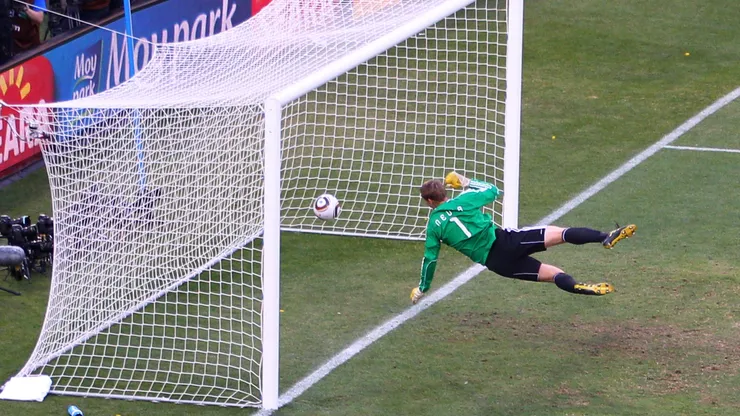
With Germany leading 2-1 in the first half of a heated Round of 16 matchup against England, Frank Lampard launched a brilliant lob from outside the box. The ball struck the underside of the crossbar and bounced clearly—by nearly two full feet—behind the goal line before spinning back out into the arms of German keeper Manuel Neuer.
Referee Jorge Larrionda and his linesman waved play on, completely missing that a legitimate goal had been scored. A deflated England squad lost all momentum and eventually fell 4-1. The blunder was so egregious that it single-handedly forced FIFA to fast-track the implementation of Goal-Line Technology.