
Golf has a language of its own—part poetry, part code. Among its most curious expressions are three winged terms: birdie, eagle and albatross. They’re not wildlife sightings, but they do mark rare moments on the course.
These words pop up in broadcasts, headlines and clubhouse chatter. Yet their true meaning often floats by unnoticed—even for loyal fans who spend every weekend watching putts and drives.
Are they triumphs? Mistakes? Flukes of nature? Behind each term lies a story, a logic, and a tradition passed down more by lore than by definition. Let’s take a closer look at how these birds landed in golf’s lexicon.
What is par?
In golf, everything revolves around one simple word: par. It’s the quiet authority on every scorecard, the invisible benchmark that defines success—or struggle—on each hole. Par represents the number of strokes a skilled golfer is expected to take to complete a hole, and by extension, an entire course.

Scottie Scheffler of the United States reacts after making birdie on the 15th hole during the final round of the Arnold Palmer Invitational in 2024. (Source: Brennan Asplen/Getty Images)
It’s calculated based on the hole’s length and difficulty, typically ranging from par-3s to par-5s. Hit the number, and you’ve met expectations. Go over, and you’re playing catch-up. Go under, and now you’re in headline territory.
Below par scores
Scoring below par is not just desirable—it’s the stuff that separates amateurs from champions. That’s when the sport’s peculiar poetry kicks in. A score of one under par on a hole is called a birdie, a term with roots in early 20th-century American slang, where calling something a “bird” meant it was excellent.
Do two strokes better than par, and you’ve hit an eagle—a natural evolution in naming, keeping with the avian theme but upping the grandeur. Three strokes under? That’s the holy grail: an albatross. Rare and magnificent, just like the bird it’s named after.
Rare shots
But is it an albatross or a double eagle? This is where the game splits hairs—and continents. In the UK and much of Europe, the term “albatross” is widely used and celebrated. Across the Atlantic, American golf culture has leaned toward calling the same feat a “double eagle“.
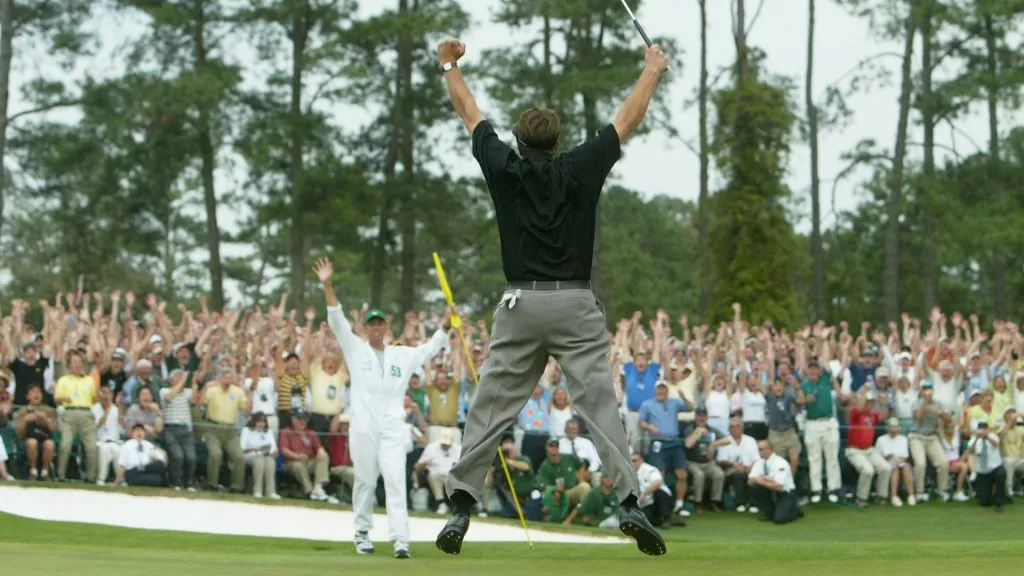
Phil Mickelson jumps in the air after sinking his birdie putt to win the Masters by one shot on the 18th green during the final round of the Masters on April 11, 2004. (Source: Andrew Redington/Getty Images)
While technically both mean scoring three under par on a hole, neither is more correct than the other. It’s a regional preference, but both terms underscore just how astonishing the shot is. After all, it’s an achievement that most golfers, even professionals, will go their entire careers without experiencing.
Double eagle vs. albatross
The confusion between “albatross” and “double eagle” is one of golf’s great linguistic quirks. Both refer to the same score—three under par on a single hole—but geography tends to decide which term you hear.
In the United Kingdom and much of the golfing world, “albatross” is the preferred term, evoking rarity and grace. In the United States, “double eagle” is more common, though somewhat mathematically awkward: two under par is an eagle, so three under would technically be a “triple eagle”, if we followed logic.
But golf rarely bends to logic—it bends to tradition. So while both terms are correct, “albatross” is often considered more elegant and increasingly, more widely accepted, as Golf Compendium reported.