From the roar of the Pacific Coliseum to the electric nights at Rogers Arena, few teams have captured Vancouver’s heart quite like the Canucks. Their history is marked by grit, heartbreak and moments of brilliance that defined generations.
Across decades of highs and near-misses, the franchise has been carried by players whose talent and character shaped its identity. Some became local heroes; others, NHL legends. Together, they built a legacy.
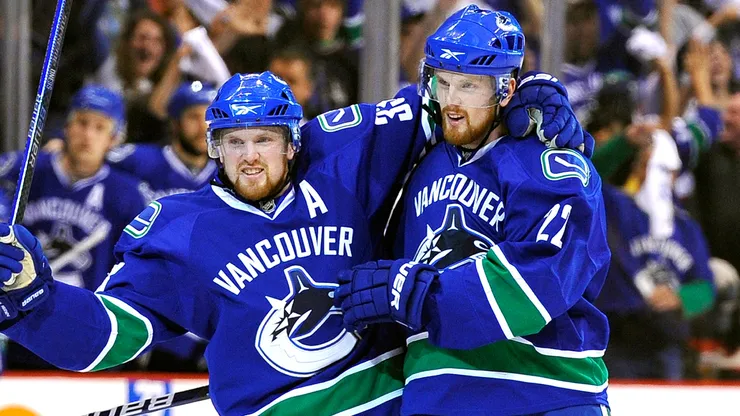
From Trevor Linden’s leadership to the artistry of the Sedin twins, every era brought new faces to the pantheon of the team’s greats. Each athlete left a lasting mark on Vancouver’s hockey heritage.
Henrik Sedin

Henrik Sedin (Source: Harry How/Getty Images)
The Swedish center, renowned for his unparalleled vision and astounding passing ability, was not only the team’s captain but the mastermind behind the iconic “Sedinery” alongside his twin. Drafted right after Daniel in 1999 (3rd overall), Henrik Sedin transformed himself into the franchise’s all-time leading scorer, an achievement built on an almost telepathic dedication to his brother.
His peak arrived in 2010, a dream season that earned him the prestigious Hart Memorial Trophy and the Art Ross Trophy, solidifying his status as the epitome of team play in Canucks history. His number 33 jersey hangs from the Rogers Arena rafters, a testament to a legacy that culminated with his 2022 induction into the Hockey Hall of Fame.
Daniel Sedin

Daniel Sedin (Source: Getty Images)
If Henrik was the architect, Daniel Sedin was the executioner, the left winger with the deadly shot who turned his brother’s impossible passes into goals. Selected 2nd overall in 1999, he followed his twin’s lead to become the franchise’s second all-time leading scorer, engaging in an offensive synergy often described as “telepathic” by observers.
His individual dominance was fully showcased in the 2010-11 season, when he surpassed Henrik to claim his own Art Ross Trophy and the Ted Lindsay Award, all while leading the team to the Stanley Cup Final. His impact, both on and off the ice—notably his extensive charitable contributions—cemented him as a franchise legend and a revered figure in the Vancouver community.
Pavel Bure

Pavel Bure (Source: NHL Wiki – Fandom)
In an era when Vancouver struggled for consistent success, the arrival of Pavel Bure from the Soviet Union in 1991 was an explosion of pure speed and spectacle. Nicknamed the “Russian Rocket”, his lightning-fast skating and ability to score electrifying goals immediately made him a global phenomenon.
He spearheaded the Canucks’ unexpected run to the 1994 Stanley Cup Final, a feat where his dramatic moments and individual flair were etched into the memories of fans. Although his departure in 1999 was bittersweet, his impact was undeniable: his ability to fill arenas and his bold, dynamic playing style defined a generation of hockey in Vancouver.
Roberto Luongo

Roberto Luongo (Source: Getty Images)
No goaltender in Canucks history has been more thrilling and polarizing than Roberto Luongo. Arriving in 2006, “Lu” not only delivered elite performance but also rewrote the franchise record books for a netminder.
His first season was legendary, setting a franchise mark with 47 wins and finishing as a finalist for both the Vezina and Hart Trophies, highlighted by a memorable 72-save, quadruple-overtime performance in his playoff debut. He even wore the Captain’s ‘C’, a rare honor for a goalie in the NHL.
Although the 2011 climax didn’t end in glory, his spectacular saves and the fan roar of “LUUUUUU” ensure his legacy, which includes his 2022 Hall of Fame induction, is about more than just wins and losses.
Quinn Hughes
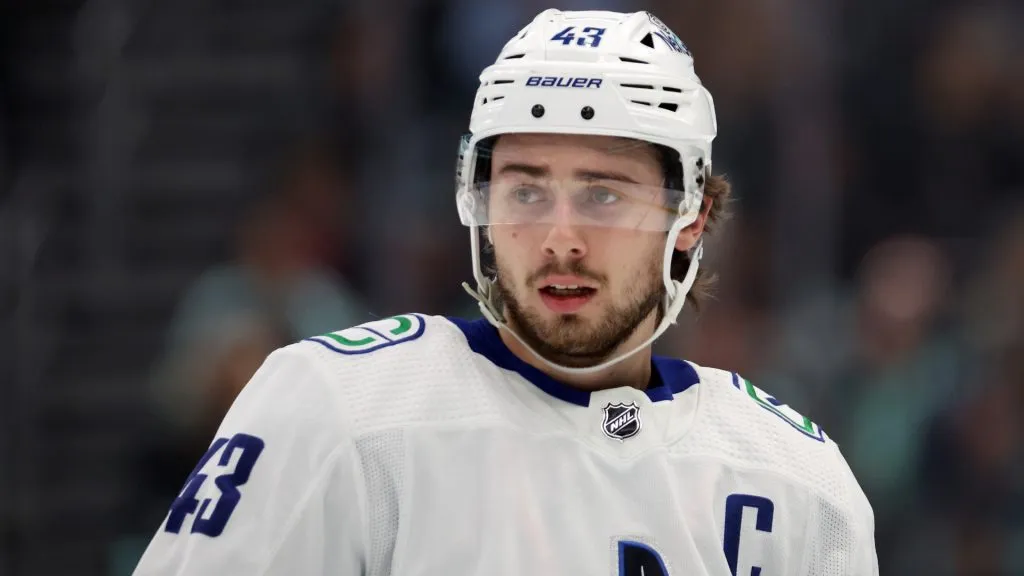
Quinn Hughes (Source: Steph Chambers/Getty Images)
In the present day, hockey in Vancouver has a captain on the blue line who embodies modern offensive defense: Quinn Hughes. Drafted in 2018, this young defenseman has revolutionized the position, fusing forward-like puck skills with a rink intelligence that is breaking records.
In his first season as captain, he set new franchise records for a defenseman in single-season points and assists. Coach Rick Tocchet has praised him as a “great competitor” and a leader who leads by example, proving that his impact is both instant and long-lasting, positioning him as the current star guiding the Canucks’ new wave.
Trevor Linden
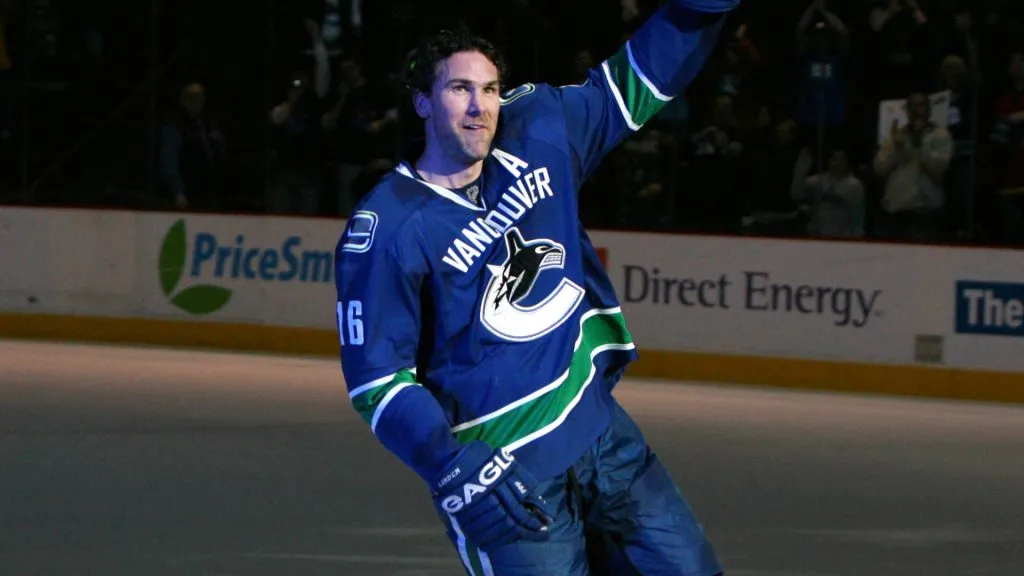
Trevor Linden (Source: Kim Stallknecht/Getty Images)
If there were an award for embodying the spirit of the Vancouver Canucks, it would be named after Trevor Linden. Known for his tireless leadership and work ethic, he was the engine behind the team’s surprising run to the 1994 Stanley Cup Final.
His influence transcended his play at right wing, as he became the first player in franchise history to reach 1,000 games in the uniform and the first to score 300 goals. Beyond the stats, Linden is remembered as the ultimate “Captain”, a role model whose connection with the city and fan base remained even after his retirement, thanks to his multiple stints with the club and his later role in management, cementing a legacy of commitment and resilience.
Markus Naslund

Markus Naslund (Source: Gregory Shamus/Getty Images)
Before the Sedins’ arrival, it was Markus Naslund, the left winger nicknamed “Nazzy,” who stood as the franchise’s offensive standard-bearer through the 2000s. Hailing from Örnsköldsvik, he spent 12 seasons in Vancouver, serving as captain for a team-record eight years.
His lethal wrist shot and stickhandling made him feared, leading him to top the team in scoring for seven consecutive seasons and earning him three selections to the NHL First All-Star Team.
His accolades include the Ted Lindsay Award in 2003. He rewrote the club’s offensive record books before the Sedins took over, and his number 19 jersey was retired in his honor, marking an era of Swedish individual dominance.
Ryan Kesler

Ryan Kesler (Source: Jeff Gross/Getty Images)
Ryan Kesler was the definition of a premier two-way center: a versatile, relentless player on defense and an explosive attacker. Drafted in 2003, he established himself as the franchise’s preeminent shutdown centerman, highlighted by his ability to neutralize the opposition’s top lines.
His performance peaked in the 2010-11 season, where he convincingly won the Selke Trophy and became the first Canuck to score 40 goals in a season in over a decade. Canucks fans will forever cherish his fierce performance during the 2011 Final run, a testament to his role as the aggressive, high-energy competitor who propelled the team during its recent golden age.
Kirk McLean

Kirk McLean (Source: Ken Levine /Allsport)
The nickname “Captain Kirk” for Kirk McLean wasn’t because he wore the ‘C,’ but because he was the undisputed leader and last line of defense during the Canucks’ resurgence in the 1990s. With a stand-up style and a cobra-quick glove hand that became famous, he was instrumental in leading Vancouver to the 1994 Stanley Cup Final, logging all 15 of the team’s wins that postseason.
Before his departure, he held virtually every major franchise goaltending record, including wins and games played. A two-time Vezina Trophy finalist, his 1994 playoff performance is remembered as one of the most significant demonstrations of goaltending heroism in British Columbia hockey history.
Todd Bertuzzi
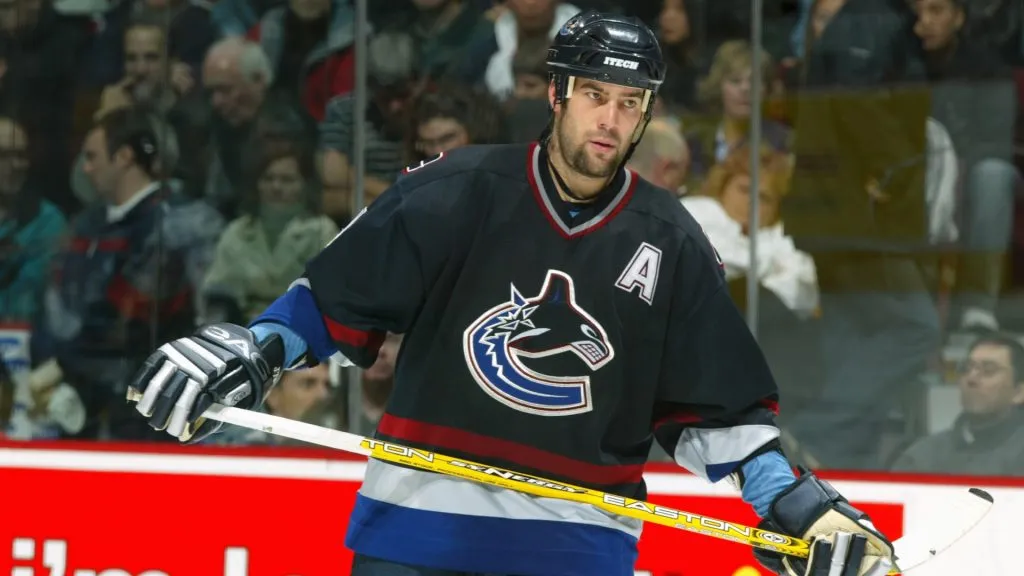
Todd Bertuzzi (Source: Jeff Vinnick/Getty Images)
Few players in Canucks history combined raw, devastating power with elite scoring touch like Todd Bertuzzi. Known as a quintessential power forward, he enjoyed the most productive period of his career across seven and a half seasons in Vancouver, peaking with a First-Team All-Star nod in 2003.
He was a dominant force who could dictate the game both with his physicality and his hands, frequently eclipsing the point-per-game mark. Yet, his legacy remains intrinsically linked to the infamous 2004 incident involving Steve Moore, which resulted in an indefinite suspension and criminal charges.
This single, dark moment overshadowed years of on-ice brilliance, leaving him as one of the franchise’s most complex and controversial figures—a player who achieved immense individual success before his career was forever altered.
Alex Edler

Alexander Edler (Source: Rich Lam/Getty Images)
For 15 seasons, Alex Edler was the pillar of defensive consistency on the Canucks’ blue line, quietly ascending to become the franchise’s all-time leader in goals and points for a defenseman. Drafted in the third round in 2004, the Swedish stalwart was a slow-burn success story, evolving from a raw prospect into a reliable two-way force and one of the league’s most effective defensemen.
His game was defined by a strong physical presence and a potent shot from the point, contributing heavily to the club’s dominant run to the 2011 Final. He was the longest-tenured Canuck following the Sedins’ retirement, embodying a dependable, no-nonsense presence through multiple eras of the franchise.
Stan Smyl
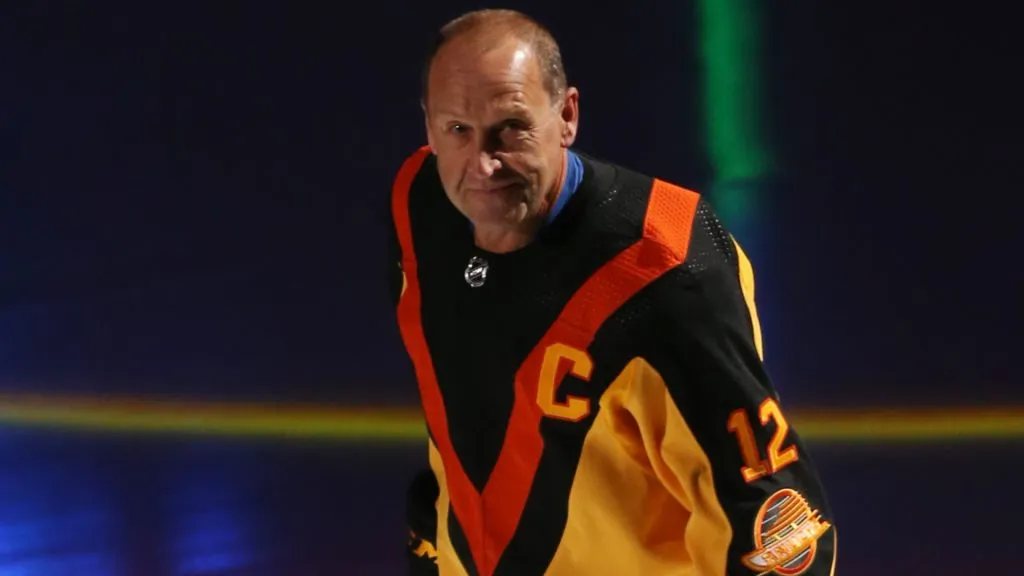
Stan Smyl (Source: Ben Nelms/Getty Images)
Before the legendary runs of the 90s and 2010s, there was Stan Smyl, affectionately known as “The Steamer”. His impact wasn’t just in scoring—though he retired as the franchise leader in games played, goals, assists, and points.
His legacy rests on his unyielding grit, ferocious tenacity, and seminal leadership. Dismissed by some as too small when drafted in 1978, he quickly earned respect by challenging the biggest players.
He was named sole captain in 1982, famously leading the team’s improbable “Towel Power” run to the Stanley Cup Final. His number 12 was the first jersey retired in Canucks history in 1991, cementing his place as the original heart and soul of the team.
Thomas Gradin

Thomas Gradin (Source: Canucks Army)
A crucial bridge between the Canucks’ expansion years and their later Swedish dominance, Thomas Gradin was a playmaking center with keen intelligence. Arriving in Vancouver in 1978, he was part of the first trio of Europeans to join the club, quickly establishing himself as the team’s premier setup man throughout the early 1980s.
He became the franchise’s all-time leading scorer and was instrumental in the 1982 Stanley Cup Final appearance. His smooth, skillful style earned him an All-Star nod in 1985, and his lasting commitment to the organization continues today, serving as an associate head scout where he notably helped discover the Sedin twins and Edler—making his influence truly generational.
Mattias Ohlund

Mattias Ohlund (Source: Richard Wolowicz/Getty Images)
Mattias Ohlund was the definitive modern, hard-nosed, two-way defender for the Canucks in the late 90s and 2000s. Drafted 13th overall in 1994, the towering Swede immediately made an impact, finishing runner-up for the Calder Trophy as the league’s top rookie. Over 11 seasons, he was celebrated for his powerful shot, robust physical play, and quiet leadership.
Despite battling significant injuries—including a deflected puck that nearly ended his career early—he broke franchise records for a defenseman in goals and points before Alex Edler ultimately surpassed them. He was the cornerstone of the defense that paved the way for the later Roberto Luongo and Sedin era, a true warrior inducted into the Ring of Honour.
Alexander Mogilny

Alex Mogilny (Source: Ian Tomlinson /Allsport)
Acquired in 1995, Alexander Mogilny brought his breathtaking speed and renowned sniper’s touch to Vancouver for five seasons. He was already a legend—the first Soviet player drafted to defect to the NHL—and one of only seven players in history to score 76 goals in a single season.
While his peak production was achieved with Buffalo, his time with the Canucks saw him lead the team’s offense, including a massive 107-point season in 1995-96, showcasing his lethal combination of skill and athleticism. He was a pure goal-scorer, capable of creating offense out of thin air, offering a spectacular, if often mercurial, talent that thrilled fans in the post-Bure years.
Alex Burrows

Alex Burrows (Source: Harry How/Getty Images)
The story of Alex Burrows is one of pure, improbable determination. Undrafted out of the QMJHL, he clawed his way through the ECHL and AHL, eventually signing with the Canucks as a free agent.
Initially an agitator and energy player, he defied all expectations by developing into a skilled, reliable top-line left winger, a key fixture alongside Ryan Kesler and eventually the Sedins.
His crowning moment came in the 2011 playoffs, where he scored the series-winning goal in overtime of Game 7 against the Chicago Blackhawks, forever solidifying his legacy as the ultimate Cinderella story and a beloved clutch player in Vancouver.
Elias Pettersson

Elias Pettersson (Source: Derek Cain/Getty Images)
A member of the current elite, Elias Pettersson represents the latest evolution of the Swedish star in Vancouver. Selected fifth overall in 2017, “Petey” immediately wowed fans with his slick dekes, deceptive release, and high hockey IQ, winning the Calder Memorial Trophy as the league’s top rookie in 2019.
His game reached new heights in the 2022-23 season when he eclipsed the 100-point mark, confirming his status as an offensive franchise cornerstone. He is the face of the Canucks’ next generation, a dazzling center whose blend of scoring, playmaking, and unique flair promises a bright future.
Jyrki Lumme
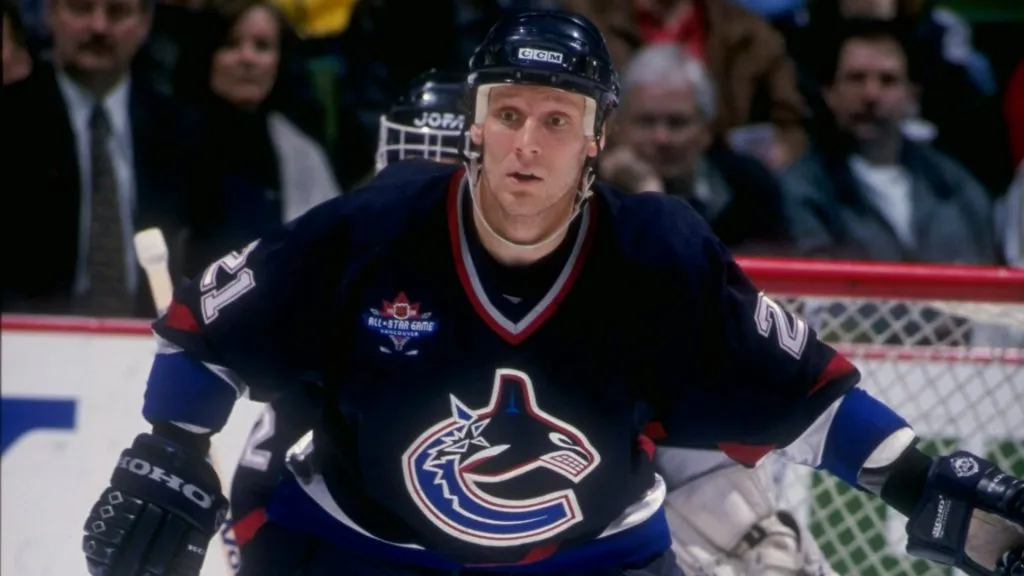
Jyrki Lumme (Source: Ian Tomlinson /Allsport)
Jyrki Lumme was the quintessential offensive defenseman for the Canucks throughout the 1990s. Acquired in a trade in 1990, the Finnish blue liner quickly found his groove in Vancouver, becoming the team’s annual top defenseman on four occasions. His forte was his puck-moving ability and knack for contributing offensively, playing a major role in the club’s 1994 Stanley Cup Final run.
He was an incredibly productive player, briefly holding the franchise record for most goals and points by a defenseman before being surpassed by fellow Swedes and the later defensemen of the 2000s. His steady, high-producing presence cemented his reputation as a key European import who transformed the Canucks’ defense.
Tony Tanti

Tony Tanti (Source: Mike Powell /Allsport)
Before Bure and Mogilny, the title of Vancouver’s first “true sniper” belonged to Tony Tanti. Traded to the Canucks in 1983, he rapidly became the team’s offensive engine, using his formidable shot to net 40 goals or more on three separate occasions during the mid-80s—a massive achievement in that era of Canucks hockey.
Known for his keen goal-scoring instincts, he became an immediate fan favorite and won the team’s “Most Exciting Player” award five times running. He retired second only to Stan Smyl in all-time Canucks goals, defining an entire era of scoring for a franchise that often struggled to find consistent offense.
J.T. Miller

J.T. Miller (Source: Derek Cain/Getty Images)
J.T. Miller isn’t just a point-producer; he’s the versatile, high-octane engine of the Canucks’ modern offense. Since arriving in Vancouver in 2019, he has transformed his game, becoming one of the most productive and physically demanding forwards in the entire league.
His tenure has been defined by elite scoring, relentless drive, and a willingness to play any position, making him indispensable to the team’s power play and overall attack. He achieved the coveted 100-point plateau during the 2021-22 season, a rare feat that cemented his status alongside the franchise greats.
He is a fiery competitor whose intensity can often be matched only by his clutch production, solidifying his role as a crucial figure in the team’s ongoing quest for sustained success.
Cliff Ronning

Cliff Ronning (Source: Glenn Cratty /Allsport)
A local product from Burnaby, Cliff Ronning was the kind of player fans instantly adored: an undersized, supremely skilled center who played with more heart than players twice his size. After being traded to his hometown club in 1991, he became a vital offensive piece, highlighted by a career-best 85-point season in 1992-93.
His most legendary contribution came during the 1994 Stanley Cup Final run, where he played a major role despite famously nursing a broken hand, demonstrating a grit that resonated deeply with the city. His slick playmaking and never-say-die attitude made him a beloved fan favorite and a memorable part of that era’s core.
Greg Adams

Greg Adams (Source: BC Hockey Hall of Fame)
For many Canucks fans, the name Greg Adams is synonymous with one of the most unforgettable goals in franchise history. Adams, the B.C.-born left winger, was a consistent 30-goal scorer and a powerful offensive force in Vancouver throughout the late 80s and early 90s.
Traded to the Canucks with Kirk McLean in 1987, he quickly hit his stride, posting a 76-point season in 1987-88. However, his lasting fame comes from his double-overtime winner in Game 5 of the 1994 Western Conference Final, a goal that sent the Canucks to the Stanley Cup Final and remains a defining moment of euphoria in Vancouver lore.
Ed Jovanovski

Ed Jovanovski (Source: Jeff Vinnick/Getty Images)
Nicknamed “JovoCop”, Ed Jovanovski was arguably the Canucks’ most explosive and physically dominant defenseman in the modern era. Acquired from Florida in 1999 as part of the trade for Pavel Bure, the former first overall pick brought an aggressive, two-way style that quickly captivated fans.
He possessed a rare blend of raw power, offensive rush ability, and punishing physicality, often leading the team’s defensemen in scoring while racking up high penalty minutes. He won the team’s best defenseman award three years in a row, embodying the up-tempo, high-impact defense that defined the early 2000s era of Canucks hockey.
Dennis Kearns
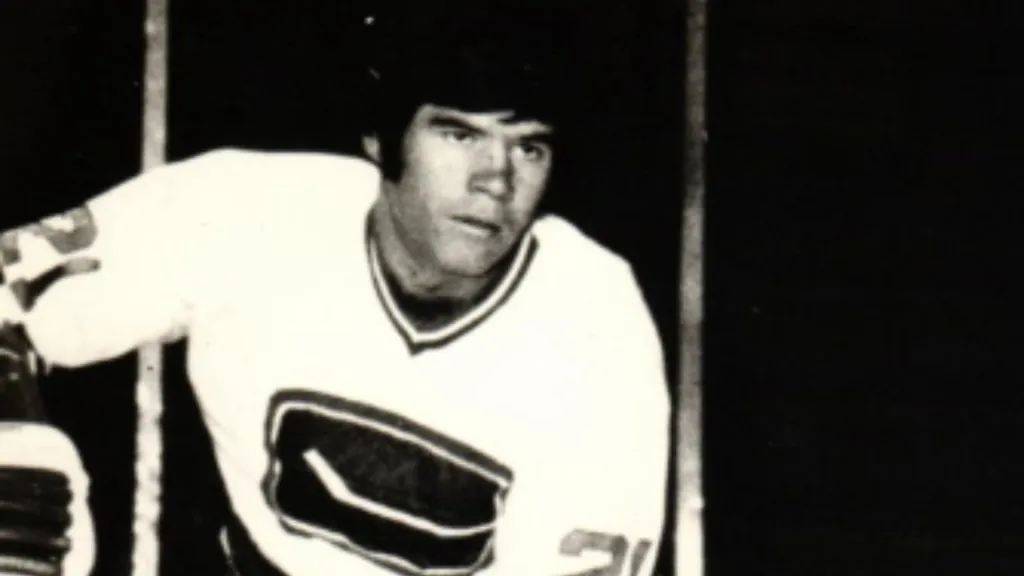
Dennis Kearns (Source: BC Hockey Hall of Fame)
Before Quinn Hughes dazzled the crowds, there was Dennis Kearns, the Canucks’ original star offensive defenseman from the expansion era. Spending his entire NHL career in Vancouver, he was a prolific playmaker despite his smaller size, known for his skill on the power play.
In 1977, he set a franchise record for defensemen with 55 assists in a single season, a mark that stood for over four decades until surpassed by Hughes in 2022. He held the career points record for Canucks defensemen for nearly 30 years, earning him the nickname “the Denis Potvin of the West” from The Hockey News and securing his place as a true pioneer of the position for the franchise.
Brock Boeser

Brock Boeser (Source: Elsa/Getty Images)
The winger from Burnsville, Minnesota, Brock Boeser has long been celebrated for his world-class wrist shot and innate scoring touch. Since joining the Canucks, the right winger has established himself as a perennial threat on the top line, especially on the power play.
After years of injury struggles and inconsistent scoring, he finally enjoyed a career-defining season in 2023-24, eclipsing the 40-goal mark and demonstrating the two-way commitment necessary to be a top-line fixture.
Known for his confidence and ability to deliver crucial goals, he has transformed from a promising rookie into a reliable and indispensable offensive leader for the current Canucks core.