

South Africa wear yellow at the 2026 FIFA World Cup because it reflects the national soccer identity rooted in the country’s flag colours and long-standing sporting tradition. The look is a continuation of a visual identity.
The yellow jersey—usually paired with green accents—directly draws from the South African flag and has been consistently used as the team’s primary home kit since the post-apartheid era. The kit has evolved into a marker of national pride.
It became especially symbolic after the nation’s return to global soccer in the 1990s, when the kit helped represent unity and a fresh sporting beginning. Over time, it has become instantly recognizable in competitions, such as the RSA abbreviation on the scoreboard.
Has South Africa ever changed its World Cup jersey colors?
South Africa, ranked 60th by FIFA, has not significantly changed its World Cup jersey colors, with the national team consistently using a yellow-based home kit combined with green details since its modern return to international soccer.
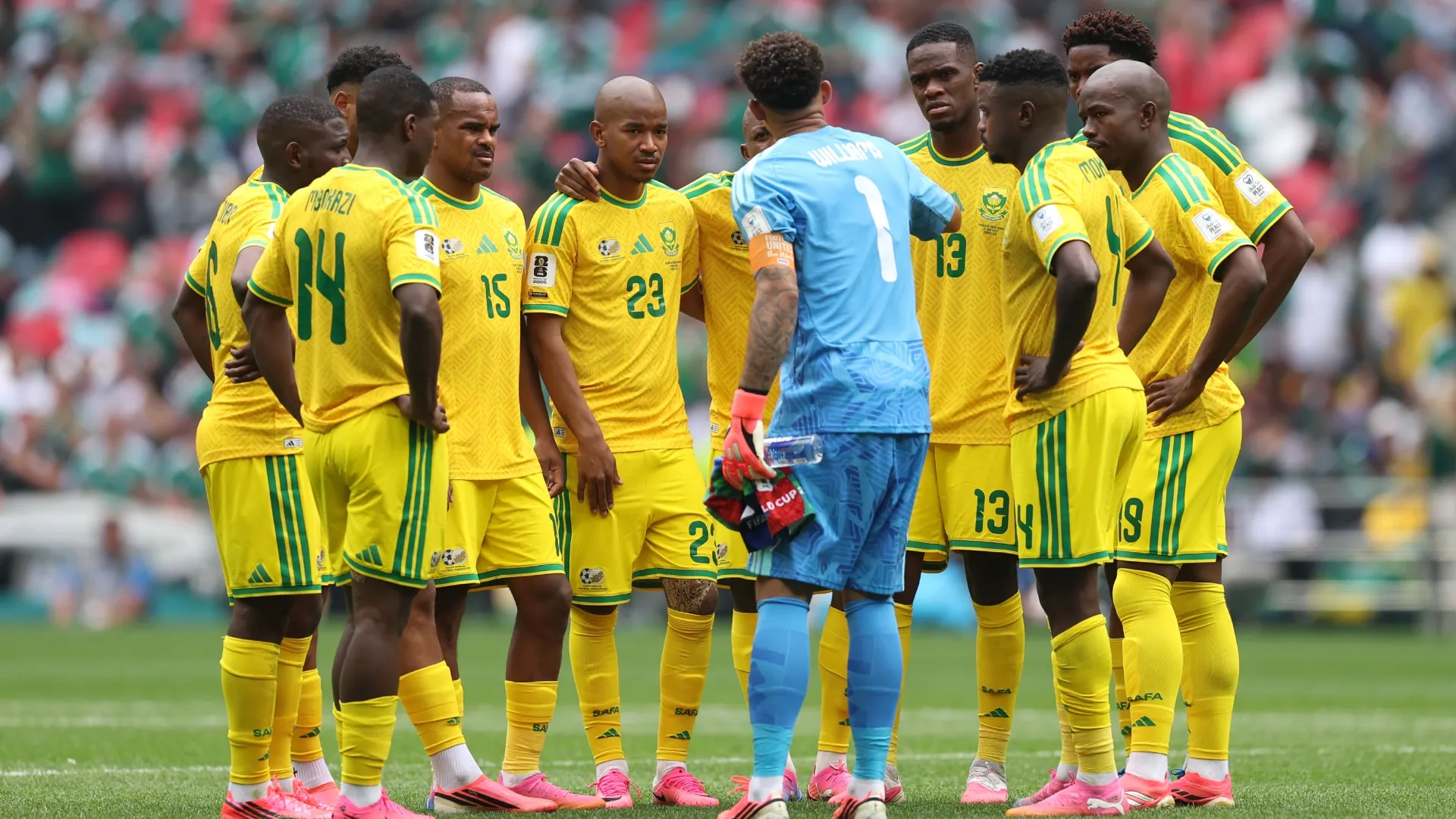
South Africa players huddle during the FIFA World Cup 2026 Group A match (Source: Luke Hales/Getty Images)
The South Africa national soccer team has maintained this identity across multiple eras, including major tournaments like the 1998, 2010 and the build-up to the FIFA World Cup 2026.
While manufacturers have changed over time—from Kappa in the 1990s to Nike, Puma, Le Coq Sportif and now Adidas—the core color structure has stayed remarkably stable. Minor variations have appeared in shading, patterns and trim styles.
How the yellow jersey became a symbol of “Bafana Bafana”
The yellow jersey became a symbol of “Bafana Bafana” through South Africa’s post-apartheid soccer identity, where the national team adopted bold, flag-inspired colors that represented unity, renewal and global re-entry.
The nickname “Bafana Bafana”, meaning “the boys” in Zulu, became closely tied to this visual identity as the team re-emerged on the international stage in the early 1990s.
The emotional connection between fans and the kit grew strongly during landmark moments such as the 1996 Africa Cup of Nations victory and the 2010 FIFA World Cup, where the yellow shirt became a symbol of unity inside stadiums.