
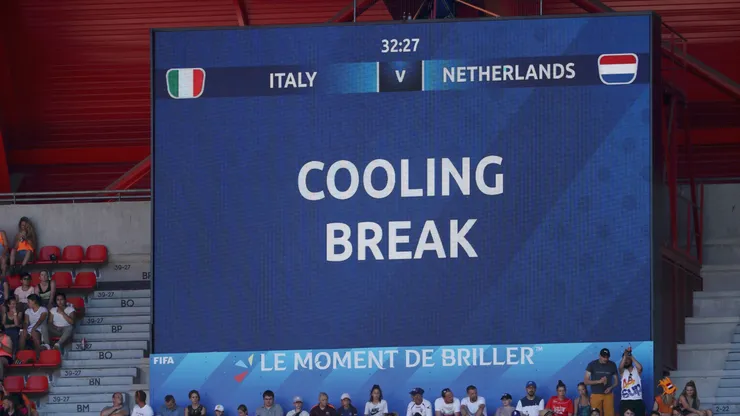
The 2026 FIFA World Cup includes several specific implementations throughout the tournament, one of which is the cooling break. It takes place once in each half of the match.
According to the official FIFA website, each of these stoppages lasts three minutes, with the aim of prioritizing player welfare throughout the summer tournament.
The 2025 FIFA Club World Cup served as one of the final tests for this new implementation. The break takes place in the 22nd minute of each half.
“For every game, no matter where the games are played, no matter if there’s a roof, (or) temperature-wise, there will be a three-minute hydration break. It will be three minutes from whistle to whistle in both halves,” said Manolo Zubiria, Chief Tournament Officer.

Head coach of Brazil talks to his players in a cooling break.
Will every 2026 World Cup game have a cooling break?
FIFA has established a universal regulatory framework dictating that mandatory hydration breaks will feature in every single match of the tournament. Departing from previous historical formats where cooling intervals were strictly conditional and dependent on environmental heat index thresholds, soccer authorities have standardized the rule to apply across all venues.
Temperatures during the World Cup
Given the vast layout of the North American tournament, fans and athletes can expect a highly diverse climate experience depending on the host region. Matches held in Canadian cities like Vancouver and Toronto generally offer mild, pleasant summer conditions with average daytime temperatures ranging from 68°F to 77°F.
In contrast, venues across the United States and Mexico introduce starkly warmer and more intense climates. While coastal regions maintain moderate warmth, inland and southern regions—especially areas in Texas, Florida, and Monterrey—frequently face scorching summer heat peaks that can exceed 95°F, often accompanied by high humidity or intense afternoon sun.