

March Madness is one of the most exhilarating moments in sports, a time when college basketball takes over television screens, and millions of fans fill out their brackets with dreams of predicting the next Cinderella story.
But before the buzzer sounds on that first game, a lot of work goes into selecting the 68 teams that will participate in this highly anticipated tournament. So, how do these talented teams get chosen?
Every year, the NCAA Selection Committee faces the tough task of deciding which teams qualify for the tournament, with over 350 universities in Division I competing for a spot in this exclusive event.
Section 1: The basics of team selection
Every year, 68 teams from across the United States get the chance to compete in March Madness, the frenzy of college basketball. This group includes 32 automatic bids and 36 at-large bids. So, what’s the difference?
- Automatic bids (32 teams): These are the easiest to understand. Each of the 32 conferences in NCAA Division I men’s basketball holds a tournament. The winner of each of these tournaments automatically receives a spot in the NCAA Tournament, regardless of their overall record or ranking. These teams are known as “conference champions.”
- At-large bids (36 teams): The remaining teams are selected by the NCAA Selection Committee, which evaluates hundreds of teams across the country. These teams, known as “at-large” bids, didn’t win their conference tournament but are still considered strong enough based on their performance over the course of the season to earn a spot in the tournament. This process is far more subjective than the automatic bids, and it’s where the real debate begins.
Section 2: The selection committee | The key players
The Selection Committee is a group of 10-12 individuals who are responsible for selecting and seeding the 68 teams. The members are typically athletic directors or basketball administrators from different universities, and they meet in person for several days to evaluate teams.

The NCAA Basketball Tournament Selection Committee meets on Wednesday afternoon, March 8, 2017. (Source: Drew Angerer/Getty Images)
They follow a set of rules and guidelines but also have a lot of discretion. The committee’s decision-making is based on a variety of factors, according to NCAA guidelines and analysis from basketball experts.
Section 3: Key factors in team selection
Several key factors determine whether a team earns an at-large bid, and these factors are debated heavily by the committee. Here are the main ones:
- Regular-season record: A team’s performance throughout the season plays a significant role. Teams with strong win-loss records, especially in competitive conferences, are more likely to earn a bid.
- Strength of schedule: This is critical. A team’s performance against tough opponents, including non-conference games, is closely examined. Beating a strong team early in the season can bolster a team’s resume.
- Quadrant system: The Selection Committee categorizes games into four quadrants based on the quality of opponents. A team’s performance against teams in these quadrants impacts its overall ranking. Quadrant 1 games are the most difficult (against teams in the top 30 of the RPI, for example) and are considered the most important for selection.
- NET ranking: The NCAA Evaluation Tool (NET) is the primary metric used by the committee to assess teams. This ranking system incorporates factors like scoring margin, strength of schedule, and road performance. It’s often compared to the RPI (Ratings Percentage Index), which was used in previous years, but NET is considered more comprehensive and reliable.
- Conference strength: The strength of the conference a team plays in matters. Teams from major conferences like the ACC, Big Ten, and SEC tend to get more attention due to the overall level of competition.
- Head-to-head results: In cases where two teams have similar resumes, head-to-head performance may be the tie-breaker. Teams that beat other strong teams during the regular season will often edge out their competitors for a spot in the tournament.
- Team performance in key games: The Selection Committee also looks at how teams performed in crucial moments, such as during conference tournaments or against higher-ranked teams.
Section 4: The bracketology debate
One of the most intriguing parts of the selection process is the annual “Bracketology” predictions that emerge long before the Selection Sunday reveal. Experts like Joe Lunardi at ESPN are known for forecasting the 68 teams that will make the tournament.

The NCAA men’s basketball championship trophy is displayed before the game between the Arizona State Sun Devils and the USC Trojans on January 20, 2024. (Source: Christian Petersen/Getty Images)
While these predictions aren’t official, they give fans and analysts a glimpse into how close teams are to making the cut. Bracketology helps fans track who is in and who is on the bubble – the teams who might or might not make it depending on their final games or conference tournament results.
Section 5: The role of the Conference tournaments
While regular-season performance plays a major role in the selection process, conference tournaments are the last big chance for teams to improve their chances of making the tournament. If a team with a poor record wins its conference tournament, it automatically qualifies for the NCAA Tournament.
But there are also “bubble teams” whose futures hinge on their performance in these tournaments. Some teams need to make a deep run to secure an at-large bid, while others might be comfortably in the field, but their seeding is influenced by their performance.
Section 6: Selection Sunday | The final reveal
The process culminates on Selection Sunday, when the 68 teams and their respective seeds are revealed live on television. The Selection Committee announces the bracket, including which teams will be in each of the four regions.
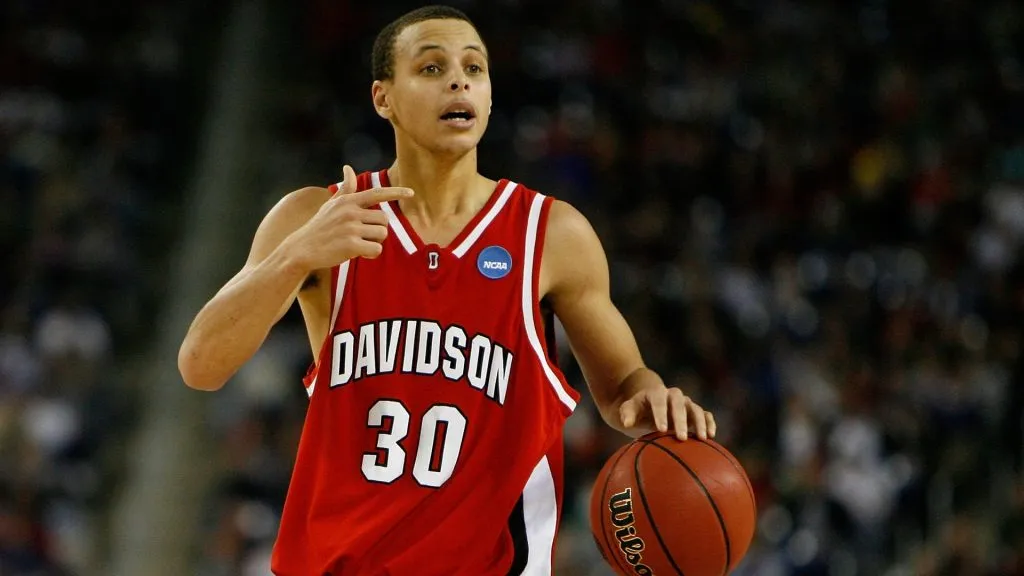
Stephen Curry #30 of the Davidson Wildcats directs the offense against the Kansas Jayhawks during the Midwest Regional Final of the 2008 NCAA Division I Men’s Basketball Tournament. (Source: Gregory Shamus/Getty Images)
The teams are seeded from 1 to 16 in each region, and the rest of the teams are placed in the bracket according to their rankings and matchups. There are always surprises and snubs, as some teams are left out and others, often unexpectedly, get in.
Section 7: The last word on the process
While the process for selecting teams is a mixture of data, rules and subjective evaluation, it’s ultimately what makes March Madness so special. The selection isn’t perfect, and some teams inevitably feel left out.
Yet, part of the excitement is seeing which teams will defy expectations, creating the chaos and drama that fans have come to love. Whether a team gets an automatic bid, an at-large bid, or is left off the bracket, the selection process sets the stage for the most thrilling postseason in sports.
So, next time you’re watching Selection Sunday, you’ll have a better idea of what goes into the decision-making process that leads to March Madness. It’s not just about wins and losses—it’s about the storylines, the debates and the drama that builds up to that first game of the tournament.