
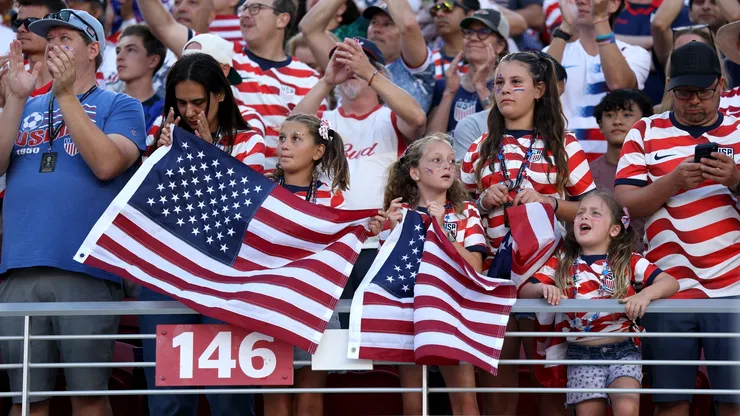
Following a 32-year wait since 1994, the United States co-hosted the 2026 tournament alongside Canada and Mexico. Historically, no single nation has ever hosted two World Cup tournaments within a brief 12-year span. However, a growing theory suggests that soccer’s biggest spectacle could make a remarkably swift comeback on American soil by 2038.
According to Yahoo Sports, FIFA‘s strict continental rotation rules prohibit confederations from bidding if they hosted either of the previous two tournaments. With 2030 spanning Europe, Africa, and South America, and 2034 awarded to Saudi Arabia, four major continental confederations are immediately sidelined for 2038. That leaves only CONCACAF and Oceania eligible, positioning the American nation as the primary candidate for what might become a 64-team event.
Andrew Joseph of USA Today highlighted how this theoretical pathway virtually guarantees a strong bid, since Oceania lacks the necessary infrastructure. With Australia competing under the Asian confederation, New Zealand simply cannot supply the required stadium capacities for a global competition.
Political pressure and FIFA’s financial engine
President Donald Trump told FOX Sports reporter Jenny Taft that the country would be requesting hosting rights again immediately. Speaking at Trump Tower on July 17, Trump even mentioned that Gianni Infantino had suggested co-hosting with China, though Trump insisted on hosting alone and leaving Canada and Mexico out.
President Trump spoke with @JennyTaft ahead of the 2026 FIFA World Cup Final@realDonaldTrump pic.twitter.com/Wk463lj1wU
— FOX Sports (@FOXSports) July 19, 2026
The financial incentive behind another North American tournament makes the ambitious bid equally attractive for the governing body. Entrepreneur and investor Joe Pompliano noted on X that FIFA is making so much money that another hosting stint in 2038 is highly likely. As Pompliano pointed out, all observers have to do is follow the money.

Built-in venues and world-class infrastructure
Unlike most global hosts, the United States does not need to spend tens of billions constructing brand-new athletic venues from scratch. Existing NFL stadiums and multi-purpose arenas already offer state-of-the-art facilities across the entire nation.
American host cities boast incredible open-air and retractable-roof stadiums featuring massive seating capacities and modern fan amenities. Furthermore, major urban hubs are already seamlessly designed around these mega-structures to support high-density traffic and global tourism.