The Round of 32 at the 2026 World Cup introduces a ruthless, single-elimination reality where historical reputation guarantees absolutely nothing. While Brazil enters the knockout stage carrying the heavy expectations of a five-time champion, Japan is quietly positioning itself as the tournament’s ultimate giant-killer.
Japan’s group stage performance was highly impressive. Not only did they finish as the runner-up in Group F, but their offense was just as potent as Brazil‘s, with both teams racking up seven goals. The main difference lies at the back, where the Samurai Blue conceded three goals compared to Brazil’s single allowed goal.
Therefore, Japan’s primary path to victory hinges on minimizing defensive errors, given that the two sides possess a remarkably similar attacking threat. By absorbing pressure and leveraging their clinical speed on the wings, Japan can drag Brazil into a frustrating, low-scoring dogfight.
Surviving the first half against Brazil
Statistically, underdogs that manage to keep tournament favorites scoreless through the first 45 minutes see their win probability jump exponentially as the pressure shifts. Japan’s primary objective is to survive the initial storm, quiet the crowd, and force Brazil into taking low-percentage shots from distance.
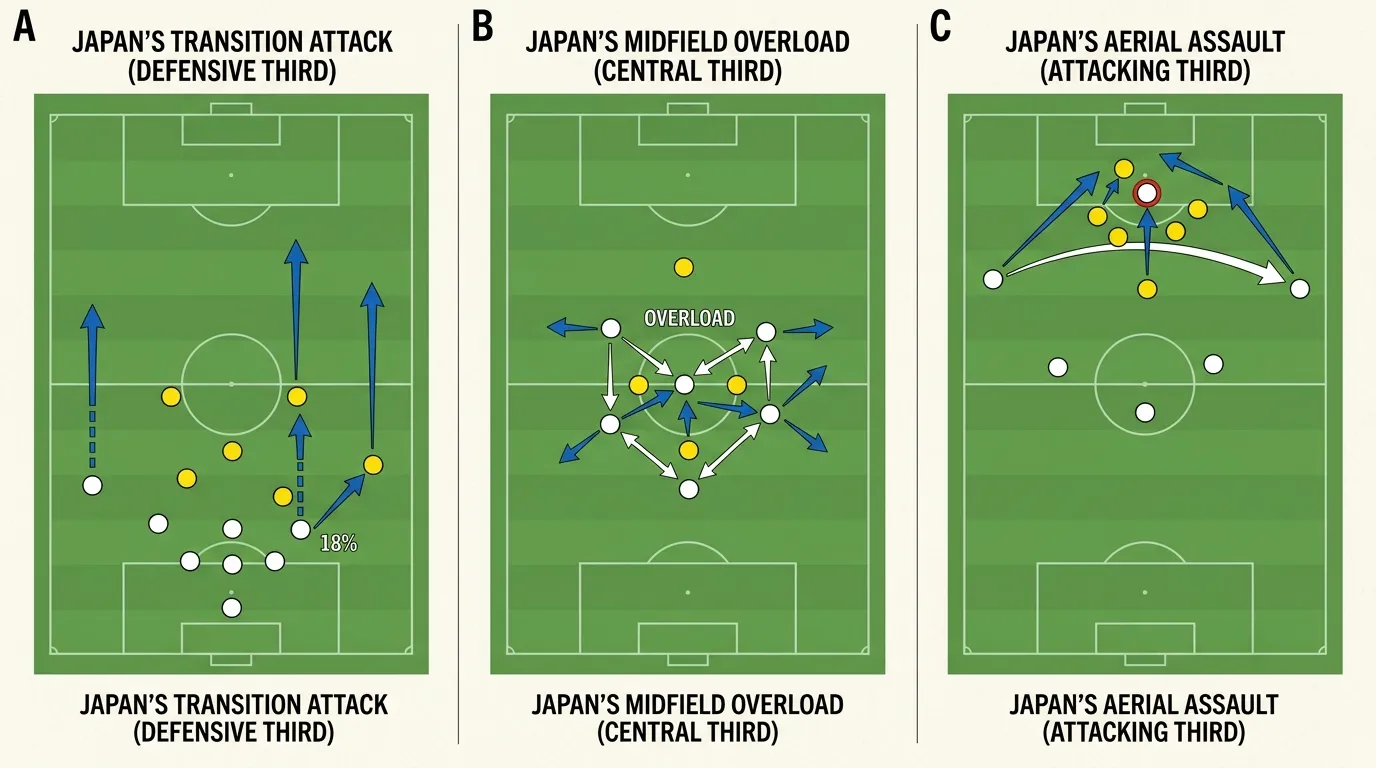
Proposed idea of how Japan can survive the first half. (Infographics made with Gemini AI)
But why is it so vital for Japan to hold their ground in the opening 45 minutes? The answer is simple: during the group stage, five of Japan’s seven goals came in the second half. This demonstrates a clear trend of growing efficiency late in games after successfully weathering early attacks from the Netherlands, Tunisia, and Sweden.

Ayase Ueda could be the key to victory
According to an Opta Analyst article by Ryan Benson, Japan possesses a lethal, under-the-radar offensive weapon in striker Ayase Ueda, who leads Europe’s top 10 leagues with nine headed goals. Their metrics also confirm that Japan recorded more headed goals during qualification than any other AFC nation.
By shifting their attacking strategy away from standard central combinations and heavily prioritizing deep, diagonal crosses, Japan can directly target the weakest elements of Brazil’s aerial defense during this Round of 32 matchup.