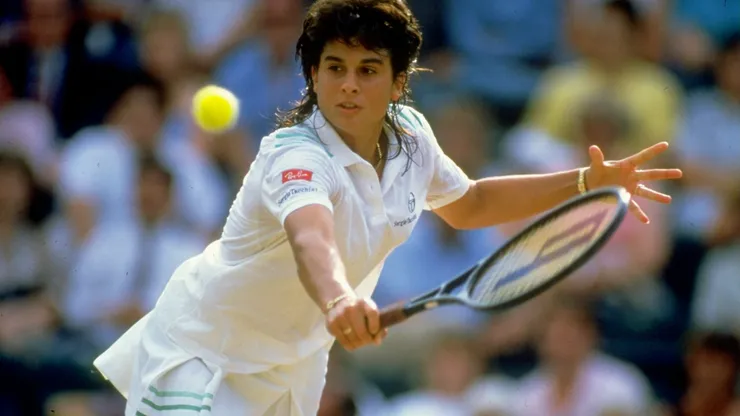
Few tennis players achieve the glory of winning a Grand Slam while reaching the Top 3 in the rankings. Argentine star Gabriela Sabatini did just that, establishing herself as one of the greatest players of the 1980s and 1990s. She defeated rivals like Steffi Graf and Monica Seles before deciding to retire at just 27 years old.
Sabatini began her professional career as a teenager and quickly became one of the world’s best players. At just 15 years and three weeks old, she became one of the youngest players ever to reach the semifinals of the French Open, where she lost to Chris Evert. In the following years, she also reached the semifinals at Wimbledon (1986) and the French Open (1987).
Her first major breakthrough came at 18 when she won the silver medal at the 1988 Seoul Olympics, losing to Graf, who was already one of her biggest rivals and closest friends. Their matches were unforgettable, though Graf had the upper hand in most finals, including the 1989 US Open.
Sabatini finally defeated Graf in straight sets to win the 1990 US Open, her lone Grand Slam title. They faced off again in the 1991 Wimbledon final, with Graf winning once more. However, they also shared success as doubles partners, winning Wimbledon in 1988 and reaching three French Open finals together.
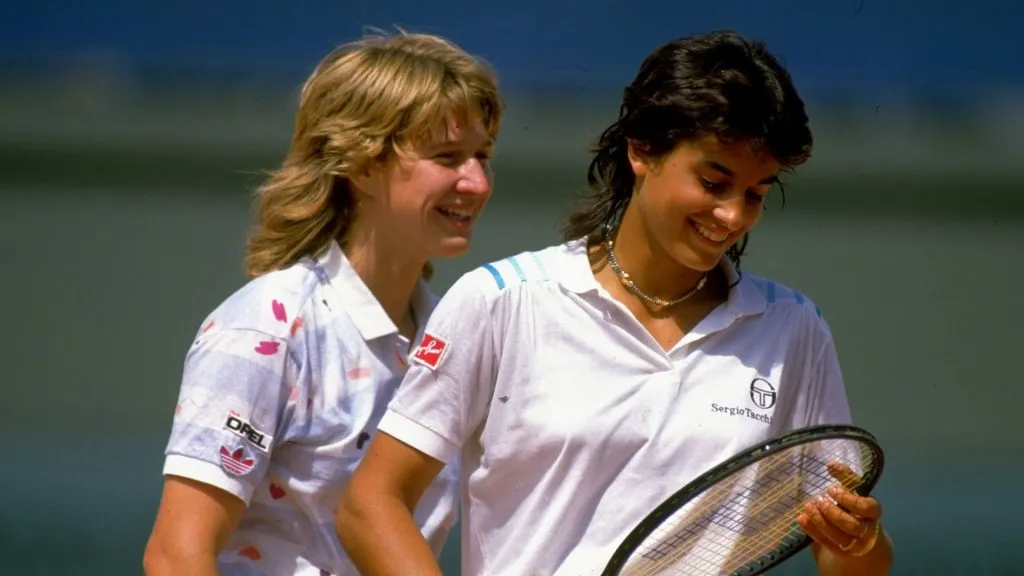
Graf and Sabatini played doubles together (Allsport UK /Allsport)
Graf wasn’t her only fierce competitor. Sabatini also battled against Monica Seles, the legendary Martina Navratilova, and Spain’s Arantxa Sanchez Vicario and Conchita Martinez. She claimed two WTA Finals titles, both in New York.
Admired by Roger Federer but uncomfortable with fame
In total, Sabatini won 41 WTA titles across singles and doubles, including four Italian Open titles in 1988, 1989, 1991, and 1992, defeating Helen Kelesi, Sanchez Vicario, and Seles (twice). Known for her baseline game and all-court skills, she was also one of the most popular players on tour, with Roger Federer even naming her one of his childhood favorites. They have shared several moments together, with Sabatini inviting the Swiss star to her house when he visited Buenos Aires in 2019.
Monica Seles and Steffi Graf have both spoken about Sabatini’s character. In her autobiography, From Fear to Victory, Seles recalled Sabatini’s support after a fan of Graf stabbed her in Hamburg. The WTA’s top players voted against freezing Seles’ No. 1 ranking.
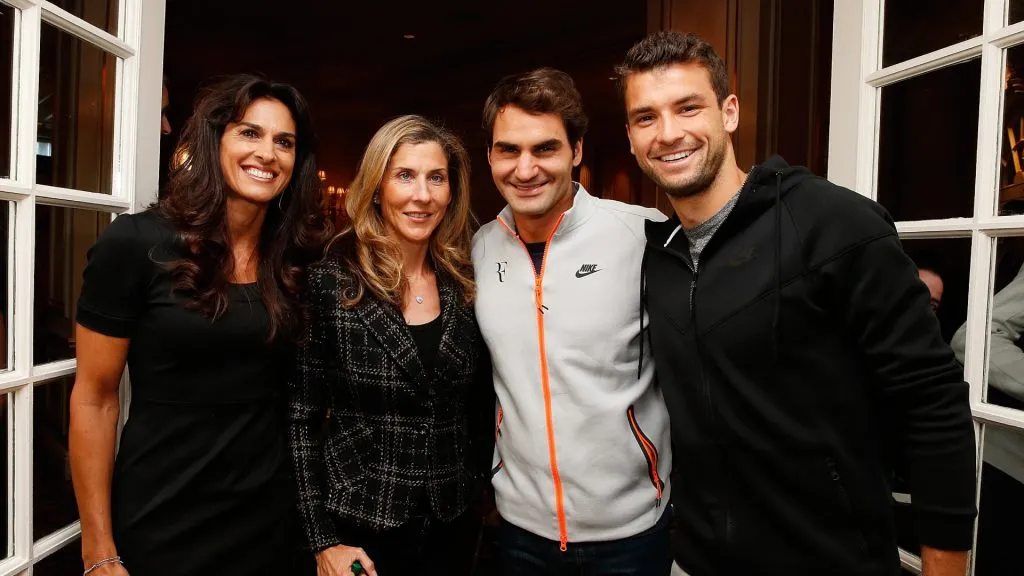
Gabriela Sabatini at, Monica Seles, Roger Federer and Grigor Dimitrov at the 2015 Indian Wells (Mike Stobe/Getty Images)
“Gaby was the only player who supported me after the attack. She thought as a person, not about the ranking, not about sponsors or the business. She is different from the rest of the players on the tour,” Seles wrote.
Despite her popularity, Sabatini never enjoyed fame or the pressures that came with being an elite athlete.
“Another thing that was very difficult for me, something I had to deal with, was the press. I remember that when I started becoming famous and reached the top rankings, the media began talking and demanding that I become No. 1. They would say things like I didn’t train enough, that I didn’t want to train, that I was missing this or that. Those things hurt me so much when I read them, and that was even without social media at the time,” she told CNN en Español in 2021.

Retirement
Despite being one of the most dominant players on tour, she soon realized she no longer wanted to compete. In 1996, at just 26, she announced her retirement after missing five months due to a pulled stomach muscle, which forced her to skip the French Open and Wimbledon.
“I have always considered myself a happy person. When I no longer felt that way, when things became complicated or I wasn’t at peace, I changed course. That’s why I left tennis. I was only 26, but I was no longer happy playing. So, when I started feeling that, I made a change,” she told CNN in 2021.
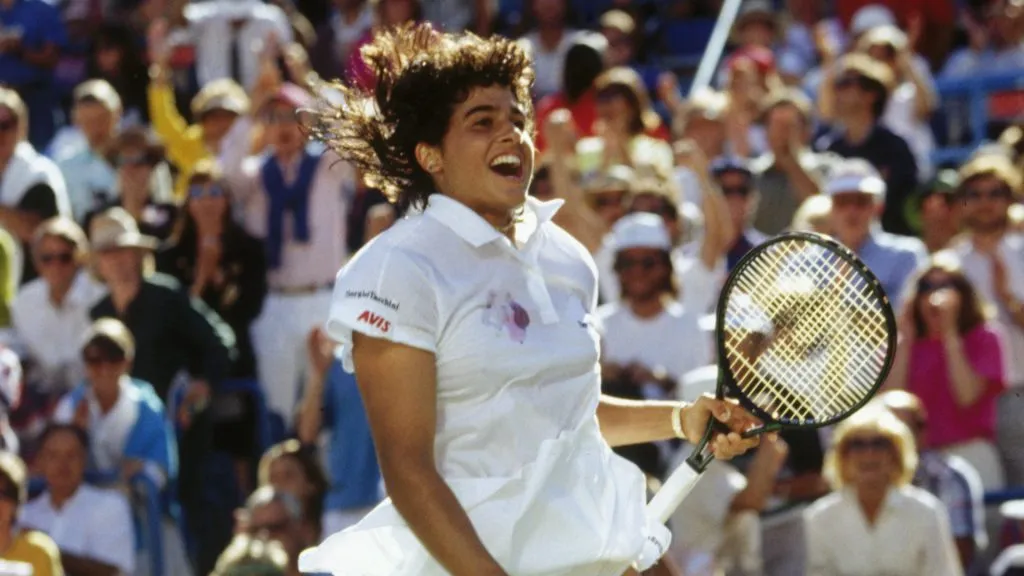
Sabitini celebrates winning the 1990 US Open (Rick Stewart/ Getty Images)
Life after tennis
Despite stepping away early, she has no regrets. “My decision to retire was well thought out. I took my time to make sure it was the right choice, and it was. Since I decided to stop playing, I have never missed being on the court. I enjoy watching as a spectator, and I may miss certain places, tournaments, and people, but I’ve never felt the desire to play again,” she told La Nación in 2020.
The Argentine star has remained active from her home in Switzerland, speaking openly about her life and career while staying involved in tennis in various ways. In 2015, she played an exhibition match against Monica Seles.
“I have several projects, some related to tennis and others not so much. I’ve had my own perfume line for many years. I’m also involved in different tennis-related ventures and work with various companies. I stay quite busy most of the time,” she said.
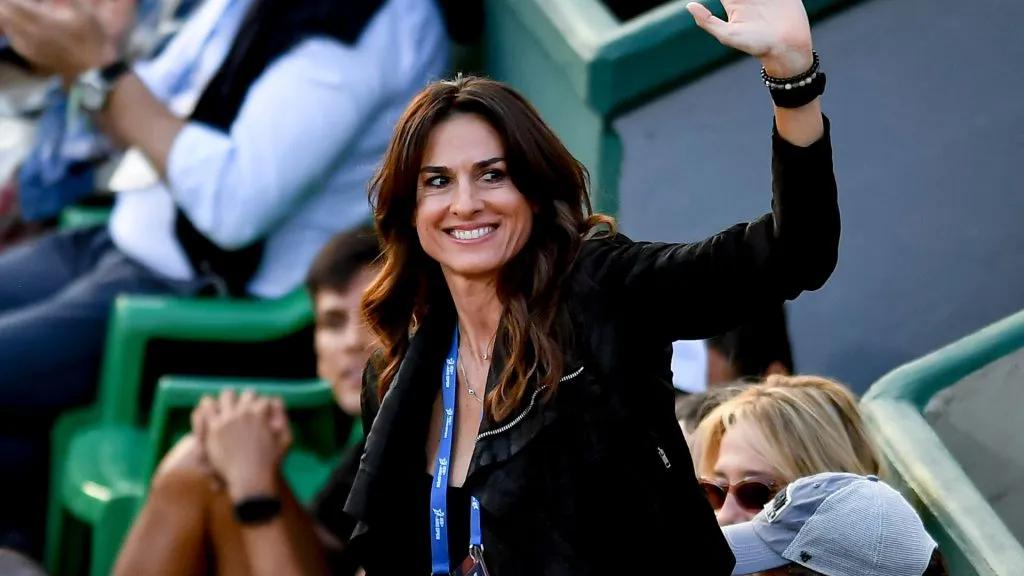
Sabatini at the Argentina Open 2025 (Marcelo Endelli/Getty Images)
Though she never reached World No. 1, Sabatini made history in many other ways. She was the first Argentine woman to win a Grand Slam, and from 1986 until a five-month injury sidelined her in 1996, she remained in the world’s top 10 for 508 consecutive weeks—the fourth-longest streak in WTA history. In 2006, she was inducted into the Tennis Hall of Fame.