

Switzerland‘s matches at the 2026 World Cup come with a detail that often puzzles casual fans: the three-letter code “SUI” displayed on scoreboards, standings, documents and official FIFA graphics.
FIFA, which has Switzerland at No. 19 in the world ranking, officially lists the Swiss Football Association under the code SUI, which has been used for decades across World Cup competitions. The abbreviation is linked to “Suisse”, the French name for the country.
While many national teams use abbreviations that closely resemble their English names, it is one of several countries whose sporting code reflects historical and linguistic traditions rather than modern English usage.
Why doesn’t FIFA use SWI or CHE for Switzerland?
FIFA does not use SWI or CHE because the organization officially identifies Switzerland with the abbreviation SUI, a code that comes from “Suisse”, the French name for the country.
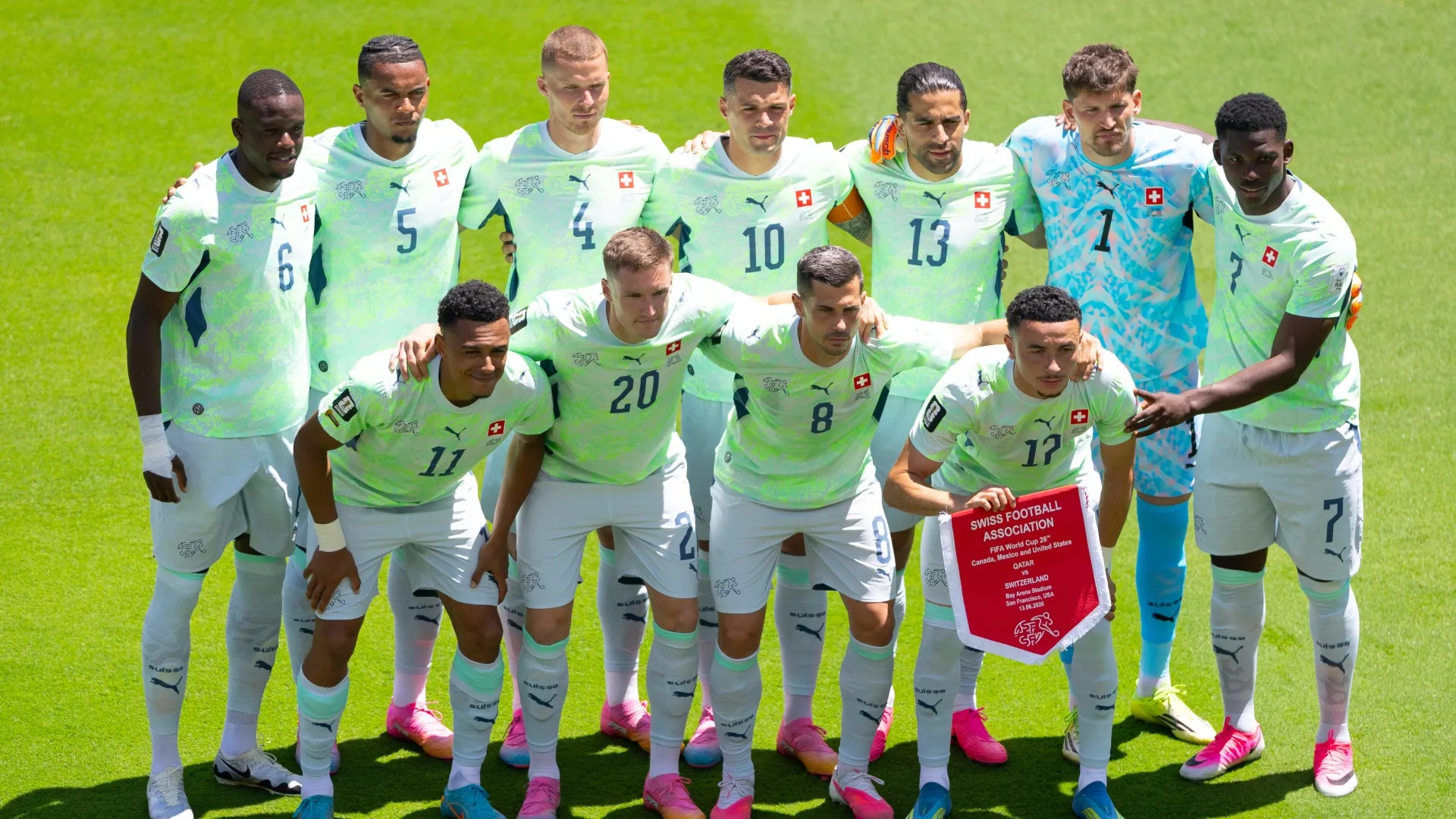
Players of Switzerland pose for a team photo prior to the FIFA World Cup 2026 Group B match (Source: Fran Santiago/Getty Images)
The Swiss Football Association is listed under the SUI designation in FIFA’s official member association database, and that code is used on World Cup scoreboards, rankings and tournament documents.
The code CHE, meanwhile, belongs to a different system. Switzerland’s ISO 3166 alpha-3 code is CHE, derived from Confoederatio Helvetica, the Latin name of the Swiss Confederation.
The mountainous Central European country frequently uses Latin in official international contexts because the country has four national languages—German, French, Italian and Romansh—and Latin provides a neutral alternative.
What is Switzerland’s nickname in international soccer?
Switzerland’s most widely used nickname in international soccer is “Nati”. The term is a shortened version of the German word Nationalmannschaft, meaning “national team”. It has become the most common way supporters refer.
Because it is a multilingual country, the national team is known by several names depending on the language being used. However, Nati has emerged as the nickname most commonly recognized both inside and outside the country.
Other nicknames have also been used over the years. In Italian-speaking regions, the team is sometimes called the Rossocrociati (“Red Crosses”), a reference to the country’s famous white cross on a red background.
How has Switzerland performed in FIFA World Cup history?
Switzerland has been one of the most consistent European teams in World Cup history, qualifying for the tournament 13 times and regularly advancing to the knockout rounds.
Although they have never won, they have established themselves as a difficult opponent. The country’s best World Cup performances came in 1934, 1938 and 1954, when they reached the quarterfinals.
The 1954 tournament was especially memorable because it was hosted in Switzerland, and the team advanced to the last eight before losing an unforgettable 7-5 match against Austria.
In the modern era, they had become a fixture at the tournament. According to FIFA, the Swiss have reached the Round of 16 five times since 1994 and entered the 2026 World Cup on a streak of six consecutive appearances.
Some of their most notable recent players include Xherdan Shaqiri, who isn’t playing at the 2026 World Cup, Granit Xhaka, and Yann Sommer, who isn’t playing for Switzerland anymore.