

The Stanley Cup playoffs have long been the true measure of an NHL franchise’s staying power. Through decades of shifting eras, rules and rivalries, a select group of teams has turned spring hockey into a near-annual tradition built on endurance.
From Original Six royalty to modern-era contenders, playoff consistency has shaped legacies as much as championships themselves. Every return to the bracket adds another chapter to histories forged through pressure, resilience and year-after-year relevance.
At the center of that conversation sit familiar names, led by the Montreal Canadiens and closely followed by rivals like the Boston Bruins. Their numbers hint at a deeper story of longevity, adaptation and survival in the league’s harshest environment.
Montreal Canadiens | Playoff seasons: 86 | Final appearances: 33

Montreal Canadiens (Source: Minas Panagiotakis/Getty Images)
For any hockey fan, the name Montreal Canadiens immediately conjures the notion of dominance. It’s not just that this is the franchise with the most championships, but its history is inextricably woven with the very existence of the playoffs.
With an astonishing 86 seasons in the postseason, the Habs don’t just play in the NHL; they are the NHL, being the only active club that predates the league’s founding. Their record of 33 Stanley Cup Finals appearances is, simply put, unreachable. Yet, beyond the total numbers, a description of their Golden Age is mandatory: the dynasty that won five consecutive titles between 1956 and 1960.
Led by monumental figures like Jean Béliveau and Maurice “Rocket” Richard, during those glorious years, the team never needed a Game 7 to win a series and never trailed in a playoff matchup. The legend of the Bleu-Blanc-Rouge is not just one of victories, but of a permanence and standard of excellence that places them on a unique pedestal in professional sports.
Boston Bruins | Playoff seasons: 77 | Final appearances: 20

Boston Bruins (Source: Harry How/Getty Images)
If Montreal embodies majesty, the Boston Bruins represent granite-like solidity. As the first U.S.-based team to join the NHL in 1924, the Black and Gold have forged a path of persistence and brute force, cementing their reputation with 77 trips to the postseason. Their longevity stands out, having won their first Stanley Cup in 1929 against the Rangers, in the first Final between two American teams.
Nevertheless, their legend is marked by two periods of particular brilliance. The first, in the 1970s, with the franchise’s resurrection on the shoulders of superstars like Bobby Orr and Phil Esposito, which resulted in two Cups after a near three-decade drought.
The second, in the modern era, with their 2011 triumph. Furthermore, their impressive mark of 20 Stanley Cup Finals appearances speaks to an organizational culture that, even in the worst times, always finds a way back into contention, making Boston an adversary that embodies the definition of tenacity.
Toronto Maple Leafs | Playoff seasons: 74 | Final appearances: 21

Toronto Maple Leafs (Source: Carmen Mandato/Getty Images)
The case of the Toronto Maple Leafs is a dichotomy of glorious history and demanding present. As one of the league’s Original Six teams, the Leafs have qualified for the playoffs in 74 seasons, a figure that honors their founding in 1917. Their tally of 13 Stanley Cups is a testament to a franchise that dominated different eras, especially the 1940s and the dynasty of the 1960s, when they lifted the trophy four times between 1962 and 1967.
However, for Toronto, the playoff drama is not a statistic of success, but the measure of the league’s longest championship drought. Their last title was in 1967, and since then, the franchise lives under a unique historical pressure.
Despite this and the difficulties in recent series, the fact that they have reached 21 Finals and continue to be one of the most frequent postseason clubs underscores that, while the present may be complicated, their place in the historical NHL Olympus is undisputed.
Detroit Red Wings | Playoff seasons: 64 | Final appearances: 24
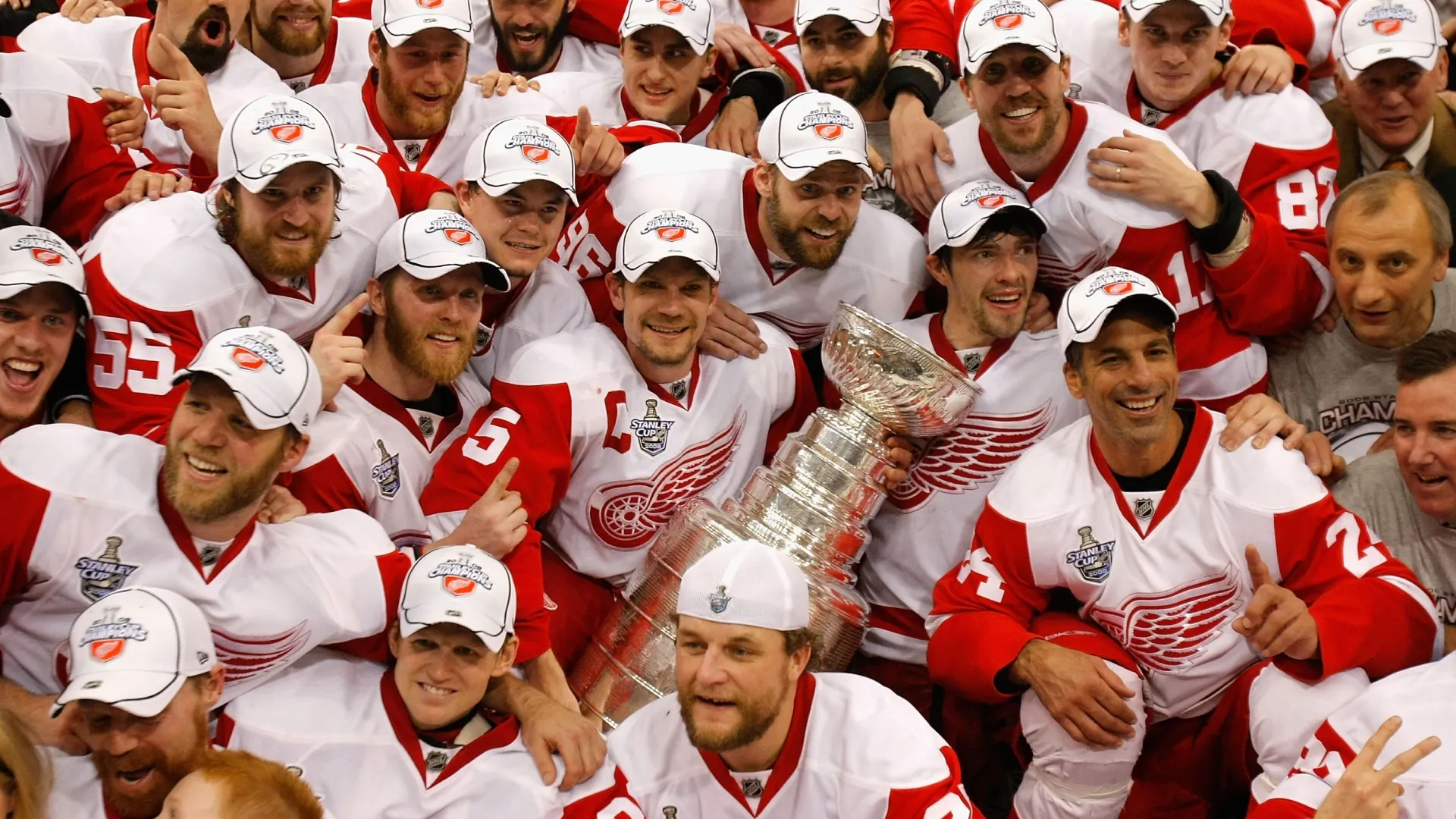
Detroit Red Wings (Source: Dave Sandford/Getty Images)
The pride of “Hockeytown” is manifested in the timeless consistency of the Detroit Red Wings. With 64 seasons in the postseason and 11 Stanley Cups to their name, their greatness spans three distinct eras.
There were the “Original Six” years of the 1950s, led by the immortal Gordie Howe; then came a difficult period, derisively known as the “Dead Wings”. But their true defining mark is the NHL record of 25 consecutive playoff appearances, a streak that ran from 1991 to 2016.
This period, under the leadership of Steve Yzerman and featuring the legendary “Russian Five,” was a masterclass in maintaining a high-performance culture, translating into four titles and proving that for the Red Wings, qualification isn’t a goal, but the starting point.
Chicago Blackhawks | Playoff seasons: 63 | Final appearances: 13

Chicago Blackhawks (Source: Bruce Bennett/Getty Images)
The Chicago Blackhawks have navigated NHL history with 63 playoff seasons, demonstrating an ability to surprise and dominate at key moments. One of their most curious milestones dates back to 1938, when they won the Stanley Cup with the worst regular-season record for a champion, thanks to the fact that six of the eight teams qualified at the time.
Nevertheless, their prominent place on this list is largely due to their recent dynasty. After a 49-year championship drought, the team burst onto the scene starting in 2010.
Led by Jonathan Toews and Patrick Kane, the Hawks captured the Stanley Cup three times in six seasons, solidifying their position as one of the most successful teams of the 21st century. Their trajectory is a clear example of how concentrated periods of dominance can catapult a franchise up the historical postseason statistics.
New York Rangers | Playoff seasons: 63 | Final appearances: 11

New York Rangers (Source: Bruce Bennett/Getty Images)
The team from Broadway, the New York Rangers, not only shares the mark of 63 playoff seasons with Chicago but also holds the honor of being the first U.S. franchise to lift the Stanley Cup, achieving it in 1928. Much of their historical success is concentrated in their early years, as three of their four titles were won between 1928 and 1940.
The history of the Blueshirts is marked by the intense passion of their fans and, often, by a postseason drama that extends to seven games. Despite a notorious “Curse” that lasted from 1940 until the iconic triumph of 1994, the Rangers have maintained a constant presence in the chase for the title, reaching 11 Stanley Cup Finals.
In the last decade, their resurgence has made them a frequent contender, reaching the Final in 2014, proving that in the Garden, the hope for Cup glory is a constant ritual.
St. Louis Blues | Playoff seasons: 56 | Final appearances: 4

St. Louis Blues (Source: Bruce Bennett/Getty Images)
The St. Louis Blues have been a constant pillar in the Western Conference, boasting an impressive mark of 56 postseason seasons. Their history is a mix of consistency and, for a long time, palpable frustration.
The Blues are famous for a unique feat: they reached the Stanley Cup Finals in each of their first three seasons (1968, 1969, 1970)—an achievement no expansion team has replicated—though they were swept in all three instances.
However, what truly defines the Blues is their epic patience, which finally paid off. After decades of waiting and 52 years of existence without a championship, the team delivered one of hockey’s most inspiring redemption stories in 2019.
Fueled by a stunning second half of the season, the Blues not only qualified but were crowned champions for the first time, proving that postseason perseverance, even with only four Finals appearances, is the true measure of a contender.
Philadephia Flyers | Playoff seasons: 40 | Final appearances: 8

Philadelphia Flyers (Source: Al Bello/Getty Images)
Since their entry into the NHL during the 1967 expansion, the Philadelphia Flyers quickly established themselves as a dominant and, often, intimidating force. With 40 playoff seasons, the Flyers are the original expansion franchise with the most qualifications, surpassing their “Class of ’67” peers.
Their identity was defined in the 1970s by the “Broad Street Bullies,” a group known for their physical playing style and unmatched toughness, which captured two consecutive Stanley Cups. The Flyers’ history is one of deep and constant playoff threat.
Despite a championship drought extending since the 70s, the franchise has been a persistent competitor, reaching the Stanley Cup Final on eight occasions. This underscores their reputation as a team built for the intense postseason atmosphere, always ready to battle for the right to hoist the trophy.
Dallas Stars | Playoff seasons: 37 | Final appearances: 5

Dallas Stars (Source: Cooper Neill/Getty Images)
The count of 37 playoff seasons for the Dallas Stars is a testament to the consistency of a franchise with historical roots extending beyond Texas. Born as the Minnesota North Stars in 1967, postseason success followed them after their relocation to Dallas in 1993. Their move marked the beginning of one of their most competitive eras.
Their climax arrived in the late 90s. Under the guidance of legendary captain Mike Modano, the Stars became a Western Conference powerhouse, crowning their success by capturing their first and only Stanley Cup in 1999.
Since that title, the franchise has maintained its status as a frequent contender, reaching the Final on five occasions and demonstrating that, whether under the cold temperatures of the North or the heat of Texas, a culture of playoffs can endure.
Pittsburgh Penguins | Playoff seasons: 37 | Final appearances: 6

Pittsburgh Penguins (Source: Bruce Bennett/Getty Images)
The Pittsburgh Penguins‘ record of 37 postseason seasons is notable not only for its frequency but for the spectacle of the players who have led the franchise. The Pens are the epitome of a franchise that has capitalized on generational talent.
Their first great era was fueled by the arrival of Mario Lemieux, who led the team to their first two consecutive Cups in the early 90s. However, recent history is even more impactful. With the arrival of Sidney Crosby and Evgeni Malkin in the mid-2000s, the Penguins transformed into a playoff machine.
This dynamic core reached six Finals and managed to lift the Stanley Cup three times, becoming the first team in the salary cap era to win back-to-back championships. The Penguins represent the perfect fusion between high frequency of appearances and the ability to convert those opportunities into glory.
Los Angeles Kings | Playoff seasons: 34 | Final appearances: 3

Los Angeles Kings (Source: Harry How/Getty Images)
With 34 playoff seasons, the history of the Los Angeles Kings is that of a team that, for a long time, sought validation in a market atypical for hockey. Their early history, defined by the arrival of Wayne Gretzky in the 1990s, culminated in their first Stanley Cup Final appearance in 1993, though they did not lift the trophy.
Patience and meticulous rebuilding led to their era of greatest dominance. In the early 2010s, the Kings transformed into a defensive, relentless team, known for their low scoring and physical play.
Under the leadership of Anze Kopitar and Drew Doughty, they managed to capture two Stanley Cups in a span of three years. Despite only three Finals appearances, the efficiency and impact of their brief dynasty solidified Los Angeles as a serious competitor, proving that quality in the postseason can outweigh quantity.
Washington Capitals | Playoff seasons: 34 | Final appearances: 2

Washington Capitals (Source: Patrick McDermott/Getty Images)
The narrative of the Washington Capitals‘ 34 postseason seasons is one of perennial contention often shadowed by the inability to secure the ultimate prize. After their rough inaugural season in 1974, the Capitals transformed into a consistent playoff fixture, especially during the 1980s and 90s, though they often faced deep-rooted rivals that thwarted their progression.
Their first taste of the Final came in 1998, a quick sweep by the Detroit Red Wings. However, the team’s modern history is defined by the quest to shed the label of being “perennial underachievers.”
Under the leadership of their star, the franchise became synonymous with regular-season dominance, winning three Presidents’ Trophies. The dam finally broke in the 2017-18 season, a legendary run that saw them conquer longtime rivals and secure their first-ever Stanley Cup, defeating the Vegas Golden Knights.
The Capitals’ history proves that consistent playoff presence, even with only two Finals appearances, is necessary for eventually achieving that career-defining breakthrough.
Calgary Flames | Playoff seasons: 31 | Final appearances: 3

Calgary Flames (Source: Dave Sandford/Getty Images)
For the Calgary Flames, their 31 playoff seasons are inextricably linked to the intense culture of Canadian hockey and one of the most storied rivalries in the sport, the “Battle of Alberta”. Since moving from Atlanta in 1980, the Flames quickly built a powerful identity, culminating in their first Stanley Cup Final appearance in 1986.
They tasted glory just a few years later, defeating the Montreal Canadiens in a memorable 1989 Final to claim their sole championship. The Flames’ history is marked by a passionate resilience.
Their 2004 run, which ended in a controversial seven-game loss in the Final, is remembered as a heroic charge that ignited the legendary “Red Mile” celebration in the city.
To reach three Finals and be a constant presence in the West despite sharing a division with another dynasty (Edmonton) shows a formidable institutional commitment to making the postseason the expectation, not the goal.
Colorado Avalanche | Playoff seasons: 30 | Final appearances: 3

Colorado Avalanche (Source: Elsa/Allsport)
The Colorado Avalanche’s record of 30 postseason seasons is a remarkable story of concentrated success, efficiency, and generational talent. The franchise, relocated from Quebec, made an immediate and unforgettable impact, winning the Stanley Cup in its inaugural season in Denver in 1996—a stunning feat.
This set the tone for a team built for the pressure of May and June. What truly distinguishes the Avalanche is their pristine record when it matters most: three Finals appearances have resulted in three Stanley Cup victories.
This perfect conversion rate underscores a culture of closing out series and performing at an elite level when the stakes are highest, making them one of the most efficiently successful playoff franchises in the league’s history. They prove that consistent excellence, even over a shorter history, is paramount.
Buffalo Sabres | Playoff seasons: 29 | Final appearances: 2

Buffalo Sabres (Source: Elsa Hasch /Allsport)
The Buffalo Sabres stand as a franchise with 29 playoff seasons and a loyal fan base that celebrates a rich, if frustrating, history. The team’s identity was first forged by the iconic “French Connection” line in the 1970s, which led them to their first Stanley Cup Final in 1975, a memorable series that featured the famous “Fog Game”.
Despite their persistent presence and the brilliance of players like Dominik Hasek in the 1990s, the Sabres have the unfortunate distinction of having the longest active playoff drought in the NHL.
Their second and most recent Finals appearance came in 1999, a controversial loss to the Dallas Stars. While their total of two Finals appearances is low for a team with nearly 30 playoff seasons, the Sabres’ history highlights the fine line between being a perennial contender and achieving the ultimate glory in a league defined by its grueling postseason.
| Team | Playoff seasons | Final appearances | Wins |
| Montreal Canadiens | 86 | 33 | 23 |
| Boston Bruins | 77 | 20 | 6 |
| Toronto Maple Leafs | 74 | 21 | 13 |
| Detroit Red Wings | 64 | 24 | 11 |
| Chicago Blackhawks | 63 | 13 | 6 |
| New York Rangers | 63 | 11 | 4 |
| St. Louis Blues | 46 | 4 | 1 |
| Philadelphia Flyers | 40 | 8 | 2 |
| Dallas Stars | 37 | 5 | 1 |
| Pittsburgh Penguins | 37 | 6 | 5 |
| Los Angeles Kings | 34 | 3 | 2 |
| Washington Capitals | 34 | 2 | 1 |
| Calgary Flames | 31 | 3 | 1 |
| Colorado Avalanche | 30 | 3 | 3 |
| Buffalo Sabres | 29 | 2 | 0 |
| New York Islanders | 29 | 5 | 4 |
| Vancouver Canucks | 29 | 3 | 0 |
| Edmonton Oilers | 27 | 9 | 5 |
| New Jersey Devils | 25 | 5 | 3 |
| San Jose Sharks | 21 | 1 | 0 |